

Haslett Saving Big Hits for Game Time
August 16, 2016
By Geoff Kimmerly
Second Half editor
HASLETT – The sound of cleats on pavement. He and his teammates, hand in hand, walking toward the field together minutes before kickoff. Manowar’s “Heart of Steel” ringing in their ears from a few minutes before.
 Justin Kuchnicki gave himself goose bumps Monday describing Haslett’s weekly pregame ritual, which the senior lineman will take part in again beginning Aug. 26 when the Vikings open this season against Remus Chippewa Hills.
They’ll certainly be revved up – and especially to lay some big hits after saving them up during three weeks of non-collision practices.
Haslett has one of the most successful football programs in the Lansing area, with two trips to MHSAA championship games and 14 playoff appearances total over the last 18 seasons. The Vikings finished 6-4 a year ago against a schedule featuring four eventual playoff teams.
The program also might be the first in all of Michigan high school football to fully eliminate full-speed hitting at practice, something Haslett has moved toward over the last few seasons before longtime coach Charlie Otlewski decided to knock it out of his practice plans completely this fall in large part to keep his players healthier for when it matters most.
“It gives you the edge when it gets to game day. You practice all week and you’re not really hitting or doing anything like that, and you get to game day … and everyone’s ready to just go out there and fly around and make plays,” Kuchnicki said. “You’re not really worried about kinks and stuff in your body that you’d have from practices, so you just go out there and lay it on the line.”
Friday was the first day Michigan high school players were allowed to practice in full pads. Storms drenched mid-Michigan that afternoon, so Haslett’s first day in full gear was Monday. And from a distance, it sounded like any other full-contact practice with the normal hoots and hollers and smacking of pads.
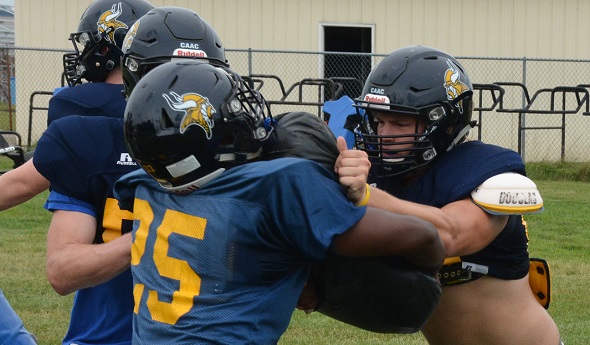
But on closer look, it was anything but. Lineman worked against blocking dummies on a sled or teammates holding hand pads. When the offense came together to run plays, linemen blocked against overturned plastic trash barrels. On the opposite end of the field, subvarsity players worked on defensive pursuit angles but again without hitting. Under a set of uprights laid an old gymnastics mat used to soften the fall during tackling drills, which players again did against standup dummies instead of their teammates.
Reducing collisions – that is, live, game-speed, player-vs.-player hitting – remains the focus of most conversations on health and safety in football. Much of the discussion is centered on reducing concussions, and MHSAA rules changes that took effect beginning with the 2014 season limit teams to one practice per day during the preseason (when teams frequently practice twice) where collisions can take place. During the regular season, teams can have collisions during practice only two days per week.
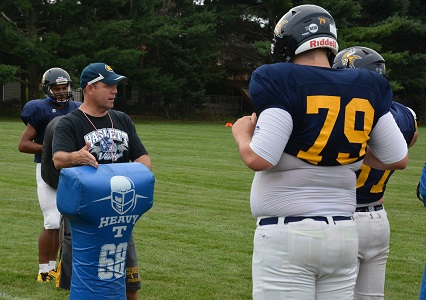 Otlewski – who formerly coached St. Ignace from 1990-93 before taking over at Haslett in 1994 – said his practices used to follow what could be considered a traditional after-school plan: individual position drills for an hour or more followed by 11-on-11 full contact team practice for 30-40 minutes, twice a week.
But a handful of reasons, chiefly the desire to avoid injuries, started his program on a different path five years ago.
“Nobody wants injuries, but you surely don’t want them in practice. Then the concussion thing started to happen. (But) we didn’t do it because of concussions; we did it because of general overall injuries,” Otlewski said.
“If we lose a guy in Thursday’s scrimmage, or next Thursday in a game, OK, that’s football. But what we don’t want to do is lose someone in practice, because that seems unnecessary.”
The initial changes Haslett began to make to practices that fall of 2011 became drastic two years later, when he and his staff went to a different practice model completely. The Vikings now break every practice into 10-minute sessions alternating between team time and position drills, so position coaches can work with players individually before and after seeing how they perform when all 11 are running plays together.
This new breakdown brought the amount of player-on-player contact at practice down significantly as much more time was dedicated to learning proper footwork, blocking and tackling techniques and other fundamentals. Players on Monday worked at 50-percent speed, at most, against teammates either in front of them and also not moving at game speed, or against others holding pads and dummies.
The last two seasons, the only full-contact session during practices came during preparation for goalline situations; Otlewski and his staff decided to eliminate those this fall as well.
“We’re OK with a certain level (of contact). But we never want to go on the ground; we always want to stay up,” he said. “We want to go fast enough so where we have to use the perfect technique to get there footwork-wise. But we’re trying to eliminate the physicality part.”
To be clear, eliminating all collisions/contact is not required by the MHSAA. And there are probably more than a few in the coaching fraternity who would think Haslett is making a massive mistake.
But the Vikings’ no-contact strategy follows a way of thinking made popular in part by coaches like Dartmouth College’s Buddy Teevens, whose team hasn’t tackled during practices in six years. The Ivy League as a whole adopted a policy of no tackling in practice for the regular season beginning this fall.
 Otlewski said teaching to tackle without contact allows his players to practice the same technique-building drills during four-player offseason workouts, his team’s no-pads summer camp and then while wearing pads during the season. His defense doesn’t face a live offense during the week, but he doesn’t think his players lose out because they can gain just as much from watching film and working on pursuit angles and recognizing formations. Same goes for his offense, which can still practice skill work and the passing game full-speed while lineman go half-speed working on footwork and blocking technique.
And he sees 37 players on his varsity roster, with that total remaining consistent over the last many seasons – while three opponents on this year’s schedule don’t have junior varsities and a fourth won’t field a freshman team.
His players three seasons ago didn’t really like the idea of not hitting in practice at first. But they’ve since bought in. He hasn’t heard a ton from parents either way; but he taught a class on football for local moms over the winter, and they seemed to like the idea as well.
“On one hand, I’m a little apprehensive,” Otlewski said. “OK, we haven’t gone full go. Is there a difference all of a sudden when it’s live Thursday against (Grand Rapids) Christian? Are we going to be up to speed?
“I think I still worry about that a little bit. But once we get into it, it’s fine.”
Kuchnicki is just as confident. Contact doesn’t bother this guy. He’s 6-foot-6 and in the neighborhood of 320 pounds. Sure, he’d love to have one contact practice this year so he and his teammates can back up some of the trash-talking they do to each other on the field.
But he’s fine with saving his biggest hits for opponents – and especially those who might think Haslett won’t be prepared for a physical game.
“They’d probably think we’re soft,” Kuchnicki said. “But when it comes game day, they change their minds instantly. I’ll tell you that.”
 Geoff Kimmerly joined the MHSAA as its Media & Content Coordinator in Sept. 2011 after 12 years as Prep Sports Editor of the Lansing State Journal. He has served as Editor of Second Half since its creation in Jan. 2012. Contact him at [email protected] with story ideas for the Barry, Eaton, Ingham, Livingston, Ionia, Clinton, Shiawassee, Gratiot, Isabella, Clare and Montcalm counties.
PHOTOS: (Top) Haslett lineman work on blocking during Monday's practice. (Middle) Vikings coach Charlie Otlewski instructs his players on one of the team's blocking schemes. (Below) Backs work on the option with barrels serving as the defensive front.
Friday's Game-Winner Latest, Greatest Highlight for Adrian Kicker Hassan
By
Doug Donnelly
Special for MHSAA.com
September 30, 2025
When Zack Hassan was a freshman, he decided to play two sports at Adrian High School – soccer and football.
 Because he was a soccer player, the Maples’ football coaches decided he would be a good candidate to be a kicker.
“I had never really kicked a football before, but they thought I could because I played soccer,” Hassan said. “I thought, ‘Sure, why not?’”
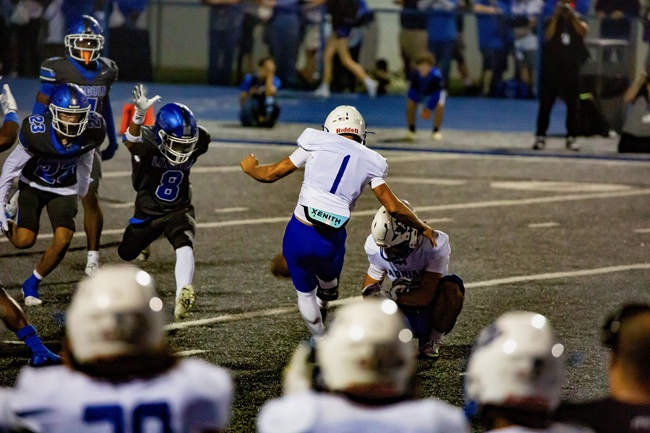
Fast forward four years and Hassan is no longer a soccer player. He not only is the Adrian kicker – he is eying a college football scholarship and Friday had the biggest moment of his career when he booted a 37-yard field goal as time expired to give Adrian its biggest football win in years.
“I love the pressure moments,” Hassan said. “I like having all of the eyes on me and going out there and kicking.”
Hassan also played receiver and defensive back the last couple of years, but is focused entirely on kicking this season because of a knee injury suffered toward the end of basketball season. He’s delayed surgery because he didn’t want to miss his senior year of football.
“I could have played receiver this season, but I wanted to be safe,” Hassan said. “I had a choice. I could have had surgery before the season or in the middle, but I just wanted to finish out my last year.”
The injured knee part of his kicking leg – but that’s probably for the best if he had to be injured at all.
“As a kicker its almost better because I don’t have to worry about planting,” he said. “That would be constant impact on it. It’s not super bad. I think I will recover quickly. I should be 100 percent by April or May. I should probably try to save the leg, but I enjoy kicking. I like to kick as much as possible in practice.”
Hassan handles all placekicking duties for Adrian, but doesn’t punt. Maples coach Joel Przygodski said Hassan would make a good punter, though.
“He has a strong leg,” he said. “He regularly kicks off to the 10-yard line. It’s a nice weapon to have.”
Hassan’s family moved to Adrian from Sylvania, Ohio, when he was in middle school.
“When I was growing up, I thought I was going to be a basketball player,” he said.
After he joined the varsity football team as a freshman, he decided he liked kicking.
“After freshman year I thought maybe I could get some free tuition out of this,” he said.
 He’s made two college visits already – to Baldwin Wallace in Ohio and Macalester College in Saint Paul, Minn., which has offered him a scholarship. He’s headed back to Macalester in a few weeks to check out what it’s like on game day.
“They are a very good school to get an education,” said Hassan, who has a grade point average above 4.0.
Hassan’s siblings stayed on the soccer route. His older sister was a college goalkeeper and his younger sister plays soccer for Adrian.
On Friday, Adrian was locked in a 0-0 tie with unbeaten Ypsilanti Lincoln. In the fourth quarter the two teams exchanged punts, swapping field position. Adrian got the ball back with fewer than 40 seconds left.
“As coaches, we talked about whether or not we wanted to play it safe, play for overtime,” Przygodski said.
After an incomplete pass on first down, running back Luke Bruggeman carried the ball up the middle and broke a tackle to put the ball past midfield. He even got out of bounds to stop the clock.
“I was thinking, okay, we are in business,” Przygodski said.
After quarterback Jaxon Dowling connected with receiver Adam Parker to reach the Lincoln 25-yard line, Przygodski knew the Maples had a chance. Hassan was warming up.
“We were telling him to be ready,” Przygodski said.
Hassan had missed two field goals earlier in the game. One of those attempts was from 48 yards out.
“My coaches just told me to get ready and told everyone else to stay away from me,” Hassan said.
With less than 1.5 seconds to play, Adrian reached the 20-yard line and called timeout. Hassan trotted out onto the field. The snap was a little slower than he was used to, he said, but he lined up perfectly and hit the 37-yarder, sending the Maples into a frenzy and stunning the home crowd of about 3,000 people at Lincoln’s homecoming.
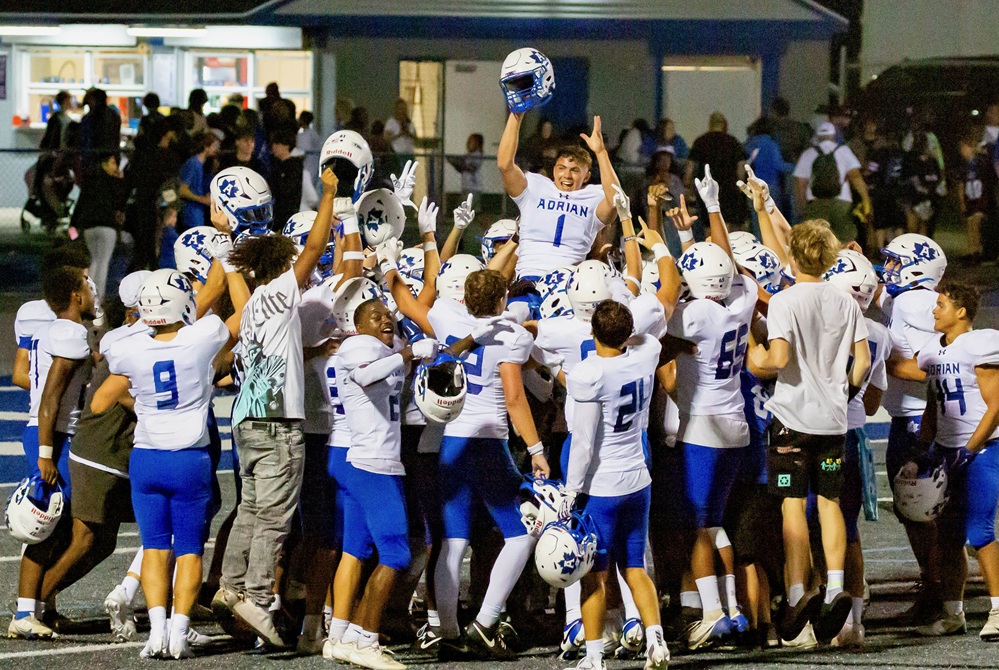
Hassan was carried off the field by teammates – and not because of an injury.
“After we shook hands, we went into huddle and everyone was like, ‘Lift him up, lift him up,’” he said.
The win was a big one for Adrian, which continues to make strides under Przygodski’s leadership. Adrian is 4-1 with chief rival Tecumseh coming up this week. The Maples have a lot of momentum for the rest of the season.
“Going into the season we were really unsure how we were going to be, because we lost a lot of seniors last year,” Hassan said. “It’s good. We’ve had a lot of people step up. We are turning a lot of eyes right now.”
 Doug Donnelly has served as a news and sports reporter at the Adrian Daily Telegram and the Monroe News for 30 years, including 10 years as city editor in Monroe. He's written a book on high school basketball in Monroe County and compiles record books for various schools in southeast Michigan. He is now publisher and editor of The Blissfield Advance, a weekly newspaper. E-mail him at [email protected] with story ideas for Jackson, Washtenaw, Hillsdale, Lenawee and Monroe counties.
PHOTOS (Top) Adrian kicker Zack Hassan is carried by his teammates after making the game-winning field goal Friday against Ypsilanti Lincoln. (Middle) Hassan steps into his winning kick. (Photos by Marnette Sutherland.)