

Kicker Steps Into Historic Moment
December 8, 2020
By Doug Donnelly
Special for Second Half
CLINTON – After what Jonathan Baughey has gone through, kicking a football through two yellow goal posts doesn’t seem like a very big deal.

But, when it came against an undefeated, state-ranked team on the last play of the Division 6 District championship game, it was just that.
“It was definitely a scary moment,” said Baughey, a junior from Clinton High School in Lenawee County.
Baughey’s 22-yard field goal as time expired gave Clinton a 16-13 victory over Blissfield and sent his team into a Regional Final against Warren Michigan Collegiate.
It’s been a long road for Baughey, who thought that after a successful kidney transplant in 2015 that his football career was over. At the urging of a family friend and Clinton middle school coach, however, Baughey tried kicking. It was a good choice as he’s now etched his name into Clinton football lore by making probably the biggest field goal in school history.
 “He’s been through so much, and I couldn’t be happier for him,” said Clinton football coach Jeremy Fielder. “We had a lot confidence in him kicking in that situation. There was no hesitation.”
Baughey was born with one kidney functioning at 25 percent and the other at 75.
“From birth he always had kidney issues,” said his mother, Kelly Baughey. “We knew growing up he would need a transplant. They tested his father and I, and we were both matches. His dad (Kevin) decided that he wanted to do it for him. He was his donor.”
Kevin Baughey never hesitated.
“It wasn’t a decision at all,” he said. “I would have given him both if I needed to.”
For years, dealing with the kidney issue was just part of Jonathan’s life. He would tire easier than other kids, but he learned to cope with it.
“I was more of a tired kid,” Baughey said. “When I was younger, it wasn’t about contact, it was about how tired I would get. I couldn’t keep up with a lot of other kids. It was hard.”
He had a kidney removed in December of 2012. After that, he said, “it was a roller coaster.” The transplant didn’t come until June of 2015, soon after he finished the sixth grade.
It took roughly six weeks in the hospital for Baughey to recover from the transplant.
“As soon as I had the transplant, I started feeling better than I had felt,” he said. “I had more energy.”
Baughey played flag football as a kid and had started playing tackle football. But when he neared the time for a transplant, he figured his football days were done. That’s when family friend and Clinton middle school coach Keith Tschirhart suggested he try kicking for the Clinton middle school team.
“I had played soccer and thought it was something I could do, so I tried it,” Baughey said. “I went out with him to the football field to see how I would do. It was pretty rough at the beginning. It took some time.”
He didn’t get much practice that first season.
“We never really kicked extra points,” he said.
Baughey kept working at it though and made it through his eighth-grade season. As a freshman he figured he would continue kicking, most likely for the Clinton JV team. He went to the tryouts.
“I kicked my first football and the coach said I was on the varsity,” he said.
Fielder said Baughey made an immediate impact.
“We didn’t have a kicker,” he said. “We had no one. I even told the coaches, ‘What are we going to do?’ Then, I saw him kick the ball and it was like, ‘He’s our kicker.’”
 It was big adjustment for Baughey. Not only had he once thought he would never play football again – but he found himself suddenly on the varsity as a freshman, not knowing anyone on the team. And, being exclusively a kicker, meant he practiced mainly by himself.
“That was the struggle that I went through,” he said. “I didn’t know anyone. The only kids I knew were the snapper and the holder.”
Clinton grad Erik Bouse stepped in to help Baughey. Bouse had been a standout kicker for Clinton for three seasons before graduating in 2017.
“He was the one who I mainly worked with,” Baughey said. “He helped me a lot. He really started me out not creating bad habits and helped with the mental part of it.”
As a freshman, Baughey made 42 of his 50 extra-point attempts and a 21-yard field goal. As a sophomore he made 48 of 54 with a 19-yard field goal. This season he has made 29 of 37 extra-point attempts. The winning field goal against Blissfield was his only field goal of the season, on two tries.
Baughey is exclusively a kicker because of the potential risk of injury following the transplant. He wears a special pad on his stomach under his uniform because that is where doctors put his new kidney.
His mother said the no-contact rule causes some angst for her.
“He knows there is a chance he could get hit,” she said. “He wears a shield for padding. The transplant team has okayed him to play.”
Baughey practices every day, often by himself. He goes to the game field and starts at the extra point yardage and works his way back, making at least two kicks at each distance before moving on to the next level. He’ll use his cell phone to record himself, then watch the videos to make sure he is kicking correctly and not developing bad habits.
“The biggest part for me is to go out and know that I can do it,” he said. “You have to know you are going to kick it through the uprights, not just think you are going to. I like to pick out a small target, even a leaf or something, and just clear my mind and just kick the ball.”
When Clinton got the ball back with just over three minutes to go in the District Final against Blissfield, Baughey started thinking the game might come down to his foot.
“I went to the net and started kicking,” he said.
Clinton drove the ball inside the Blissfield 10-yard line, but did not reach the end zone. Fielder called a timeout on fourth down with only a few seconds left. Baughey jogged onto the field and lined up when Blissfield called a timeout.
“I remember walking to the sidelines and taking a deep breath,” he said. “People came up and talked to me and told me I could do it”
Baughey blocked everything out.
“I was really mentally focused,” he said. “After I made the kick, I started clapping. I turned around and all my teammates were jumping up and down. I ran to our coaches and everyone started hugging.”
His father, his donor, could not have been happier to see the ball go through the uprights.
“I was beside myself happy,” Kevin Baughey said. “Thinking about all of the time he spent working in the offseason, and then seeing the confidence his coaches showed with making the call to go for the field goal ... I was as proud as I could possibly be.”
 Doug Donnelly has served as a sports and news reporter and city editor over 25 years, writing for the Daily Chief-Union in Upper Sandusky, Ohio from 1992-1995, the Monroe Evening News from 1995-2012 and the Adrian Daily Telegram since 2013. He's also written a book on high school basketball in Monroe County and compiles record books for various schools in southeast Michigan. E-mail him at [email protected] with story ideas for Jackson, Washtenaw, Hillsdale, Lenawee and Monroe counties.
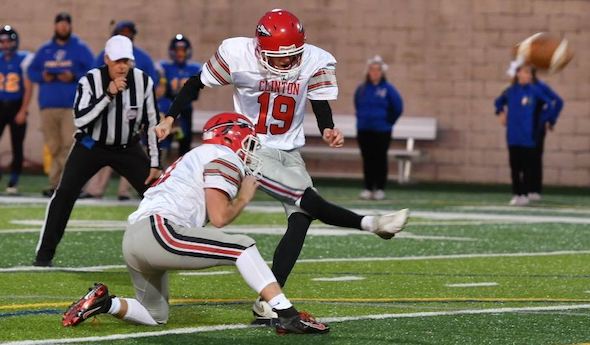
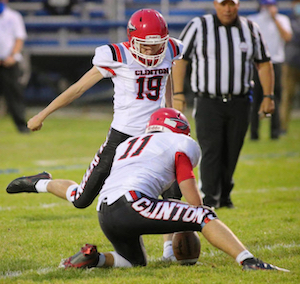
PHOTOS: (Top) Clinton's Jonathan Baughey connects on a kick. (Middle) Baughey, following through on another kick this season, clinched his team's District title with a game-winning field goal. (Photos courtesy of the Clinton football program.)
Capac Ends 14-Year Postseason Drought, Eager to Begin 8-Player Playoff Run
By
Paul Costanzo
Special for MHSAA.com
October 29, 2025
Not having the option to qualify for the 8-player postseason wasn’t something the Capac football concerned itself with the past three seasons.
 Enrollment was too high at the school to be included in the MHSAA playoff field, and while the 2024 team most certainly would have made it, co-coach Troy Schneider said that since there was nothing that could be done about it, the players weren’t really concerned with it.
But this year, with the opportunity finally there, it lit a fire under the Chiefs.
“It was very motivating for us,” Capac senior quarterback Brody Tesnow said. “All summer, we had decent numbers show up to workouts. Our senior group was really pushing everyone. Our coaches have been on us all year, telling us this is our year that we can do this. I mean, really, we had a decent season last year, and I just feel like that pushed me more to come back this year and be even better.”
Capac is back in the playoffs for the first time since 2011, and at 7-2 is coming off its best regular season since 2001.
That year, the Chiefs advanced to the Division 5 Semifinals. This year’s run will start Friday night with a matchup at Brown City in 8-Player Division 1. A win would be the program’s first in the postseason since 2009.
“I’d love that,” Tesnow said. “That would be a great feeling for us, all the seniors. I remember that win over Deckerville (in Week 8), that was a surreal feeling. I could only imagine what a playoff win would feel like, especially after 14 years of not being in the playoffs.”
It’s been a long road for Capac, which has now had its first back-to-back winning seasons since running off four straight from 2008-11.
Enrollment at the school was near its height back then, peaking at 613 in 2008 before starting a steady decline. It first dipped below 400 in 2015, and by 2020 it was under 300.
That, naturally, led to a decline in football participation as well, and the team was unable to complete the 2020 season, a year where nearly everyone was granted access to the postseason because of the COVID-19 pandemic.
After a 1-8 run in 2021, with a total school enrollment of 211, Capac made the decision to switch from 11-player to 8-player. In each of its first three seasons under the new format, Capac was over the 215-student limit for competing in the postseason. This year, the school is at 203.
 “I didn’t have any decision in that, but our numbers had dropped steadily for a number of years in the school,” said Schneider, who had coached at Capac in 2000s, and took over as varsity coach with Bill Nestle in 2024. “When we came out of the (Blue Water Area Conference), we were a small school, and we were getting pretty well destroyed. Once we moved into the other conference (Greater Thumb), we were with Ubly and Harbor Beach, and I wasn’t coaching at the time, but those are some really good teams, too. There were quite a few people who did not want to make a move to 8-man, but the writing was on the wall with the numbers at the school and the numbers in the football program. It’s been a good move for us. Obviously, a lot of schools have gone to that in the last five years.”
When the program moved to 8-player in 2022, the current senior class was entering high school. Schneider and Nestle had been coaching that group in middle school, and it had shown quite a bit of promise.
There are currently 15 seniors on the varsity team, and while there are only 18 players total on the roster, the junior varsity and middle school programs are thriving, which has people in the high school program optimistic about a future that was pretty uncertain not long ago.
“We’ve got some potential coming up – things are looking pretty good,” Schneider said. “The junior group is small, so they’re going to have small numbers next year as seniors, but the three juniors we have are starters. The next three to four years, it should stay steady and we should be solid.”
But there’s still plenty of work to be done this year, and Capac is confident heading into the postseason despite the fact it lost to Brown City 61-22 in Week 3.
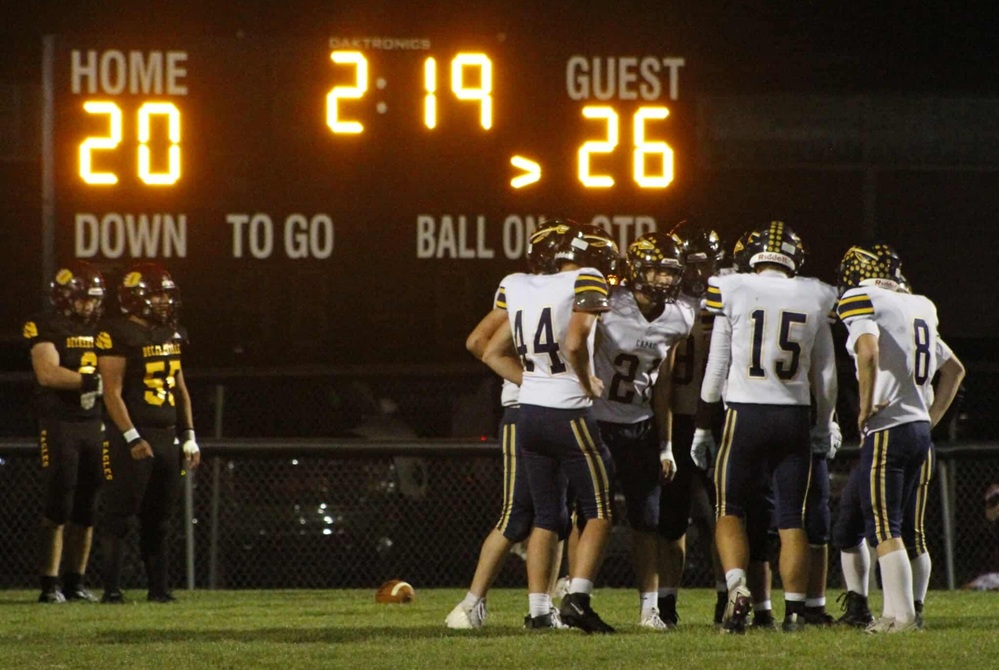
Much of that confidence comes from that Week 8 win against 2024 8-Player Division 1 champion Deckerville. The 28-20 triumph ended Deckerville’s 20-game win streak, as it had not lost since the 2023 Semifinals. It was the first regular-season loss for the Eagles since Sept. 29, 2023.
“Starting the season we went kind of slow, but beating Deckerville told us that we were on that top tier,” senior defensive end and tight end Wiley Roose said. “I mean, after that game, it was crazy. To me, it was definitely the highlight of my sports career in high school. The whole team really came around.”
Beating Deckerville is an accomplishment in its own right, but the fact the Eagles had this season defeated Brown City and Kingston – which delivered Capac’s two losses – was another boost of confidence for the Chiefs, who are ready to show how far they’ve come this fall.
“We watched some film from the game (against Brown City) earlier in the season, and we were just comparing what we were then to how we are now,” Tesnow said. “It’s a huge difference. I’m pumped. We’re proving everyone wrong, and I love that feeling of being the underdog and surprising people.”
Tesnow and his teammates are hoping to continue doing that, but what they’ve done already to get the Capac program back on the right track is a massive accomplishment in itself.
“Coach Nestle and I care about all our players, but seeing these kids develop for five years, go through school, go through some of the losing seasons early in middle school then slowly build and get better – I can think of a number of kids and how they improved with being more aggressive, being tougher and taking the next step,” Schneider said. “It’s really nice to see the kids develop through the program. It’s been sweet. It’s that much better because it’s a great group of kids. They’re wonderful.”
 Paul Costanzo served as a sportswriter at The Port Huron Times Herald from 2006-15, including three years as lead sportswriter, and prior to that as sports editor at the Hillsdale Daily News from 2005-06. He can be reached at [email protected] with story ideas for Genesee, Lapeer, St. Clair, Sanilac, Huron, Tuscola, Saginaw, Bay, Arenac, Midland and Gladwin counties.
PHOTOS (Top) Capac huddles up during the closing minutes of its Week 8 win over Deckerville. (Middle) Sam Schneider (22) carries the ball and follows his Chiefs blockers as they attempt to create an opening against the Eagles. (Photos courtesy of the Capac football program.)