

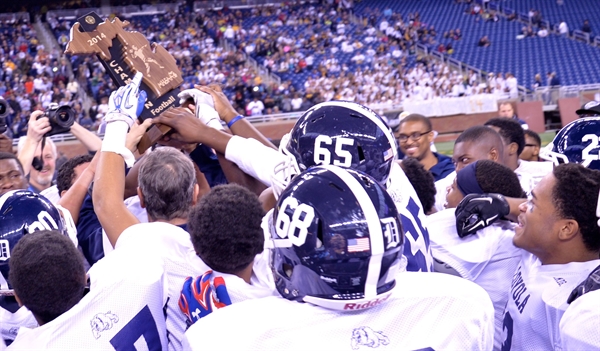
Loyola Learns Championship Lessons
November 29, 2014
By Geoff Kimmerly
Second Half editor
DETROIT – Saturday’s celebration began with respect, senior linebacker Paul Engram said, for an opponent that had become familiar and frustrating.
Detroit Loyola hasn’t lost a regular-season game since 2010. But the Bulldogs also hadn’t solved Ishpeming in their first two MHSAA Division 7 Final matchups, falling to the Hematites to end both of the last two seasons despite obvious size and arguable speed advantages.
“We know they could beat us, and they thought they could beat us, and we had to recognize that,” Engram said. “We knew what we can do. We had to believe in ourselves and play as a team.
“Football isn’t always about just playing a game. It’s about life. We really learned a lesson about how to stick together and trust, what love and trust are really all about. Because that’s what we were missing the last couple of years.”
Loyola had all of the above Saturday morning in defeating Ishpeming 29-8 to claim its first MHSAA title.
Just as in 2012 and 2013, Ishpeming scored first. But this time, the Bulldogs responded with 29 unanswered points dominating with the physicality that has helped it build a 65-10 record under coach John Callahan since he took over the program in 2009.
“Passion, motivation. Us losing two times in a row, we just really had a goal,” said senior running back Marvin Campbell, who like Engram had played prominent roles on all three Finals teams. “We just knew we had to get this done.”
 Campbell finished with 215 yards on 21 carries with all four of Loyola’s scores – on runs of 47 and eight yards in the second quarter, 66 in the third and five yards in the fourth.
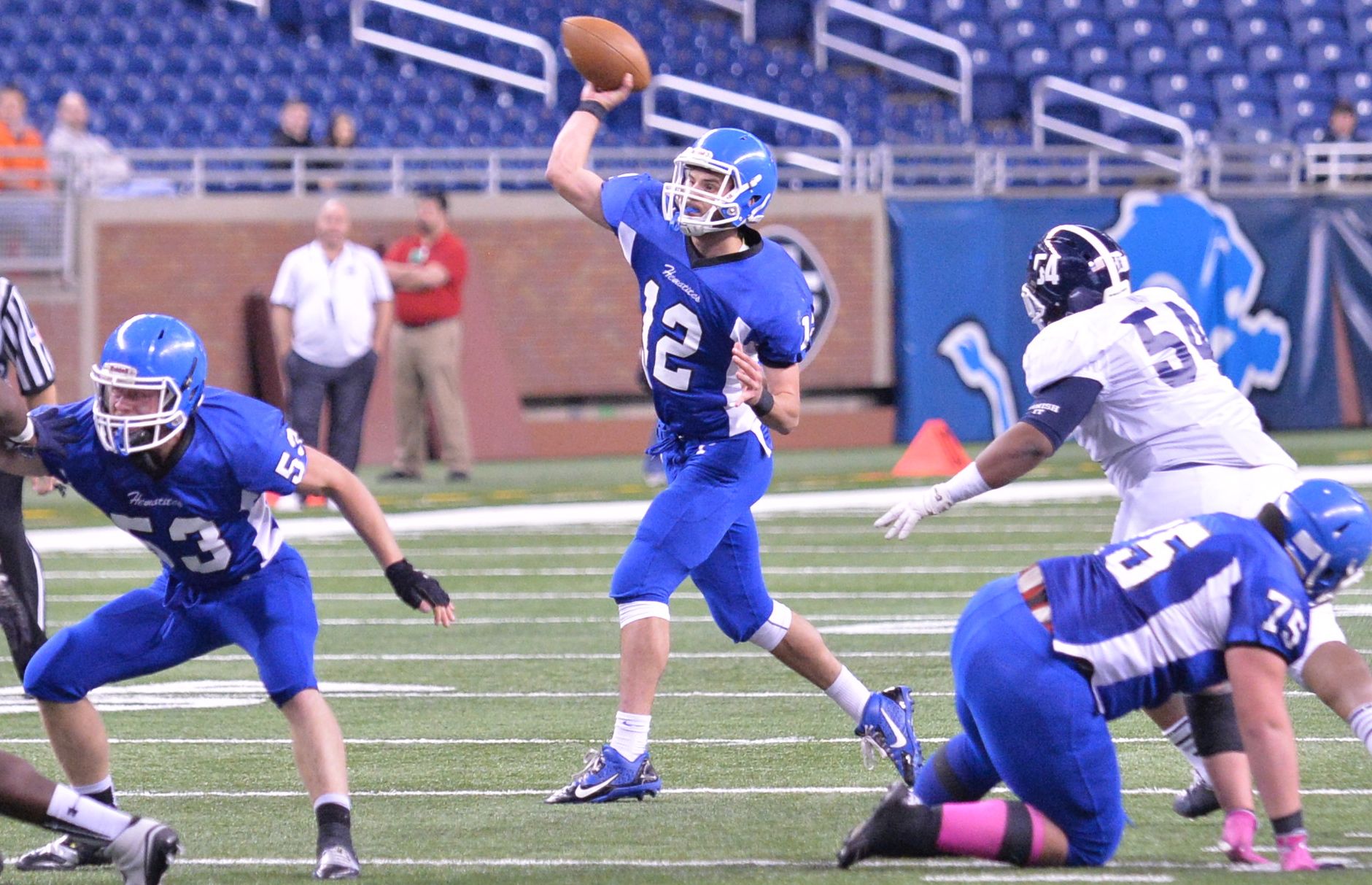
The first touchdown would’ve come earlier – a two-yard scoring run was called back because of a penalty – and Ishpeming junior Thomas Finegan intercepted a Loyola pass on the next play. With junior quarterback Ozzy Corp either running or completing passes on 10 plays, the Hematites responded with a 13-play, 90-yard drive capped by his 1-yard scoring run and two-point conversion pass with 1:03 to go in the first quarter.
But Loyola (14-0) made adjustments – taking opposite tacks for each side of the field.
Callahan had traveled to watch Ishpeming twice this season, including against eventual Division 8 semifinalist Beal City when those teams met in Week 6. Callahan noticed how the Aggies tried to defend Ishpeming’s powerful run – and came back to a defense he’d used coaching Pontiac Notre Dame to a league title before moving to Loyola. The “nitro” defense took all of his players off the line and gave a look of seven linebackers able to range side to side.
Loyola finished Saturday with six tackles for losses and three sacks, with junior lineman Anthony Fitzpatrick leading with 11 tackles.
“(Nitro) gives us better vision,” Callahan said. “With what they ran, they were going one way or the other. It gave our guys the opportunity to move as quick as they were and get to the spot.”
Meanwhile, the Bulldogs did just about the opposite offensively, as the game wore on getting back to the fundamentals of its base power running game that had served so well the last four seasons.
 Loyola finished with 297 yards on the ground, with senior Mideyin Wilson picking up 75 on 16 carries.
“Those guys are seniors now, all those guys we played before,” Ishpeming coach Jeff Olson said. “They’re big. They’re strong. They were better than us. There are only so many things you can do, and we tried a lot of different things, a lot of different blocking schemes. They just dominated us at times.”
Corp turned in another courageous performance without senior teammate and top back Ozzy Hakkarinen to assist – the latter was injured in last week’s Semifinal. Corp ran for 198 yards in that game, and added 111 yards passing to the team’s lone score Saturday.
Senior Dominic Suardini had 14 tackles for the Hematites (12-1), which had won 33 straight games entering Saturday – good to tie for eighth-longest winning streak in MHSAA football history and fourth longest among streaks to take place entirely during the playoff era (beginning in 1975).
“People don’t understand how hard it is to get here. When you do it three times in a row and win two, people think it gets easy,” Olson said. “We had some tough teams we had to play along the way, and you’ve got to beat those teams. And those teams are giving you everything they have. You can’t just have talent; you’ve got to have great kids, got to have competitors. We had that.”
PHOTOS: (Top) Detroit Loyola celebrates its first MHSAA football championship at Ford Field. (Middle) Ishpeming quarterback Ozzy Corp prepares to throw with the Bulldogs pressuring. (Below) Loyola’s Marvin Campbell runs away from tacklers for some of his 215 rushing yards. (Click for action photos and team photos from Hockey Weekly Action Photos.)
VIDEO HIGHLIGHTS:
ISHPEMING PICK - The Ishpeming defense stopped a long game-opening Detroit Loyola drive when Thomas Finegan intercepted a Nicholas Lee pass. The Hematites scored on the ensuing drive.
MARVELOUS MARVIN - Marvin Campbell rushed for 215 yards and four touchdowns for Detroit Loyola in its 29-8 Division 8 victory over Ishpeming. Here's the third score on a 66-yard run.
Watch the entire game and order DVDs by Clicking Here.
Bark River-Harris Making Good on Preseason Possibilities, Showing Postseason Potential
By
John Vrancic
Special for MHSAA.com
October 24, 2025
HARRIS – The Bark River-Harris Broncos have certainly made some noise throughout this football season.
 BR-H, which improved to 6-1 with a convincing 44-7 victory over West Iron County last Friday, hopes to make a deep run in the Division 8 playoffs.
“So far, so good,” coach Caleb Adams said. “At the beginning of this season we thought we had a special team, and everything has gone according to plan.”
The Broncos are 6-1 and last week clinched the outright championship in the Western Peninsula Athletic Conference Iron.
Among this year’s highlights are a pair of victories over Iron Mountain, something no other BR-H team had been able to accomplish.
The Broncos earned a 30-22 overtime win inside the yellow walls at Mountaineer Stadium on Sept. 5, then beat Iron Mountain 38-14 at home Oct. 10.
“We were 0-17 against them until that point,” Adams said. “It was like getting a monkey off our back. We had an opportunity to beat them and thought we could do it. There’s something about those yellow walls.”
Junior running back Gionni McDonough had similar thoughts.
“After our win up there, it was pretty crazy,” he said. “It was a great feeling to win up there. Although, we had beaten them in jayvee ball. We felt we had a shot at them.”
The Broncos next must turn their attention to tonight’s regular-season finale against Houghton. Kickoff is set for 7 p.m.
The Gremlins (2-6) are led by speedy senior running back/nickel back Brayden Goudge, who shows a quick first step, and junior quarterback Alex Hebert. Two weeks ago, Goudge scored on a 37-yard interception return and ran for two touchdowns in a 34-22 loss at Gladstone.
 “(Goudge) is very fast,” Adams said. “He’s one guy we have to pay attention to. If we win Friday, we’ll probably be able to host two (playoff) games.”
Junior QB Dane Schmitt believes the Broncos have to attack the middle in tonight’s game.
“That’s the type of team they are,” he said. “We're a pretty deep team. We have more jayvee kids coming up, and they’re getting better.”
The Broncos were 3-0 following a 42-14 triumph at West Iron Sept. 12.
They made the long trip to Auburndale, Wis., the following week. That contest, however, was cancelled by lightning.
BR-H then traveled to Gaylord to face undefeated Division 7 contender Pewamo-Westphalia, where it dropped a 49-0 decision Sept. 26.
That game was scoreless after the first quarter before two Broncos’ offensive linemen were injured.
“We wanted to see how we ranked with one of the best teams in the state,” Adams said. “After the injuries, everything kind of got away from us. The way they performed and their communication on the field kind of showed our kids what it takes to perform at that level.”
The Broncos responded the following weekend with a 44-16 victory at L’Anse.
“They’re a physical team,” McDonough said. “If we see them in the playoffs, we would have to be able to match their intensity.
A rematch with L’Anse in the postseason opener is possible, based on the current playoff rankings.
“If we play our game, we should beat them,” Schmitt said. “Although, they have some fast kids. We just have to play our style of defense and do our job.”
Junior lineman Sean Burton is among the Broncos’ leaders in the trenches.
“I honestly love it,” he said. “I like to be physical. The game with Pewamo-Westphalia was a big learning experience. Defensively, they play at a much faster pace than we’re used to. They’re very physical. It's a big difference from playing in the U.P. They’re a bigger school, and all their players are fast. We were pretty fired up after the first quarter, but it was hard to adapt after that.”
 John Vrancic has covered high school sports in the Upper Peninsula since joining the Escanaba Daily Press staff in 1985. He is known most prominently across the peninsula for his extensive coverage of cross country and track & field that frequently appears in newspapers from the Wisconsin border to Lake Huron. He received the James Trethewey Award for Distinguished Service in 2015 from the Upper Peninsula Sportswriters and Sportscasters Association.
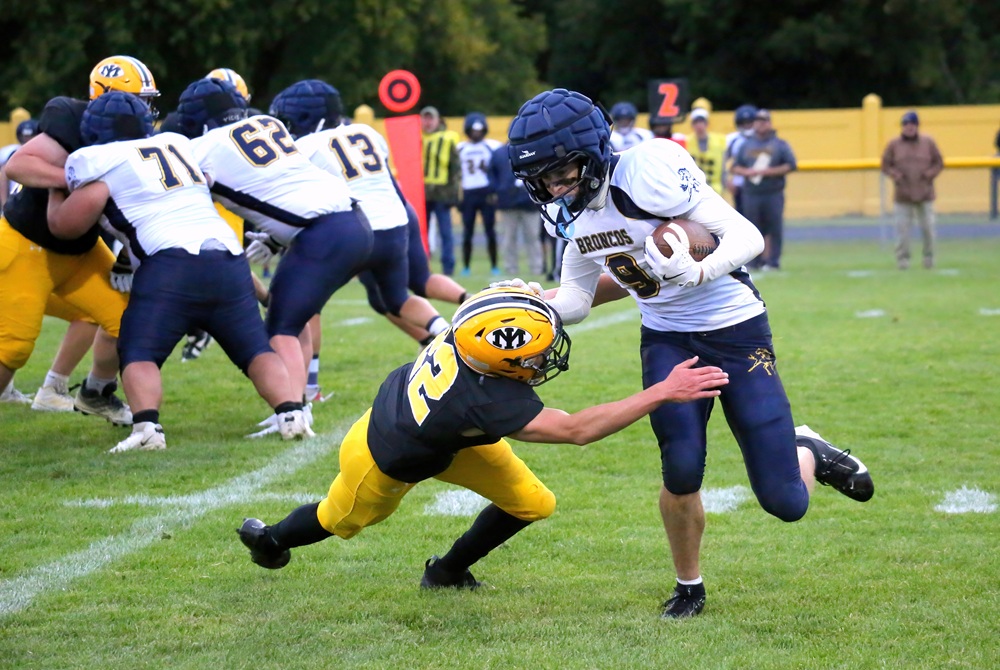
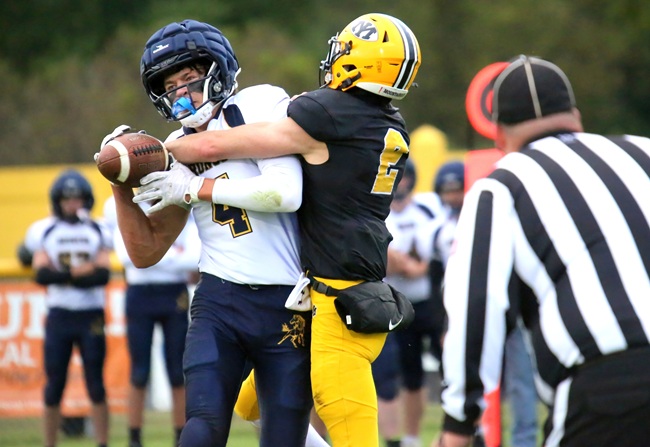
PHOTOS (Top) Gionni McDonough (9) breaks outside trying to elude the tackle of Ethan Davis (22) during Bark River-Harris' win over Iron Mountain on Oct. 10. (Middle) BR-H's Gabe Spear (4) hauls in pass as Brayden Kassin (2) tries to break it up. (Photos by Terry Raiche.)