

NFHS: Reserve Fridays for HS Football
August 9, 2017
Special from NFHS
In an effort to re-emphasize that Friday nights in the fall should be reserved for high school football, the National Federation of State High School Associations (NFHS) has adopted a resolution that urges schools and teams at the college and professional levels to honor that longstanding tradition and schedule games on other days.
The NFHS membership, composed of state high school associations in the 50 states plus the District of Columbia, has adopted the following resolution:
“Be it RESOLVED that every Friday night during the fall in America is ‘High School Football Night.’
“Be it FURTHER RESOLVED that college and professional football teams should refrain from scheduling contests on Friday nights. Such restraint would be an investment in their own future success. It would also demonstrate that high school football has value well beyond the field of play. Schools, communities and scholastic teams for girls and boys all benefit when football is strong.
“THEREFORE, the National Federation of State High School Associations urges all parties to observe the central premise of this resolution.”
Although some major college football games have been played on Friday nights for about 20 years, the numbers continue to increase. This year, more than 50 major college football games will be played on Friday nights, including eight on Sept. 1 – the Friday night before Labor Day weekend. Most recently, the Big Ten Conference joined a growing number of conferences that has scheduled a handful of games on Friday nights.
“The value of tradition cannot be understated,” said Bob Gardner, NFHS executive director. “Friday nights offer communities a traditional time and place to congregate and support their students. If a major college football game was scheduled in the area on a Friday night, it could affect attendance at the high school game or cause the game to be moved to another day. In addition, many of the Friday night college games are televised, which could result in lower attendance at high school contests nationwide.
“We believe retaining Friday nights for high school contests is a plus for colleges as well, as they reap the benefits of healthy programs at the high school level.”
Performance of the Week: Gladwin's Treyton Siegert
December 2, 2022
 Treyton Siegert ♦ Gladwin
Junior ♦ Football
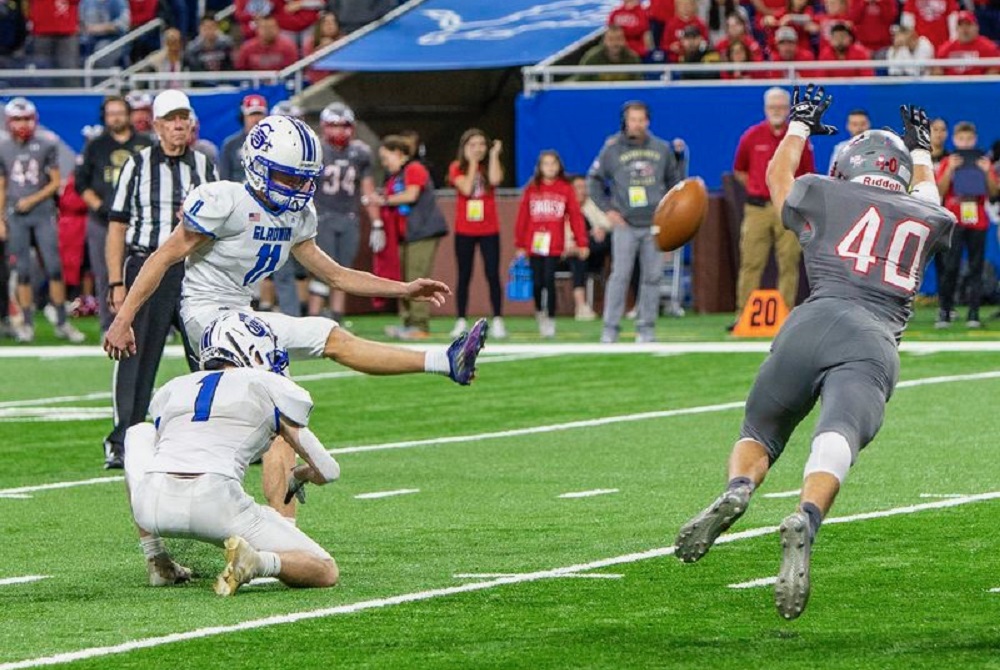
In just his second year kicking a football, Siegert connected on a field goal that's sure to be remembered in his community for years to come. His 21-yarder with two seconds to play in Saturday's Division 5 championship game clinched a 10-7 win over Frankenmuth and Gladwin's first football Finals championship. The field goal was his fourth this season, in five attempts.
Much more unnoticed but still important Saturday, he sent two of his three kickoffs into the end zone for touchbacks, and he also averaged 41.2 yards on six punts, with his longest on the day 57 yards. Siegert also plays on Gladwin's soccer team during the fall, club hockey during the winter, and he was the Mid-Michigan Golf Conference champion shooting a 77 at the league tournament this past spring.
@mhsaasports 🏈POW: Treyton Siegert #performanceoftheweek #football #kicker#statechamp #champion #congrats #gladwin #MHSAA #highschoolsports #tiktalk #interview #TikTok #mistudentaid #fyp ♬ Beat Automotivo Tan Tan Tan Viral - WZ Beat
Follow the MHSAA on TikTok.

MHSAA.com's "Performance of the Week" features are powered by MI Student Aid, a part of the Office of Postsecondary Financial Planning located within the Michigan Department of Treasury. MI Student Aid encourages students to pursue postsecondary education by providing access to student financial resources and information. MI Student Aid administers the state’s 529 college savings programs (MET/MESP), as well as scholarship and grant programs that help make college Accessible, Affordable and Attainable for you. Connect with MI Student Aid at www.michigan.gov/mistudentaid and find more information on Facebook and Twitter @mistudentaid.
2022-23 Honorees
Nov. 24: Lily Witte, Dexter diving - Report
Nov. 17: Navea Gauthier, Shelby volleyball - Report
Nov. 10: Derek Huisman, Holland Christian soccer - Report
Nov. 3: Thomas Westphal, New Baltimore Anchor Bay cross country - Report
Oct. 27: Justin Wickey, Colon football - Report
Oct. 20: Owen DeMuth, Bloomfield Hills Cranbrook Kingswood tennis - Report
Oct. 13: Mia Melendez, Ann Arbor Greenhills golf - Report
Oct. 6: Shawn Foster, Grand Ledge football - Report
Sept. 30: Hannah Smith, Temperance Bedford swimming - Report
Sept. 22: Helen Sachs, Holland West Ottawa cross country - Report
Sept. 15: Nina Horning, Lake Orion volleyball - Report
Sept 8: Arturo Romero, Muskegon Oakridge soccer - Report
Sept. 1: Austin King, Midland Dow tennis - Report
Aug. 25: Olivia Hemmila, Troy Athens golf - Report
(Top photo by High School Sports Scene.)