

Talking Practice: Texas, Illinois Revise Policies
December 20, 2013
By Rob Kaminski
MHSAA benchmarks editor
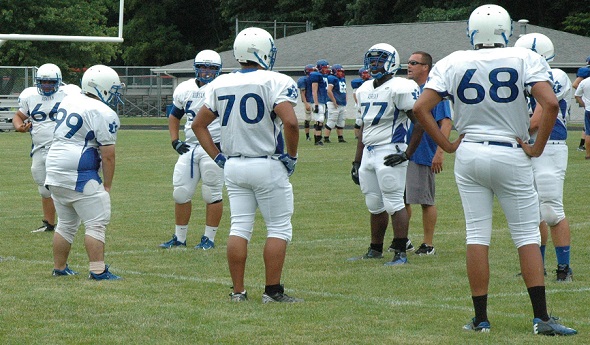
Coaches and players in Texas and Illinois adapted to new football practice limitations this fall, with the Texas policy focusing on contact, and the Illinois regulation emphasizing length of preseason practices.
Following are the main changes those states put in place heading into the 2013-14 season:
The University Interscholastic League, which governs school sports in Texas, put into writing that, “During the regular season and postseason, no football player is allowed to participate in more than ninety (90) minutes of full contact practice per week,” effective with the first day of practice this fall.
The complete policy follows:
For the purposes of the of rule, "full contact" is defined as football drills or live game simulations where "live action" occurs. Live action, as defined by USA Football, is contact at game speed where players execute full tackles at a competitive pace taking players to the ground. A team may continue to dress in full pads for practice, but may only participate in live action drills and game time simulations no more than ninety minutes per athlete per week. It is assumed that when players are in shells (shorts, shoulder pads, and helmets) no live action drills or simulations will occur. This rule is intended to limit live action drills and simulations and not the number of practices a team may participate in full pads. A team may participate in "air," "bags," "wrap," and "thud" drills and simulations at any point. These contact levels are defined below:
• Air - Players should run unopposed without bags or any opposition
• Bags - activity is executed against a bag, shield or pad to allow for a soft-contact surface, with or without the resistance of a teammate or coach standing behind the bag.
• Wrap - Drills run at full speed until contact, which is above the waist with the players remaining on their feet.
• Thud - Same as wrap but tempo is competitive with no pre-determined winner and the players are not tackling to the ground.
 The rule came to the UIL Legislative Council as a recommendation from the UIL Medical Advisory Committee, a permanent advisory committee to the Legislative Council which meets twice each year to discuss and review safety policies for UIL participants. The committee, which is made up of leading medical professionals in various specialties and includes representatives from the Texas High School Coaches Association, the Texas Girls Coaches Association, and the Texas State Athletic Trainer Association, unanimously recommended this limitation in full-contact football practice.
The rule formulates into a formal policy the existing actions of the majority of coaches across Texas, and most coaches have had to make few adjustments, if any. In fact, according to a story on statesman.com, the proposal caused more of an uproar on social media than from coaches.
“It’s not going to affect us in anyway,” Vandegrift HS coach Drew Sanders said in the story. “Most good coaches were way below that 90-minute amount already. Prior to legislation we still monitored it ourselves – the only change is now we have to keep up a log more publicly.”
Illinois put standards in place for its first 14 days of football practices, known as the state’s Preseason Football Acclimatization Practice Period. At the core of the policy is a three-hour practice limit for the first five days, during which teams can also conduct a one-hour walk-through.
 Teams must observe a minimum two hours rest between the practices and walk-throughs. Players may wear helmets only on the first two days, then helmets and shoulder pads for the next three. From days seven through 14 of the acclimatization period, schools may practice for a maximum of five hours per day, as long as that day is followed by a three-hour day, or an off day. During the five-hour days, no session can last more than three hours and must include a two-hour break between practices. Full pads may be worn for the final seven dates leading up to the first contest.
“This policy was the result of a collaborative effort between the IHSA Sports Medicine Advisory Committee and the Football Advisory Committee,” said SMAC committee member and University of Illinois Associate Professor of Orthopedic Surgery Dr. Preston M. Wolin. “The guidelines are based on the most recent scientific evidence, as well as the expertise of the coaches who will help implement them. Both committees believe the guidelines represent a significant positive contribution to the health of our athletes.”
“This new policy undoubtedly changes the way we, as coaches, approach preseason practice,” said Metamora HS coach Pat Ryan, who is a member of the FAC and a past President of the Illinois High School Football Coaches Association. “Coaches have to get more creative with when and how they schedule practices, as well what they do with their time. The proposals were strongly supported by both committees. It is a crucial final step to the process of being able to effectively prepare our teams in a safe manner. Change is always difficult, but the game is changing and we need to adapt to continue to put the safety of our players first.”
The IHSA offered multiple interactive online webinar meetings for high school coaches leading up to the start of practice where questions were answered, along with further clarifications on the policy and the science behind it.
“I think most coaches understood that changes were on the horizon,” said IHSA Executive Director Marty Hickman. “We wanted to be in a position to give our coaches as much information as possible to make sure they are comfortable with the new policy. Their input will be critical moving forward as we develop educational materials, like a best practices presentation. I commend our committees on a policy that is supported by medical experts, football coaches and school administrators.”
Menominee Caps Powerful Ford Field Return with 1st Championship Since 2007
By
Scott DeCamp
Special for MHSAA.com
November 30, 2025
DETROIT – Menominee’s football program has been known a long time for its single-wing offensive scheme, which certainly has served the Maroons well over the years.
The secret to their success goes way deeper than that, however, and it has nothing to do with X’s and O’s. Call it grit, tenacity, resolve – the Maroons have built their program around those characteristics – and now they’re back on top.
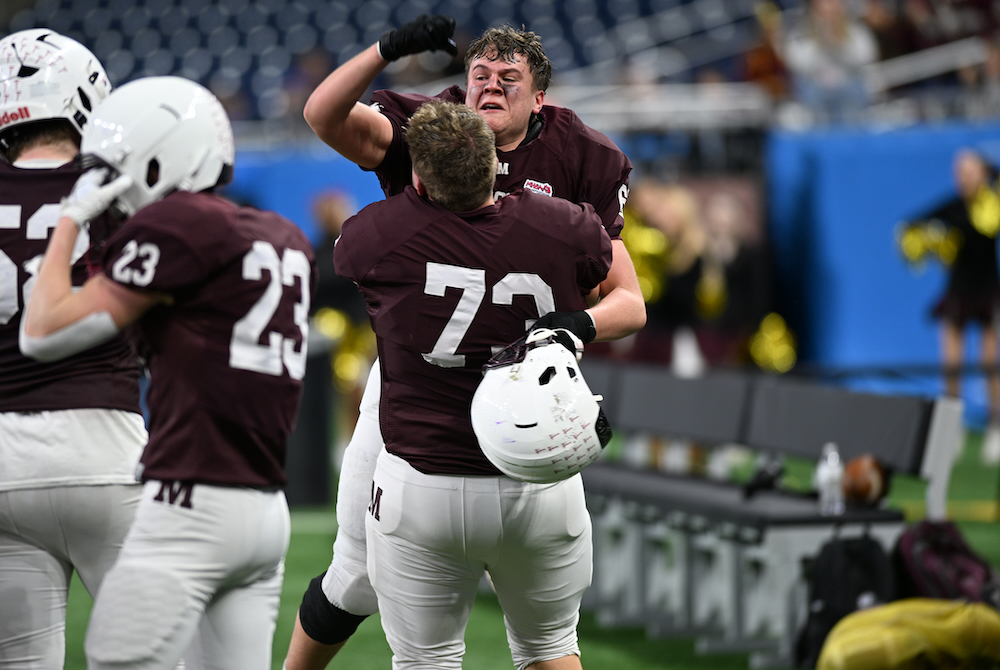
Menominee defeated Schoolcraft, 34-6, in the Division 7 Final on Sunday at Ford Field, where the word “grit” has been stamped into the fabric of the Detroit Lions by head coach Dan Campbell.
With a comprehensive effort, Menominee (14-0) captured its first Finals title since 2007, the fourth in program history, and the first for an Upper Peninsula 11-player football team since Ishpeming claimed the Division 7 championship in 2015.
“Just grit and just hard work. I mean, you saw it out there, we’ve got 30 guys on our sideline. Growing up in Menominee, you’re going to have 30 guys on your team, if that,” said Menominee senior Tanner Theuerkauf, starting quarterback and safety.
“You look at our offensive line, we have our guard, he’s 150 pounds – you don’t ever see that, and he just does his job and all those guys do their job in the trenches. … Our want to win is just something you don’t see.”
Theuerkauf and some of his teammates were part of Menominee’s Division 7 runner-up squad two years ago, when the Maroons battled powerhouse Jackson Lumen Christi but fell just short, 34-30.
 In last week’s Semifinal, Menominee showed great resolve in erasing a two-touchdown deficit in the fourth quarter and securing a 32-28 victory over Pewamo-Westphalia in a matchup of teams ranked Nos. 1 and 2, respectively, in the final regular-season Division 7 poll.
“Different mentality this year with these seniors,” said fourth-year Menominee coach Chad Brandt, who coincidentally did his student-teaching at Schoolcraft starting in 1996. “Times that I’m not around and they’re running to the locker room and grabbing the footballs and I drive by and they’re out there. That means a lot. And we have linemen that text me, ‘Can we have extra weight-room sessions?’ and those kind of things.
“It takes a lot of work, and these guys have put it in and I just couldn’t be prouder of this group of guys and for our town and for our school of Menominee because they deserve and they appreciate it and they support us in every way possible.”
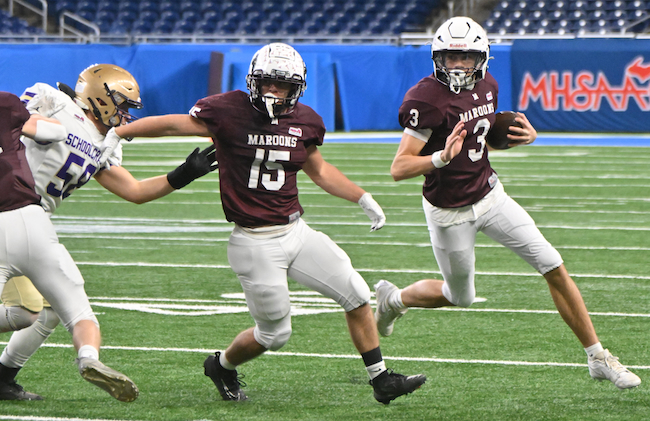
Menominee senior Clayton Miller helped set the tone Sunday with his hard-nosed running. The 5-foot-11, 190-pounder scored the first three TDs of the game for the Maroons, who took a 7-0 lead on his five-yard run less than four minutes into the contest, went up 13-0 on his two-yard run midway through the second, and led 20-0 on his 31-yard sprint four minutes into the third quarter.
Miller finished with a game-high 112 rushing yards on 25 carries.
“He’s the greatest running back that I’ve ever played with. He’s one of the greatest in Menominee history,” Theuerkauf said about Miller. “He’s not the biggest guy in the world, but he just runs so hard – he runs through guys. … Just for him to want to win, he shows so much energy out there. He’s not the most talkative guy, but he gets the job done and I love that.”
Several Menominee players got the job done, but senior Maverick Geniesse was another who stood out. With Menominee leading 7-0 late in the first quarter and Schoolcraft threatening to score, Geniesse intercepted a pass at the 1 on a Schoolcraft first-and-10 from the 12 to snuff out the Eagles’ opportunity.
Menominee embarked on an 18-play, 79-yard drive that chewed up 8:17 of the clock and was capped by Miller’s second TD run as the Maroons took command with a 13-0 lead.
Geniesse also got into the scoring act, catching a two-yard TD toss from Theuerkauf early in the fourth quarter for a 28-0 Maroons lead. Junior Jackson Myszak capped the Menominee scoring with an eight-yard TD run with 2½ minutes left.
“It feels great. I mean, I’ve dreamed about stuff like this. The ultimate goal is to just be the best team player I can and help the team in any way I can,” Geniesse said. “Of course, the interception, that got our morale going the other way; and the touchdown (reception), it felt pretty good.”
Schoolcraft (11-3) got on the board midway through the fourth quarter on senior TJ Luteyn’s four-yard scoring run.
Both teams displayed offensive balance – Menominee was just more effective throughout the game. Menominee tallied 358 total yards (198 rushing, 160 passing), while Schoolcraft totaled 248 (100 rushing, 148 passing).
 “Good, physical team,” Schoolcraft first-year coach Dan DeVries said about Menominee. “Their scheme is a challenging scheme. They can hit the edge hard and you’ve also got to watch for something up the middle and their quarterback can throw as well, so a lot of dimensions to their game. I think they played a fantastic game today. They didn’t make mistakes and we did, and that certainly showed in the score.”
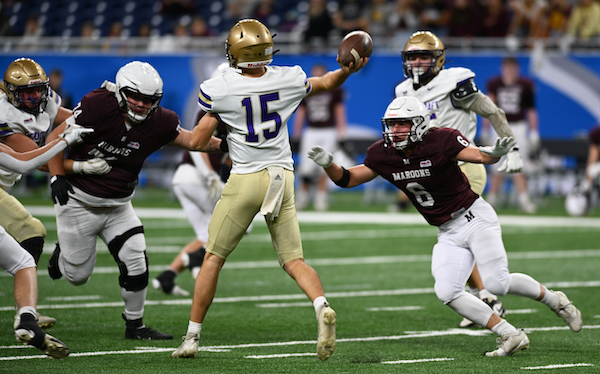
Theuerkauf completed passes to six receivers and finished 7-of-11 for 160 yards. Schoolcraft junior QB Jack DeVries was 12-for-26 for 148 yards.
Schoolcraft seniors Evan Feller and Dane Ostlund paced all defenders with 12 and 11 tackles, respectively. Junior Nathan Nelson notched nine tackles to lead Menominee.
Going back to the late-1980s, Schoolcraft has been a small-school football power, but Sunday marked the Eagles’ first Finals appearance since 2001. They’ve made seven Finals appearances overall and captured titles in 1988, 1989, and 2001.
“Just to see the support and what it means to the town and stuff like that after 24 years – I mean, that’s a long time to not make it back after we’ve had a history of having good football teams and stuff like that,” Jack DeVries said.
“It’s great to do it with the group of seniors we have. Great group of guys – been playing with them for as long as we can remember. (We’ve been) talking about (Ford Field) since we were kids, and getting to go do it was a special thing.”
Sunday signified Menominee’s seventh Finals appearance overall as well. The Maroons also seized championships in 1998, 2006, and 2007 under legendary coach Ken Hofer.
This Menominee teamed restored some of that “UP Power” that Maroons and others north of the Mackinac Bridge take such great pride in.
“That does mean something when we head back across that bridge and it’s ‘UP Power’ and we’ll go through other towns and they’ll be honking horns or happy out on the street …,” said Brandt, a Gladstone native, who spent 20 years as head coach at Stephenson in the UP.
“The UP is someplace special, and it means something.”
For Theuerkauf, this one was a bit personal, too. His older brother, Trevor Theuerkauf, was the starting QB and a two-way standout on the Menominee team that made it to the Finals in 2023.
“He just told me, ‘Go out there and play (your) game. (You) don’t have to worry about anything else,’” Tanner Theuerkauf said. “I kind of had the edge on some of these guys because I’ve been here before. I played in this game – didn’t go our way, but today, come out and get the job done, it’s just the greatest feeling of my life.”
PHOTOS (Top) Menominee’s Brayden Daigneau (73) hoists a teammate into the air Sunday as they celebrate their team’s Division 7 title. (Middle) Tanner Theuerkauf (3) follows Clayton Miller (15) around the edge. (Below) The Maroons’ Jackson Myszak (6) puts pressure on Schoolcraft quarterback Jack DeVries.