

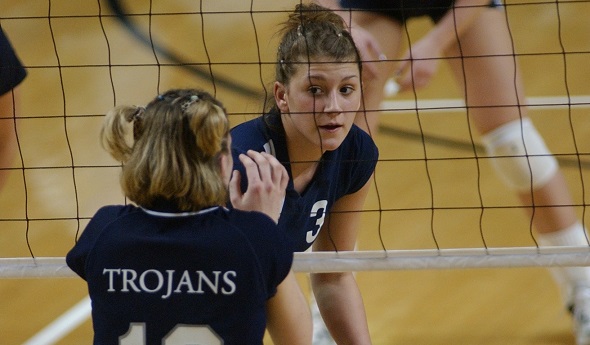
Marysville, Fruitport Wage 8-Year War
By
Ron Pesch
MHSAA historian
October 30, 2019
The history of girls volleyball in Michigan is filled with stalwarts, streaks and change.
Battle Creek St. Philip appeared in the MHSAA Finals on 28 occasions between 1977 and 2015 and won 20 titles, including nine consecutive between 2007 and 2014. Portage Northern made 12 trips to the Finals during a span of 20 years, and won 10 titles. Little Brimley High School in the Upper Peninsula won eight titles in 10 visits, including five consecutive U.P. Open Class titles between 1981 and 1985 and seven of eight between 1981 and 1988 during the days when championships were awarded in both Upper and Lower Peninsulas.
Certainly, one of the most captivating streaks was Marysville’s between 1997 and 2006. The Vikings, guided by coach John Knuth, won nine Class B titles during that 10-year span as the MHSAA championships morphed into a unified tournament beginning in 2000, with singular Finals titles awarded by enrollment class.
An interesting byproduct that developed during the string of Marysville titles was an enthralling and unexpected east side/west side rivalry with Fruitport. It featured head coaches that, from the perspective of a spectator, appeared vastly different. Separated in birth by nearly two decades, the two men in reality shared very similar approaches in developing athletic programs that altered the landscape at their respective school districts.
Building a dynasty
“The team has a lot to learn,” said John Knuth to the Port Huron Times Herald in 1985 when he was announced as the latest Marysville volleyball coach. “I’m the fourth coach in four years, and we are just starting to build a program.”
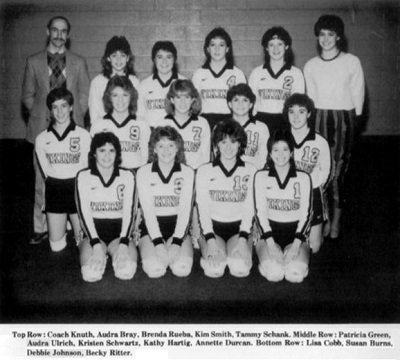 An outstanding halfback at Marysville for one of Michigan’s celebrated football coaches, Walt Braun, Knuth was recipient of the McPherson Award as a senior in the fall of 1968, given to the team’s MVP. He was captain of the basketball team and a high jumper for the track team. He returned to Marysville after graduating from Central Michigan University in 1974 to teach elementary physical education and later, health. Knuth’s father died when he was 7. Braun had a big influence on his life, and Knuth would assist his coach with track, then with football for 22 years. In time, he would also coach ninth-grade football, junior varsity boys basketball and varsity girls basketball.
“I really wanted to be a (varsity) basketball coach,” he told the Times Herald in 1994, but after 10 years as the JV (boys) coach he didn’t see an opportunity opening up. After watching the turnover with the volleyball program, he took the position. Like many schools around the state, Marysville added girls volleyball to its roster of MHSAA-sanctioned activities with a junior varsity team in 1974 and a varsity squad in 1975 following the arrival of Title IX.
“I put a lot of time and energy into learning the game,” Knuth said. “When I started, I wasn’t very knowledgeable. I enjoyed the game; I liked the team aspect. I went to clinics, and I read a lot. I tried to learn every chance I could get.”
In 1987, he added an eighth-grade team to the mix, coaching the team himself. As is common with football, he studied film from the team’s matches. He saw potential. His focus was on team, discipline, detail, defense, and attitude. His vision was on the moment – the here and now – and having fun. The players responded.
During the winter of 1990, the Vikings made their first run at the MHSAA Class B title, earning their first ever Regional championship but falling to Fenton 15-13 and 15-11 in the Quarterfinals. By 1992, Marysville had won 44 straight St. Clair Area League matches dating back to 1988, captured three consecutive league championships and advanced to the MHSAA Semifinals. In 1993, the team played in its first state championship match, falling to Comstock in three games. Coach Jeff Borr’s Comstock teams were winners of six Class B titles in eight years between 1986 and 1993.
Marysville’s conference win streak had grown to 72 in a row and six straight SCAL titles in 1994, but the Vikings lost to eventual Class B champion Holland Christian in the Quarterfinals. Lindsey Clayton, one of 11 all-state players turned out by Knuth’s volleyball program during his first 10 years at the wheel, finished her prep career second in the state in kills and earned a full-ride athletic scholarship to Michigan State.
After missing the final rounds in 1995, the Vikings were back in the Semifinals in 1996, but again were eliminated by eventual champion Comstock.
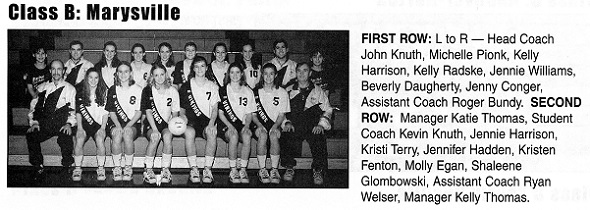 The 1997 season marked the school’s first volleyball championship and, fittingly, they finished the season with a flawless 57-0 mark.
“Charlotte (62-8-2) bolted to a 5-0 lead in the first game and led 7-1 in the second game,” stated Ted Kulfan, covering the contests for the Detroit News. “But Marysville rallied both times. With the match 10-10 in the first game, 5-0 senior Michelle Pionk served five consecutive points to put the game away for Marysville. In the second game, the Vikings rallied from an 11-10 deficit with (Jennie) Williams dominating the net.”
A three-time all-state senior, Williams, who would later attend Purdue, slammed home the winning kill in the second contest, a 15-12 win.
Marysville again finished the year undefeated and repeated as ‘B’ champion in 1998, thumping Pinconning (79-5-1) in two games in the title match.
East vs. West
Fruitport’s first taste of the final rounds of the MHSAA girls volleyball tournament occurred in 1998. The Trojans were defeated by Pinconning 15-10, 15-8 in the Quarterfinal round, but the team was back in pursuit the following winter posting its best-ever season with a trip to the semis. Not surprisingly, the Trojans ran into Marysville.
“It has taken coach Dan Potts a long time to lead the Trojans to such prosperity,” wrote Bill Roose in the Detroit Free Press prior to the 1999 MHSAA tournament.
“‘We were 5-20 in that first season,’ said Potts, in his eighth year. ‘But we’ve had steady improvement ever since. This is the fifth year in a row with a winning season.’“
The two schools had first met just prior to the start of the tournament. After Fruitport’s fine showing in the East Kentwood Invitational in late January, the Michigan Interscholastic Volleyball Coaches Association (MIVCA) had the Trojans ranked No. 1 in Class B with Marysville at No. 2 before the two teams squared off in the final round of the 32-team University of Michigan-Dearborn Invitational – a final test before MHSAA District play kicked off.
“‘We felt we were on top of our game when we played Marysville,’ said Fruitport senior Jen Brink about the dose of reality the Trojans received in the championship match. The Vikings blasted Fruitport, 15-9, 15-6. ‘We didn’t realize the potential that they have. … Now we understand the emotional state that it will take to beat Marysville. … Now we’re prepared for it.’”
As hoped, the two schools met again in the Semifinals of the postseason.
“Our Regional was very tough,” said Knuth to the Times Herald. “The Quarterfinals were not quite as tough … but (Friday’s match with Fruitport) will be war.”
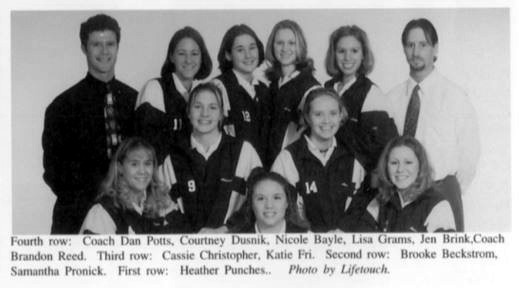 “It’s hard to say how we’ll do,” said Potts. “They handed us a pretty resounding loss.”
A 15-4 win over Marysville in Game 1 of the Class B Semifinals exemplified the learning curve and work put in by Fruitport in becoming a west side power in volleyball. Dramatically, Marysville grabbed the next two games, 15-10 and 15-9, illustrating to Potts that there was still work to be done. Despite playing 80 contests that season and posting an impressive 72-8 mark, Fruitport had fallen short of its goal.
“It was a scare,” said Vikings 5-foot-11 junior middle hitter, Kristen Fenton, to the Free Press. “They wanted to win that first one more than we did; they really came after us.” A three-time first-team all-state player, Fenton would later compete collegiately at Fresno State and with the U.S. National Team that won bronze at the 2007 Pan American Games, then return home to coach Marysville.
With a 15-5, 15-0 victory over Stevensville Lakeshore in the championship match, Marysville clinched its third consecutive crown and completed a third straight undefeated season (58-0).
It’s a three-hour trip between Marysville and Fruitport geographically, so without the MHSAA tournament, it’s unlikely the rivalry between the two high schools would have occurred naturally. Marysville continued to roll. The top-ranked Vikings had upped their consecutive match victories state record to 192 before falling to Flint Carman-Ainsworth in mid-January of 2000 at a tournament in Birch Run. Still the top-ranked team in Class B at the end of February, the Vikings blew-out third-ranked Fruitport in the final of the annual U of M-Dearborn Invitational, 15-4, 15-6.
In the postseason, Fruitport fell in the Regional Semifinals to second-ranked Reed City in two games.
“We prepared (for Reed City) all week but we weren’t able to execute like we wanted.” said Nicole Bayle, a MIVCA all-state outside hitter at Fruitport and later a star at Grand Valley State University, to the Muskegon Chronicle. “That’s the best I’ve seen them play. They’re a solid team.”
Reed City advanced to the Class B championship match, but were defeated by Marysville in convincing fashion, 15-8, 15-0.
Commitment, Intensity and Colorful Enthusiasm
A 1987 Muskegon Reeths-Puffer alumnus, Potts was 23 when he first took over a Fruitport program lacking stability and direction. A recent Michigan State graduate, he had played some club volleyball for the Spartans while in college, but picked up most of his experience as a beach volleyball player along the shore of Lake Michigan. Like Knuth, as a coach he sought knowledge from others and studied the game and the psychology of the female athlete. It was a long road.
With new focus, Fruitport was back in pursuit in 2001.
 Prior to the season, many felt Marysville wouldn’t make the return trip to Kalamazoo come tournament time as it had lost several top players to graduation in 2000 – including Fenton and Jennifer Hadden, who would play at Mississippi State. But until the U of M-Dearborn Invitational, it was business as usual. Knuth’s squad entered the invitational championship match with a perfect 54-0 mark. There, sixth-ranked Fruitport shocked Marysville in the final, 15-10, 16-14. In the second game, Fruitport overcame a 10-0 Vikings lead.
“It’s a big win for our program,” Potts told the Chronicle. The loss was Marysville’s first to a Class B school in 286 matches. “We played well as a team all day. … Now we’ll have to see if we can maintain that level of intensity heading into Districts.”
When asked by the Free Press about the possibility of a rematch between the schools in the Class B championship match, Potts was hesitant. “It would be great to get there, but there is a lot of road to cover until then,” he said.
“I think this was a good experience for the girls because they were able to see some very good competition before the (state) tournament,” said Knuth to the Times Herald, after the defeat.
Both Marysville and Fruitport cruised through the 2001 postseason and won impressively at Friday’s Semifinals hosted at Western Michigan University. Fruitport downed No. 2-ranked Dexter, 15-11, 5-15, 15-9 to advance. Marysville topped No. 1 Stevensville-Lakeshore 15-4, 15-8.
Both teams were eager to play each other again, this time with a state title on the line.
“We are glad we are in the finals; we are glad we are playing them, in a rematch,” said Mary Czarnecki, Marysville’s middle hitter. “But truthfully, we are just glad to be in the finals, no matter who we play. No one expected us to get this far. No one thought we were going to be this good.”
“That win earlier in the year told us we can contend with any team in the state,” said Fruitport’s senior setter Holly Punches to the Free Press. “They’re one of the top teams in the state and they haven’t won all those state championships for nothing.”
“The first game was over quickly (14 minutes),” wrote Joanne C. Gerstner in the Detroit News about the title match, “giving Marysville commanding momentum. ‘It got all of us going,’ said Marysville senior hitter Karen Conger (Oakland University). ‘We were all fired up.’”
“I told them it was just one game, forget it,” said Potts to the Chronicle about the 15-2 loss in the opener.
Fruitport rallied to a degree in the second game. But the Vikings, without a go-to player on the roster like in past years, were built around defense and aggressive play. They didn’t let up, and won 15-9.
Like Marysville, Fruitport had been traditionally known as a football school. But things were changing. Hundreds of fans had followed both teams to Kalamazoo.
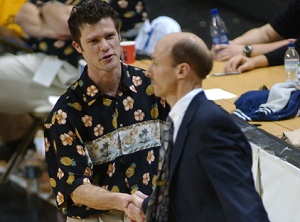
“It’s great for our program because we took another step,” said Potts, dressed in a bold Hawaiian shirt, “Unfortunately we couldn’t take the next step and win it. I think the players learned a lot from this, though.”
It was a fifth consecutive title for Marysville. Only Cedarville, with six straight titles between 1992 and 1997, had won more in a row.
“I don’t want to say losing makes you better, but our loss to them (at U of M-Dearborn) certainly was a wake-up call,” Knuth said. “We knew we had some things to work on. We knew what their game plan was and prepared for it this time.”
“We’re going to be back here,” stated Potts following the title match. “These girls know that. We had a great season and are not going to hang our heads over this.”
And so it was
For three straight years, the teams battled their way through the regular season and initial rounds of the MHSAA tournament for the right to meet in the final rounds. Each team shed first-team all-conference and all-state players annually with graduation, to be replaced by another round of outstanding athletes. Many would go on to play in college, then in later years give back by coaching the game they loved.
In 2002, Marysville won its 14th consecutive league title, but dropped its first league match in 156 played over nearly 14 years. Knuth, never one to gaze too deeply into past achievements, did comment on the accomplishment to the Times Herald: “I think it’s more amazing than the five consecutive state titles.”
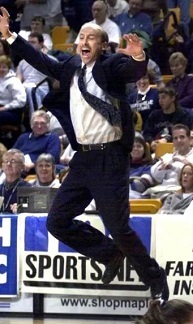 His focus quickly returned to “one-point, one game, one match.”
Before a crowd of 3,675 at Western Michigan University, the Vikings battled to a 15-6, 15-7 win over the Trojans for their sixth Class B title in a row.
“It was a war out there,” commented Knuth to the Times Herald, noting that the score of the second game was not a true indication of its competitiveness. The end of the contest was filled with side-outs, and the Vikings had a real battle on their hands. “They were not going to give up.”
Ashley Feutz, a 6-foot-1 sophomore, finished with 16 kills for Fruitport. Kelly Thomas had 39 assists for Marysville on the day.
In 2003, with the loss of seven to graduation, including three all-staters, the annual question concerning Marysville’s ability to reign again surfaced. During the season, Fraser, a Class A conference opponent, ended the Vikings’ league title streak at 14. But it was the only bump on the road. Of course Knuth had his team ready for the tournament. After dropping the opening game to St. Joseph in the Semifinals, 15-11, Marysville battled to 15-11 and 15-9 victories to advance to the championship match.
Fruitport, with only one senior on the roster, downed Carleton Airport in two games in the semis, setting up a third-straight meeting with Marysville for the Class B marbles.
Again, after dropping the opener to Fruitport, 15-12, the Vikings rallied back to 15-10, 15-7 wins to celebrate their seventh straight championship.
Allison Mattox led Marysville with 20 kills, followed by Megan Harrison – runner-up for the state’s Miss Volleyball Award – with 16. Feutz, now a junior, topped Fruitport with 25 kills.
“They always seem to play very well against us,” said Potts to the media. “They rose to another level. We certainly lost to a good team.”
Interrupted
Once again, Marysville and Fruitport finished the 2004 regular season ranked No. 1 and No. 2 in the MIVCA rankings, respectively. However, a tournament rematch was not in the cards that school year.
“… the Vikings need not fret Fruitport – or its coaches, who traditionally don the bold Hawaiian shirts,” trumpeted the Herald-Times in mid-March. “Rival Fruitport, the West Michigan powerhouse and the final victim in Marysville’s last three state championships, is out of the tournament. Upset by No. 8-ranked Whitehall in district action last weekend, the mighty Trojans must now wait at least one year to face their blossoming nemesis again.”
In mid-March, Marysville grabbed its eighth successive title with a win over Carleton Airport.
Perhaps the wait was precisely what was needed. For Fruitport, a year away from the floor at WMU provided perspective.
“I’ve got to tell you guys,” said Potts, “when you get to the finals a couple of years in a row, you can’t wait until March. The regular season means nothing when you’ve got that euphoria.”
The 2004-05 season brought big changes to volleyball in Michigan. The sport moved from side-out scoring, where a team had to serve to earn a point, to rally scoring, where a point is awarded on every serve. The style change meant a move from a best-of-three game format to a best-of five-format. Under the side-out style, games were played to 15 points, with a required margin of victory of at least two points. Under the rally approach, games are played to 25, and then shortened to 15 points if a match requires a fifth game – with a margin of two points still required to win.
Familiarity soon reigned. After a year off, the Semifinal pairing between No. 1 Marysville and No. 2 Fruitport was exactly the match-up volleyball fans craved. Led by senior setter Stephanie Booms, Marysville’s first Miss Volleyball, the Vikings made their 11th straight trip to the Semifinals and their 13th appearance in 14 years. In the first year of rally play, fittingly, it took five games to determine a Semifinal winner. Fruitport dropped the first game, 25-21.
“To be honest,” said Potts, whose team had lost six matches during the regular season, “I had a little bit of a sinking feeling. ‘Aww, man, are we gonna stall like this?’ But I’ll tell you, this team has come back all year long.”
The Trojans rebounded, winning the next two, both 25-19, but dropped the fourth game 25-14. The decisive fifth game saw the margin never exceed three points and was a battle to the end. Tied at 15, the Trojans escaped with a 17-15 win set up by a running save from Fruitport’s Danielle McGrady.
It was Marysville’s first postseason loss since 1996.
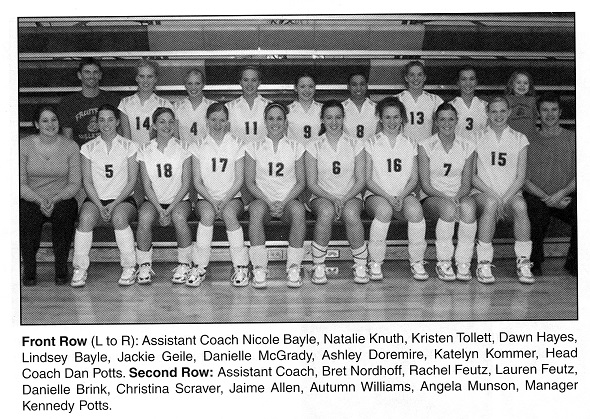
Senior outside hitter Lindsey Bayle, a member of the Trojans’ 2002 and 2003 runner-up squads and one of six seniors on the team, had 16 kills and 28 digs to lead Fruitport to victory.
“Half this team is so young that they don’t realize the magnitude of what we just did,” Bayle said to the Free Press. “The seniors know this is something the people will always remember.”
The Trojans’ coaching staff had traded out their Hawaiian attire for blue dress shirts to highlight the blue-collar nature of the 2005 squad. The following night, after dropping their first game to Otsego in the championship match, Fruitport rebounded with three straight victories to win its first state title in any sport.
Return, not revenge
In 2006, the Trojans and Vikings returned to the final rounds. After victories in the Quarterfinals, the teams would meet again in the semis.
For Amanda Kettlewell, Marysville’s senior middle attacker, “it wasn’t about getting back at the Trojans … it was simply about getting back. ‘Who wouldn’t want to play Fruitport – They’re a great team,’ said Kettlewell to the Times Herald, focused, like her coach, on the moment.
Teammate Allison Schlinkert concurred: “We weren’t looking to get revenge or anything like that – what happened last year, happened last year.”
This time, Fruitport won the first game of the Semifinal battle, 25-19. Marysville responded with easy victories in Games 2 and 3. Game 4 was a marathon.
The Trojans held a 24-21 lead after three straight kills by junior Jackie Geile, hoping to even the series. But the Vikings pulled within one, 24-23. A misplaced kill attempt by Fruitport tied the game at 24. Both teams fought off match point multiple times before Marysville emerged the winner, 30-28.
Potts complimented the Vikings’ defense for bouncing back.
“It’s the most amazing feeling,” said Schlinkert. “It’s pretty much everything – the fact that we can now play in the finals, the fact that it was Fruitport, and it’s always a good game every time we play Fruitport. Always. Always.”
Marysville knocked off top-ranked Grand Rapids South Christian for its ninth title in 10 years and final state title under Knuth. It took five games. Kettlewell delivered a championship-clinching kill to seal a 15-11 victory in the decider – delayed by 12 minutes due to a false fire alarm at WMU’s University Arena. The Vikings had won the first two games, and then had to battle back after losing the next two.
“On Cloud Nine” read the headline on Page 1 of the Times Herald on Sunday, March 19, in reference to the achievement.
Marysville again returned to the Class B Quarterfinals the following year, but was vanquished from the final four for the first time since 1994 by Carleton Airport.
 “It has been a fabulous season,” said Knuth. “We went above and beyond expectations. “
Change Abounds
Although the changes to scoring and match length detailed above were significant, the most massive switch came in 2007, when volleyball moved from a winter sport to a fall offering.
After guiding the Trojans to the Semifinals six times in eight years, Potts resigned in April following the winter 2007 season.
“I’m not a big fan of switching seasons,” Potts said to the Free Press. “I thought we had it right in Michigan.”
The Fruitport position was filled by one of his assistant coaches and a former player, Nicole Bayle. Under Bayle’s guidance, the Trojans finished as Class B runners-up in the fall of 2008, before winning Class B titles in both 2010 and 2011.
“Fruitport head coach Nicole Bayle and assistant coach Holly (Punches) Hazekamp finally have their elusive state title,” wrote the Chronicle in 2010, “after coming up short as players.”
In August 2008, Knuth stepped down to focus on his athletic director duties at Croswell-Lexington, a position he had accepted in 2002. Paul Levandowski, an assistant with the team over the previous six seasons, stepped into the head coaching role. Knuth totaled 1,129 wins against only 78 losses in 24 years as head coach.
After three seasons away, Knuth returned to the Marysville program in the fall of 2011, co-coaching with Kristen Fenton Michaelis, who had played on his first championship teams. When Knuth suffered a massive heart attack midseason and couldn’t return, she took the reins and guided the Vikings back to the Semifinals. Michaelis led the team for three seasons before moving on to coach at the college level.
Adding to Knuth’s Vikings legacy, the Kettlewell sisters – Randi Jakubiak Kaufmann, a 1999 graduate, and Amanda Busch, a 2006 alumnus – were hired to co-coach the team in 2016. Each had won three Class B titles while playing at Marysville.
“There was a new player in town, and it was volleyball”
Lindsey Clayton Brown, now residing on the west side of the state, recently recalled her time playing for Knuth at Marysville.
“He was very well-grounded. We had to focus and prepare. He is a motivator – he was able to get so much buy-in,” she said. “He had a community of volunteer volleyball assistants who would scout opponents (during the tournament). We’d get reports that rivaled what I got at a Big Ten school.
“Mr. Knuth was doing visualizations. He’d tell us, ‘Bring your pillows for this.’ We would lie on the ground for a half hour. They’d turn off the lights. ‘You’re getting to the game. You’re getting your ankles taped.’ It seemed so far advanced. It really, really helped.
“It was truly fun. He could push you far enough. We wanted to perform for him. … He was a ham. He had a bunch of – they call them Dad jokes today. He was lighthearted, but it could get very serious very quickly. You wanted to ride in his van. He is a charismatic individual, and you wanted to be around him. He wanted to win but was humble, and he shared winning. And everyone on the team was a part of it.”
The accomplishments of both squads in victory and defeat, the tireless efforts of both Knuth and Potts and the volleyball communities they created, pressed forward respect and equality for the female athlete.
“Our success helped push that … a little faster. I don’t think that we ever had to go backwards,” added Brown, reflecting on the accomplishments. “I don’t think you could.”
 Ron Pesch has taken an active role in researching the history of MHSAA events since 1985 and began writing for MHSAA Finals programs in 1986, adding additional features and "flashbacks" in 1992. He inherited the title of MHSAA historian from the late Dick Kishpaugh following the 1993-94 school year, and resides in Muskegon. Contact him at [email protected] with ideas for historical articles.
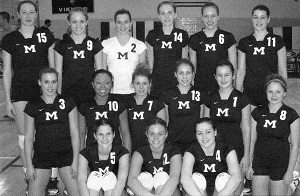
PHOTOS: (Top) Marysville's Ashley Eldridge (3) and Fruitport's Brynn Ray line up across from each other during the 2003 Class B Final at Western Michigan University. (2) The 1985 Marysville team was coach John Knuth's first. (3) The 1997 Marysville team won the school's first volleyball championship. (4) The 1999 Fruitport team met Marysville in a Class B Semifinal. (5) Fruitport coach Dan Potts (left) and John Knuth shake hands before the 2003 Final. (6) Knuth leaps in celebration during the 2002 Class B Final win. (7) Fruitport's 2005 team defeated Otsego in the Class B championship match. (8) Marysville took back Class B in 2006 with a five-set win over Grand Rapids South Christian.
Block Party: 2026 Girls Volleyball Week 8 Report
By
Geoff Kimmerly
MHSAA.com senior editor
October 14, 2026
Girls Volleyball District play begins in three weeks, and you won’t find any contenders slowing things down as we speed toward the beginning of the postseason.
Arguably this fall’s most prestigious tournament – the Beast of the East – will be played Saturday with all four state divisions sending ranked teams into the field, and the Upper Peninsula also is hosting one of its most competitive events this season, at Crystal Falls Forest Park. Several teams are attempting to put finishing touches on league championships, and many more have lined up other contenders as they prepare for the playoffs and the ultimatum of win to play again.
Records below are those reported and tracked on this website, and rankings referred to below reflect the latest polls posted by the Michigan Interscholastic Volleyball Coaches Association (MIVCA).
Week in Review
The countdown of last week’s five most intriguing results:
1. Bloomfield Hills Marian d. Farmington Hills Mercy (25-21, 25-23, 22-25, 25-17) After suffering two earlier losses to Mercy, Marian (28-3) took this match in four sets, clinched their Catholic High School League Tournament title and has taken over the No. 1 ranking in Division 1, sending the Marlins (20-4) to No. 2.
2. Parma Western d. Hanover-Horton (26-24, 25-17) Division 2 No. 3 Western’s 6-0 run through Hanover-Horton’s Karen Abbott Invitational pushed its record to 32-0 and also included wins over Division 3 No. 7 Grass Lake, No. 6 Traverse City St. Francis, Hudson, Brooklyn Columbia Central and Division 4 No. 1 Adrian Lenawee Christian, in addition to the Division 3 No. 10 Comets (21-7-5).
3. Midland Dow d. Saginaw Valley Lutheran (30-28, 20-25, 25-20) The Chargers (36-4-4) also handed Division 2 No. 4 Frankenmuth its first during this home quad, but the night’s most exciting set may have been the first one of this win over Division 3 top-ranked Saginaw Valley Lutheran (38-6-1).
4. Traverse City Central d. Grand Rapids South Christian (25-20, 25-18) The Trojans (22-2-1) finished 4-0 at the Hudsonville Unity Christian Invitational, with this sweep of the Division 2 No. 8 Sailors (22-7) the highlight but a three-set win over honorable mention Vicksburg also of note.
5. Roscommon d. Traverse City St. Francis (25-20, 25-15) These two top-10 teams in Division 3 locked up as part of a quad, with the No. 3-ranked and host Bucks (29-6-5) avenging last year’s loss to the No. 6 Gladiators (24-13-2).
Watch List
With an eye toward November, here are two teams in each division making sparks:
DIVISION 1
Clarkston (20-2) The Wolves have held down the No. 3 ranking in Division 1 since Sept. 8, trailing only Mercy and Marian after falling to both in August. Those are Clarkston’s only losses this season as it looks to bounce back from last year’s District exit against Oxford – which the Wolves defeated to start this season and again last week. A pair of wins over No. 8 Lowell and singles over No. 10 Grand Rapids Forest Hills Northern and No. 5 South Lyon East also pop off the page.
South Lyon East (25-5) The No. 5 Cougars’ most recent win also was the best of several memorable ones this fall, as they downed No. 2 Mercy in three sets last week after losing the first 25-12. They also have defeated No. 10 Forest Hills Northern twice, honorable mention Orchard Lake St. Mary’s and No. 9 Grand Haven once, and honorable mention South Lyon twice after the Lions ended East’s 2025 season in their District. Those two rivals are headed to the same District again next month.
DIVISION 2
Detroit Country Day (12-6-1) The Yellowjackets haven’t played as many matches as most contenders, but they’ve tested themselves against some of the state’s elite with losses to Division 1 No. 2 Mercy, top-ranked Marian and honorable mention St. Mary’s among others. The two-time reigning Division 2 champion is ranked No. 2 currently and tonight has an opportunity to avenge its Sept. 30 defeat against the Eaglets. Country Day also will see Division 1 No. 5 South Lyon East a second time Oct. 22 after winning their first matchup Sept. 3.
Marshall (23-9-1) The unranked Redhawks have navigated tough competition all season, going five sets before falling to No. 3 Parma Western in Interstate 8 Athletic Conference play, but defeating honorable mention Vicksburg, Division 3 No. 2 Plymouth Christian Academy, No. 4 Clinton and honorable mention Morley Stanwood and going 1-2 against Division 1 honorable mention Battle Creek Lakeview. Total, five defeats have come against teams ranked or honorable mention in Divisions 1 and 2.
DIVISION 3
Cass City (18-6-4) These Red Hawks have tested themselves substantially as they look next month to run their District title streak to six and potentially return to the season’s final weekend for what would be the fourth time this decade. Cass City went 2-2-1 at the opening Cadillac Invitational, 0-2-2 at the MI Elite Program Cup and 1-2-1 at the D3/D4 Showdown, facing elite and/or often much larger opponents at all three. The Red Hawks are otherwise 15-0 this fall.
Muskegon Western Michigan Christian (26-6) WMC matched up with a tough crew of larger opponents at the Unity Christian Invitational over the weekend and finished only 1-3 there. But the No. 5-ranked Warriors are otherwise 25-3 this season with a 5-0 day over a field that included honorable mention Hart and Fruitport in winning Mona Shores’ Best of the West, plus an earlier victory over Division 2 previously-honorable mention Fremont.
DIVISION 4
Atlanta (25-0) The Huskies are an honorable mention in this week’s poll and one of three teams statewide still undefeated. They’ve won Regional titles the last two seasons and this fall have lost only six sets. Atlanta went 5-0 winning all 10 sets during the Onaway Tournament and finished 6-0 winning all 12 sets it played at the Oscoda Invitational last month. The Huskies will travel Oct. 20 to face Hale, which delivered their only regular-season defeat of 2025.
Mount Pleasant Sacred Heart (23-6-3) The No. 2-ranked Irish have won nine of their last 10 matches, the lone loss during that time to Division 3 top-ranked Valley Lutheran, and they also defeated Division 4 No. 7 Ubly that day. Three losses total have come to Valley Lutheran, with the other three to Division 2 No. 8 North Branch, Division 3 No. 3 Roscommon and No. 9 Elk Rapids. Sacred Heart also can count a win over Division 4 No. 4 Traverse City Christian and a tie with No. 9 Crystal Falls Forest Park.
Can’t-Miss Contests
Be on the lookout for results of these matches and tournaments coming up:
Thursday – Grand Haven (26-8-1) at Hudsonville (28-3) – The best from the always-strong Ottawa-Kent Conference Red are the No. 9 Buccaneers and No. 6 Eagles, and Hudsonville won the first match Sept. 17 in three sets.
Thursday – Detroit Country Day (12-6-1) at Macomb Lutheran North (23-1) – The Nos. 2 and 6 teams in Division 2, respectively, face off in what could be a Regional Final preview.
Thursday – Elk Rapids (14-7-3) at Traverse City Christian (27-6) – The Division 3 No. 9 Elks and Division 4 No. 4 Sabres meet in one of northern Michigan’s most anticipated matchups of the season.
Saturday – Beast of the East at Trinity Health Sports Center – The field of 32 includes 18 teams currently ranked or receiving honorable mentions in Divisions 1-4, and a few others formerly in that group. Division 1 top-ranked Bloomfield Hills Marian and Division 2 No. 1 Grand Rapids Christian are among those taking the court.
Tuesday – Grand Rapids Forest Hills Central (11-18), Forest Hills Northern (22-8) at Grand Rapids Christian (22-3) – As noted above, the Eagles are ranked No. 1 in Division 2, and Forest Hills Northern is No. 10 in Division 1.
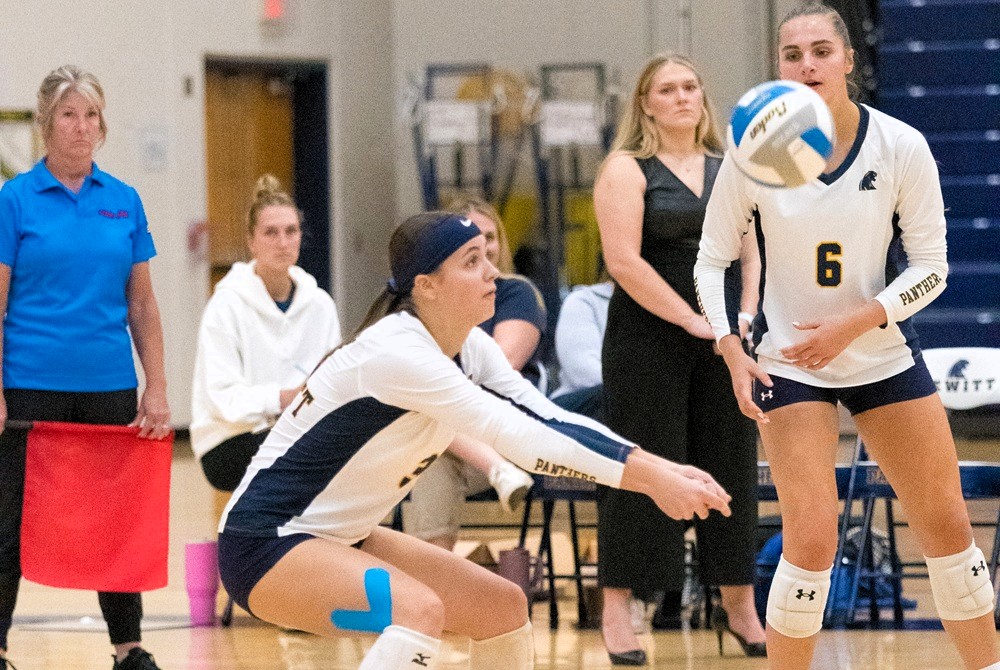
PHOTO (Top) DeWitt returns a volley during a match this season against Okemos. (Photo by TCP Photography.)