


Athletes: Prepare to Beat the Heat
August 4, 2014
By Geoff Kimmerly
Second Half editor
Despite unseasonably cool temperatures this summer in Michigan, high school athletes should prepare for the heat that usually accompanies August and the beginning of Michigan High School Athletic Association fall practices as they kick off next week.
Each year, the MHSAA provides information to its member schools to help them prepare for hot weather practice and game conditions in the late summer and early fall. Football practice can begin August 11, followed by first practices for all other fall sports August 13.
The topic of heat-related injuries receives a lot of attention at this time of year, especially when deaths at the professional, collegiate and interscholastic levels of sport occur, and especially since they are preventable in most cases with the proper precautions. In football, data from the National Federation of State High School Associations shows that nationally 41 high school players died from heat stroke between 1995 and 2013.
Many MHSAA schools this fall are expected to again follow the MHSAA’s Model Policy for Managing Heat & Humidity that directs schools to monitor heat index prior to and during activity and recommends actions based on those readings.
Also this school year, for the first time, the MHSAA is requiring all assistant and subvarsity coaches at the high school level to complete the same rules and risk minimization meeting requirement as high school varsity head coaches, or, in the alternative, one of several online courses designated for this purpose on MHSAA.com.
“It’s not an accident that causes severe heat illness and death. It’s a lack of attention to what should’ve been taking place, a lack of preparation,” said John E. “Jack” Roberts, executive director of the MHSAA. “We’re trying to communicate to our constituents that if we make the precautions that we should, plan as we should, we will have none of these tragedies in school sports.”
The MHSAA Representative Council adopted in 2013 the Model Policy for Managing Heat & Humidity that, while not mandated for member schools, has been adopted by many at the local level. The plan directs schools to begin monitoring the heat index at the activity site once the air temperature reaches 80 degrees and provides recommendations when the heat index reaches certain points, including ceasing activities when it rises above 104 degrees.
The model policy is outlined in a number of places, including the publication Heat Ways, which is available for download from the MHSAA Website. Heat Ways not only provides the model policy, but addresses the need for proper acclimatization in hot weather.
Heat, hydration and acclimatization also are again focuses of the MHSAA’s required preseason rules meetings for coaches and officials. The online presentation discusses the need for good hydration in sports, regardless of the activity or time of year.
The Health & Safety Resources page of the MHSAA Website has a number of links to different publications and information and a free online presentation from the National Federation of State High School Associations. Visit MHSAA.com, click on “Schools” and then on “Health & Safety Resources” to find the information.
Roberts said the first days of formal practices in hot weather should be more for heat acclimatization than the conditioning of athletes, and that practices in such conditions need planning to become longer and more strenuous over a gradual progression of time.
He added schools also must consider moving practices to different times of day, different locations, or change practice plans to include different activities depending on the conditions.
“I think all schools need to prepare themselves in these ways,” Roberts said. “They need to educate participants, parents and coaches about proper hydration and the dangers of practicing and competing when the heat and humidity are too high.”
Bedford Follows Mifsud's Hall-of-Fame Formula to 7-0 Start, SEC Red Title Game
By
Doug Donnelly
Special for MHSAA.com
October 15, 2026
The rumors of Dave Mifsud living across the street from Temperance Bedford High School or being able to see the school from his kitchen window are greatly exaggerated.

Mifsud, in his first year coaching the Kicking Mules, actually lives about five minutes from the stadium. And, no, he can’t see the glow from the Friday night stadium lights from his house.
All joking aside, Mifsud may have found the perfect spot to continue his hall of fame career. After stops at Dearborn, Parma Western, Monroe and Brownstown Woodhaven, Mifsud took over the Bedford program in January and has the Mules off to a remarkable 7-0 start heading into Friday night’s Southeastern Conference showdown with powerhouse Saline.
“I feel like I'm at home right now,” Mifsud said this week. “I feel working and coaching at Bedford, being around this community, I feel like I'm at home.”
The funny part is, he wasn’t looking for one.
Mifsud said he moved to Temperance about five years ago to be closer to his son and three grandchildren in Toledo. He became the head coach at Brownstown Woodhaven and thought he had found his last coaching stop.
“When I took the Woodhaven job, I said, ‘This is it – I’m not going to change jobs again.’ But I put a disclaimer on there – and that was unless the Bedford job opened up.”
This past offseason, it did.
Mifsud said the distance driving to and from Woodhaven was the difference.
“I was driving 39 miles each way to work and spending an awful lot of time in the car,” he said. “I didn’t get to enjoy as many community events as I wanted to be involved in, even just going to basketball games or baseball games and things like that. It was just too far from home. So, this job was definitely a big attraction to me.”
He was hired.
By no means was he taking over a bad program. Quite the opposite. Bedford has been a perennial playoff team – they’ve qualified 14 times since 2009 – and contended among the top half of the SEC Red most of those years.
When Mifsud arrived, however, he had a blank slate. He had to bring in an almost entirely new football staff, overhaul the offense, and create a new-look defense.
“I spent hours and hours and lots of late, late nights interviewing coaching candidates,” he said. “I didn’t really know any of them ahead of time. There was one coach, Sean Stephens, that I had met and talked to a couple of times, but really, I didn’t know any of them.
“The foundation was, the thing that I started off explaining to each and every one of them, was my philosophy and what my goals were and where I was coming from. I wanted them to know how we were going to treat the kids and treat the program.”
Football, he said, teaches great life skills and life lessons.
“Our No. 1 goal is for the kids to have the best memories and the most positive memories from their high school days as being part of the football program,” he said.
He hired coaches from Toledo and the Downriver area, a former Bedford player and one coach who was on a previous Bedford staff. He named a football operations coordinator to handle things like media requests and statistics.
The offense, he said, is a combination of all of the offenses he’s run over the years while building a solid resume at Dearborn and Parma Western.
“We adapted and evolved a little,” he said. “I think we’ve cleaned up some of the things we were doing at Woodhaven.
His defense was constructed with the help of Mike Parker, who had coached at Toledo Whitmer, one of the largest schools in northwest Ohio.
The formula has worked wonders. The 7-0 start is something even Mifsud didn’t see coming.
“Going into it, of course you have high hopes,” he said. “I feel like there was the hope or possibility of being 7-0, but there was also this reality that we could be 3-4 or 4-3. You just don’t know how games are going to play out and how kids are going to respond.”
The biggest win was probably the first, a 20-13 victory over Sterling Heights Stevenson.
“The kids played their hearts out that game, and a really great win,” he said.
What’s followed have been six more in much the same fashion.
“We’ve continued on with the thinking that we just need to go 1-0 each week,” he said. “We’ve had to battle and compete in each game.”
Not only did Mifsud have to create a new coaching staff, but few of last season’s ball carriers were back this fall. One who might have been expected to be a starting running back, for example, transferred to an Ohio school. Other players moved positions and into new roles.
Masyn Moran has emerged as the top ball carrier with 636 yards and 12 touchdowns over seven games. Luke Whetstone has thrown for 841 yards while completing 64 percent of his passes. He’s also rushed for more than 500 yards. Jaxson Lestock has 20 catches for more than 300 yards. The Mules offense has been balanced with 263 rushes and 100 passes.
Bedford’s 7-0 start is the first for the program since 2013 and just the third in school history. Mifsud said the same formula that got Bedford to this point is what he plans on using this week against the also-undefeated Hornets. The winner will own the SEC Red title outright.
“There are some really good kids at Bedford, and they have bought into and committed to the new coach and system,” he said. “The school community has been awesome.”
 Doug Donnelly has served as a news and sports reporter at the Adrian Daily Telegram and the Monroe News for 30 years, including 10 years as city editor in Monroe. He's written a book on high school basketball in Monroe County and compiles record books for various schools in southeast Michigan. He is now publisher and editor of The Blissfield Advance, a weekly newspaper. E-mail him at [email protected] with story ideas for Jackson, Washtenaw, Hillsdale, Lenawee and Monroe counties.
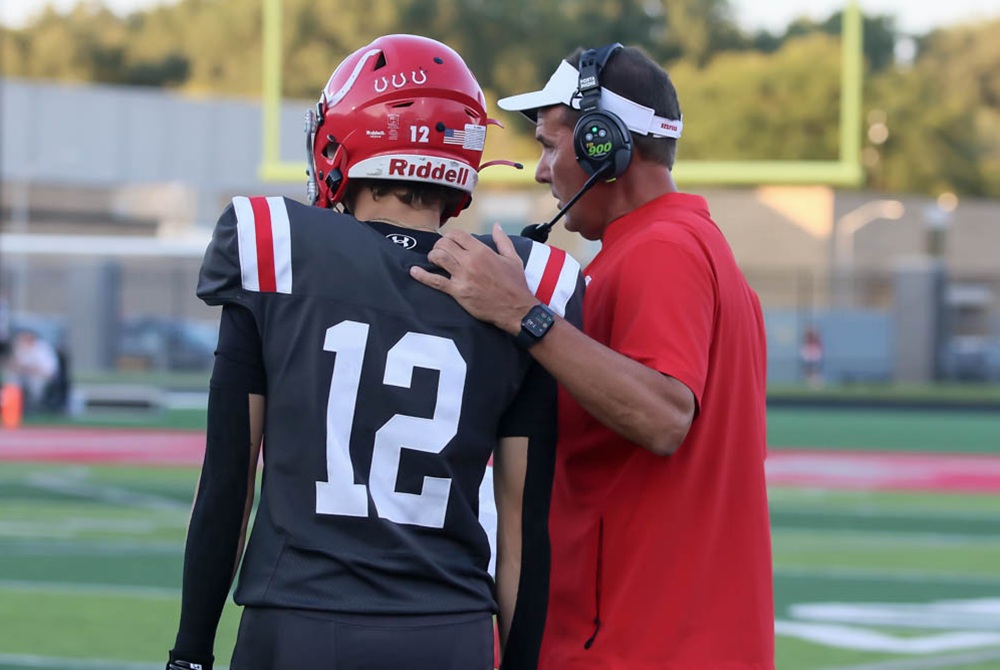
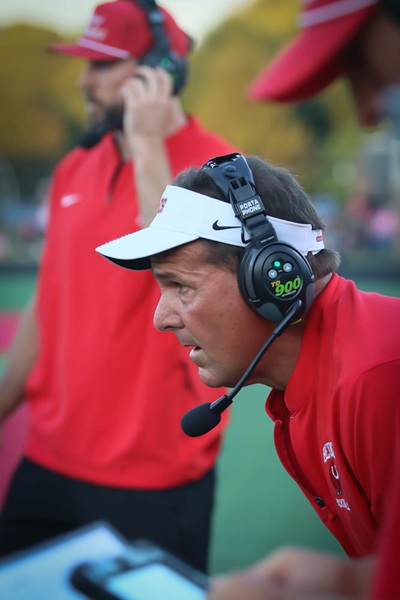
PHOTOS (Top) Temperance Bedford football coach Dave Mifsud instructs player Brady Boisselle during a game this season. (Middle) Mifsud monitors the action from the sideline. (Photos by Jaymee Beard/Temperance Bedford athletics.)