


Coaches Get U-M Concussion Training
July 24, 2012
Already administering a strong set of protocols addressing the removal and return to play of young athletes suspected of sustaining concussions in competition, the Michigan High School Athletic Association is further ramping up its concussion education efforts of coaches, student-athletes and parents as the 2012-13 school year approaches.
In partnership with the University of Michigan’s NeuroSport and the Pediatric Trauma Program at C.S. Mott Children’s Hospital, required online rules meetings for coaches and officials will include an education component illustrating the serious nature of concussions; recognition of the signs and symptoms; a review of return to play protocols; applicable MHSAA regulations; and downloadable co-branded resources from NeuroSport, as well as materials produced by a joint effort of the Brian Injury Association of Michigan, the Detroit Lions, the Center for Disease Control and the MHSAA.
This is the second year the MHSAA has included concussion education in its online rules meetings, which are annually viewed by nearly 20,000 coaches and game officials. This year, the Michigan NeuroSport Concussion Education - High School Coach edition, endorsed by the American Academy of Neurology last fall, has been modified for the MHSAA audience. The MHSAA will also promote the availability of the NeuroSport concussion education modules offered specifically for parents and coaches.
“These educational efforts, coupled with protocols addressing concussions when they take place on the field of play, put our schools in the best possible position to minimize the risk to young people,” said John E. “Jack” Roberts, executive director of the MHSAA. “We’re pleased to have our new partnership with University of Michigan NeuroSport and our ongoing partnership with the Brian Injury Association of Michigan which put our state at the forefront of addressing the critical health issue for interscholastic athletes.”
Roberts added that the same educational materials the Association has co-branded with its partners will also be used to help raise concussion awareness in other youth sports by other sponsors in the state.
“We are proud to partner with MHSAA and bring the most up-to-date concussion education to those on the frontline of athletics. Education is a vital component to improving player safety,” says Amy Teddy, injury prevention program manager at C.S. Mott Children’s Hospital. “We believe that ‘It takes a team to keep concussions on the sidelines.’ Parents, coaches, teammates, officials and athletic trainers all have a role in protecting athletes from serious injury.
“In addition to our coach modules, we recently launched our parent edition to help another member of the ‘team’ better recognize and understand concussion.” added Teddy, who also is director of education for Michigan Neurosport.
The NeuroSport online programs for parents, high school coaches and youth sports coaches is now available at http://www.MichiganNeuroSport.com. An online program for athletes will be available soon.
NeuroSport has also produced a 60-second public service announcement in which one of the state’s all-time winningest football coaches – John Herrington of Farmington Hills Harrison – talks about concussions. This video, along with a 30-second PSA recently updated by the MHSAA, “No Such Thing As Just Getting Your Bell Rung,” will be made available to media outlets in time for the coming sports season, and will be shown during MHSAA programming online and on cable television.
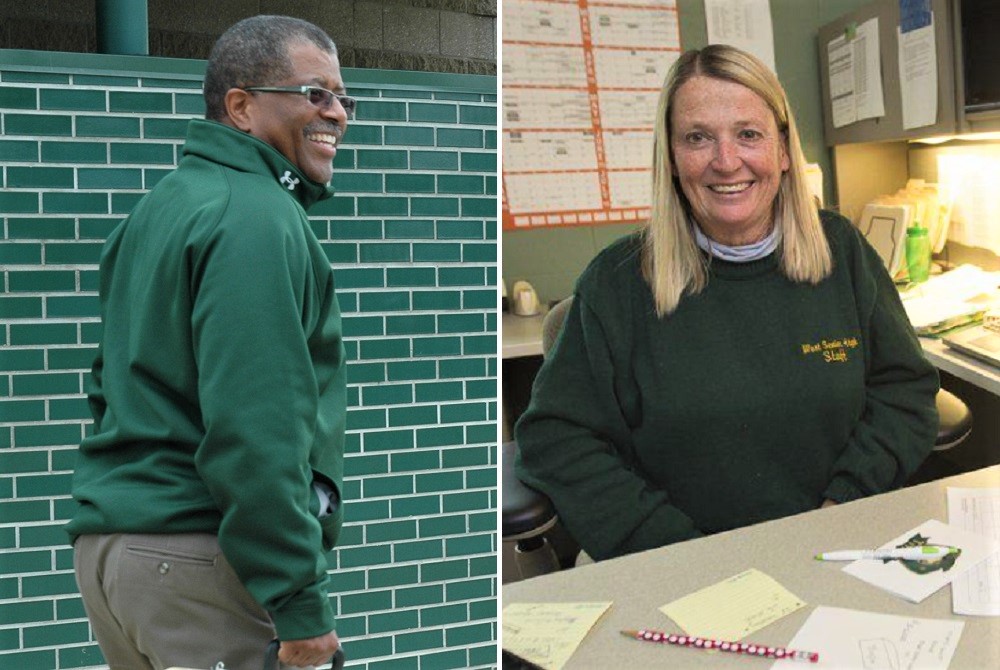
Forsythe Honorees Give All to Educational Athletics
By
Geoff Kimmerly
MHSAA.com senior editor
April 6, 2021
At one time during his four tenures as a Michigan high school athletic director, Leroy Hackley Jr. hosted MHSAA Finals in tennis and track & field and Districts in baseball, softball and soccer – all on the same day.
Another time, a neighboring athletic director hosting a Regional basketball game called because a dunk had just broken a backboard. An hour after Hackley took the call, the entire game had been moved to his school and play resumed.
Patti Tibaldi moved to Traverse City in 1995 already a high school and college basketball coaching legend and with district-wide administrative duties her next mission after also having served as a college assistant athletic director.
But with West High School set to open for the 1997-98 school year, and the most experienced applicant for the girls basketball varsity job having no more than seventh-grade experience, she stepped in again to build another program and make sure that generation of students received a great experience as well.
For nearly the entirety of their careers, and in multiple roles, Hackley and Tibaldi have been immersed in improving educational athletics. To celebrate their continued dedication and contributions over the years, they have been named honorees for the Michigan High School Athletic Association’s Charles E. Forsythe Award for 2021.
The annual award is in its 44th year and named after former MHSAA Executive Director Charles E. Forsythe, the Association's first full-time and longest-serving chief executive. Forsythe Award recipients are selected each year by the MHSAA Representative Council, based on an individual's outstanding contributions to the interscholastic athletics community.
Tibaldi spent 40 years in educational athletics at Comstock Park, Grand Rapids West Catholic and Traverse City West and also Aquinas College in Grand Rapids, serving as a coach, athletic director and physical education specialist. Hackley has spent the last 22 years of more than 40 in sports as an athletic director at Byron Center, Jenison, Grant and currently Muskegon Orchard View, as well as serving as an MHSAA-registered game official for 37 years. Both are recognized statewide among the best in their various fields.
“Patti Tibaldi has given more to athletics in our state at the small college and high school levels than perhaps anyone over the last 40 years,” MHSAA Executive Director Mark Uyl said. “She was a pioneer in small-school college basketball at Aquinas College, and my wife Marcy played against her there, and 30 years ago you could see that passion for women's sports that was unmatched. During her time at Traverse City West, her passion for kids was unchanged, and most of her students had no idea she had been that pioneer. She was a trailblazer for women in leadership positions in coaching and administration.
“Leroy and I were first-year athletic directors together in the same conference in 1999, and it's been a pleasure to watch him grow into one of the most respected voices over the last 22 years,” Uyl said. “At its core, athletics is a people business, and Leroy is all about those relationships. He's a guy who genuinely enjoys going to work every day.
Hackley has served as an athletic director first at Byron Center for five years, then Jenison for seven, Grant for three and Muskegon Orchard View for the last seven. Before those stops he served as director of health, recreation & wellness at Grand Valley State University for 14 years after serving as assistant director of recreation/intramurals for four years at Eastern Michigan University. His first administrative experience came while as a graduate assistant at the University of Iowa serving as supervisor of officials for the recreational services department. He’s also served as an adjunct professor in physical education at GVSU, Aquinas College and Muskegon Community College.
As well as hosting numerous postseason events, Hackley has served on eight MHSAA committees over the years and four years on its Representative Council. He’s been a registered MHSAA official in boys and girls basketball, softball, baseball, swimming & diving, volleyball, cross country and track & field over 37 years and has officiated every collegiate level of women’s basketball including Division I in the Mid-American Conference. He has officiated three MHSAA Basketball Finals and NCAA Division III and NAIA national championship games.
Just this week he changed his spring break plans to step in and host a Boys Basketball Quarterfinal and serve as a manager at MHSAA Semifinals on Wednesday and Thursday at Van Andel Arena in Grand Rapids.
“I’ve always wanted to step in because I know what it’s like when you need help. I’m one of those guys who doesn’t like to say no. I try to find a way to lend a hand wherever I can,” Hackley said. “I’ve always enjoyed sports; all my free times has been spent watching sports or playing sports, and I’ve been fortunate enough to have a wife who enjoys watching sports. Pretty much my whole live has been centered around recreation and athletics. Coming from a big family (as one of 13 children), that’s one of the things we always did.”
Tibaldi spent 40 years in education and athletics at the high school and college levels, beginning first at Comstock Park from 1973-75 before spending the next six years at Grand Rapids West Catholic where she led the girls basketball team to the Class B championship in 1979 and the softball team to four league titles.
Simultaneously for the final three years at West Catholic, Tibaldi also served as women’s basketball coach, then also softball coach at Aquinas College, where she also became assistant athletic director in 1981. While at Aquinas she led the Saints to a 340-136 record on the court and the National Catholic Basketball Championship in 1984.
Tibaldi then moved to Traverse City Area Public Schools, first as the district’s K-12 physical education coordinator but eventually in multiple physical education specialist roles. She also was named the first varsity girls basketball coach at the new Traverse City West High School from 1997-2011 and served as West’s athletic director from 2004 until retiring in December 2014. As coach, she led the Titans to multiple league and District championships and the final few hundred wins of more than 800 total on high school and college basketball courts.
She’s also played a prevalent role in helping make MHSAA policy over her decades. She’s served on a variety of MHSAA committees, including the Basketball Committee, and served in multiple roles with the Basketball Coaches Association of Michigan including as president. She also served at the collegiate level on the NAIA Executive Committee, the Wolverine-Hoosier Athletic Conference (WHAC) Executive Council and as part of NAIA Women in Sports Leadership program and the Michigan Women’s Foundation Tribute to Women Athletes Committee.
Tibaldi has received various honors for her coaching and administrative contributions, including the MHSAA’s Women In Sports Leadership Award in 2011. She was The Associated Press’ Class B Coach of the Year in 1981 and twice earned special mention, and she’s a member of the BCAM Hall of Fame. She also was named state Coach of the Year for basketball by the National Federation of State High School Associations (NFHS) in 2004, and named Regional Athletic Director of the Year by the Michigan Interscholastic Athletic Administrators Association (MIAAA) in 2011. She also was named BCAM’s College Coach of the Year in 1988 and is a member of the NAIA’s National Coaches Hall of Fame. She earned multiple NAIA District Coach of the Year awards for both basketball and softball and was the WHAC Coach of the Year four times.
“To me, teaching life lessons is everything,” Tibaldi said. “I had great kids, and it makes me proud to see where they’re at – the things they’re doing are mind-boggling, and it makes me really proud. The thing they all tell me is they learned what hard work was, about teamwork and persistence, and resilience. That to me is what’s valuable.”
Tibaldi also co-authored and was granted a $1 million federal grant as part of the Every Step Counts program to provide the Traverse City community with funds to fight obesity, and wrote and coordinated a USDA-funded Michigan Fitness Foundation grant for promotion of healthy school environments in five high-needs schools. She’s been an active volunteer with the Boys and Girls Club and presented at the annual Girl-Tech Conference to encourage young women to choose non-traditional careers. She continues to do work with the Michigan Fitness Foundation.
Tibaldi is a graduate of the former Redford St. Mary’s High School in Detroit and earned her bachelor’s degrees in English and physical education from Aquinas in 1973. She was named Aquinas’ Outstanding Alumni of the Year in 1995 and is a member of that school’s Hall of Fame as well as Grand Rapids West Catholic’s and the Grand Rapids Sports Hall of Fame.
Hackley is a graduate of Culpeper County High School, located southwest of Washington, D.C. He earned his bachelor’s degree in recreation administration from Bethany College in Kansas and his master’s in recreation education from Iowa.
A member of the West Michigan Officials Association (WMOA) and National Association of Sports Officials (NASO), Hackley was co-founder and has been co-director of the Michigan Intramural and Recreation Sports Association (MIRSA) basketball officials camp and served on six committees as part of the National Intramural and Recreation Sports Association (NIRSA). He also was appointed to the Board of Directors of the West Michigan Sports Commission.
He’s also volunteered with Michigan Special Olympics, Georgetown Little League, National Kidney Foundation and Habitat for Humanity, served three years on the Board of Directors for the Downtown Metro YMCA in Grand Rapids and nine years on the Board of Directors at Bethany College.
Hackley was named WMOA Athletic Director of the Year in 2011 and an MIAAA Regional Athletic Director of the Year in 2018. He also has received MIRSA’s Tom Jones Service Award.
Past recipients of the Charles E. Forsythe Award
1978 - Brick Fowler, Port Huron; Paul Smarks, Warren
1979 - Earl Messner, Reed City; Howard Beatty, Saginaw
1980 - Max Carey, Freesoil
1981 - Steven Sluka, Grand Haven; Samuel Madden, Detroit
1982 - Ernest Buckholz, Mt. Clemens; T. Arthur Treloar, Petoskey
1983 - Leroy Dues, Detroit; Richard Maher, Sturgis
1984 - William Hart, Marquette; Donald Stamats, Caro
1985 - John Cotton, Farmington; Robert James, Warren
1986 - William Robinson, Detroit; Irving Soderland, Norway
1987 - Jack Streidl, Plainwell; Wayne Hellenga, Decatur
1988 - Jack Johnson, Dearborn; Alan Williams, North Adams
1989 - Walter Bazylewicz, Berkley; Dennis Kiley, Jackson
1990 - Webster Morrison, Pickford; Herbert Quade, Benton Harbor
1991 - Clifford Buckmaster, Petoskey; Donald Domke, Northville
1992 - William Maskill, Kalamazoo; Thomas G. McShannock, Muskegon
1993 - Roy A. Allen Jr., Detroit; John Duncan, Cedarville
1994 - Kermit Ambrose, Royal Oak
1995 - Bob Perry, Lowell
1996 - Charles H. Jones, Royal Oak
1997 - Michael A. Foster, Richland; Robert G. Grimes, Battle Creek
1998 - Lofton C. Greene, River Rouge; Joseph J. Todey, Essexville
1999 - Bernie Larson, Battle Creek
2000 - Blake Hagman, Kalamazoo; Jerry Cvengros, Escanaba
2001 - Norm Johnson, Bangor; George Lovich, Canton
2002 - John Fundukian, Novi
2003 - Ken Semelsberger, Port Huron
2004 - Marco Marcet, Frankenmuth
2005 - Jim Feldkamp, Troy
2006 - Dan McShannock, Midland; Dail Prucka, Monroe
2007 - Keith Eldred, Williamston; Tom Hickman, Spring Lake
2008 - Jamie Gent, Haslett; William Newkirk, Sanford Meridian
2009 - Paul Ellinger, Cheboygan
2010 - Rudy Godefroidt, Hemlock; Mike Boyd, Waterford
2011 - Eric C. Federico, Trenton
2012 - Bill Mick, Midland
2013 - Jim Gilmore, Tecumseh; Dave Hutton, Grandville
2014 - Dan Flynn, Escanaba
2015 - Hugh Matson, Saginaw
2016 - Gary Hice, Petoskey; Gina Mazzolini, Lansing
2017 - Chuck Nurek, Rochester Hills
2018 - Gary Ellis, Allegan
2019 - Jim Derocher, Negaunee; Fredrick J. Smith, Stevensville
2020 - Michael Garvey, Lawton
PHOTOS: Muskegon Orchard View athletic director Leroy Hackley Jr., left during his time at Jenison High, and retired Traverse City West athletic director and basketball coach Patti Tibaldi are the 2021 Charles E. Forsythe Award honorees. (Hackley photo by Rob Kaminski; Tibaldi photo courtesy of Traverse City Record-Eagle.)