


Strategize for First Parent Meeting
November 12, 2014
 By Scott Westfall
Coaches often cite parents as one of the most uncontrollable and frustrating aspects of coaching.
Let’s face it, when this relationship goes south, there can be pent-up frustration and hard feelings between the two parties which can result in a negative experience for everyone involved – especially the player who often is caught in the middle.
Establishing positive relationships with parents should happen from the moment you stand in front of them at your annual parent meeting.
Throughout this meeting parents will be asking themselves: “Can I trust this coach with my child?” “Will this coach be fair in his/her decisions?” and “Will this coach always have my child’s best intentions in mind?”
In order to put them at ease, you must do everything possible to establish yourself as a person of integrity who is altruistic and 100 percent trustworthy. Below is a coaching checklist that will help you establish trust and credibility with your team’s parents:
- Transparency – Do things openly and share information as much as possible. If something bad happens on your team, be sure that you do not sweep it under the rug. Be open and consistent with your decisions, and always follow through on what you say you are going to do.
- Demonstrate Respect – Be polite and sincere with parents and let your actions show that you care. Sometimes the little things you do will resonate louder than the big things.
- List Expectations – Have high expectations for the conduct of both the players and parents in your program. List these expectations, distribute them, and then talk about them with the parents. Meanwhile, let them know what they can expect from you in return (proper dress attire, appropriate language, great sportsmanship, impeccable conduct, proper treatment of game officials, etc.).
- Express Loyalty – As often as possible, be sure to praise your players, assistants, and the people associated with your program. Be sure that you never take credit for other people’s work, and remember to use the word “we” as often as possible.
- Be Accountable – This means taking the blame for bad results– even when it wasn’t necessarily your mistake. Admitting when something goes wrong on your watch doesn’t mean that you are a bad coach or you’ve lost control of your program. True leaders are accountable for the mistakes that happen in their programs.
- Deliver Results – This is not necessarily wins and losses. Instead, deliver results on the things that really matter, such as developing a respectable team, coaching players with all passing grades and having players who do not get into trouble or break the law.
No parent meeting would be complete without a healthy dose of paperwork. To make it easier for parents to keep these papers organized, try to color-coordinate the forms and go over them slowly one at a time. Below are the basic documents you should supply at the parent meeting (Note: Try to also have these documents accessible on your team’s website):
- Coaching Philosophy – Drafting a coaching philosophy will allow parents to better understand who you are and the reasons why you coach. In this document, be sure to include your fundamental beliefs along with your personal approach to coaching. (Note: Be honest in this section – Do not advertise yourself as one type of coach, but then act like another.) Include a lot of “I statements” such as, “I coach for the purpose of teaching life lessons,” “I believe that student comes before athlete,” and, “I am demanding but never demeaning.” Developing and drafting a coaching philosophy not only gives parents insight into you and your program, but also gives you an opportunity to reflect upon why you do things the way you do.
- Team Policies – This is perhaps the most important document you will distribute to your team’s parents. It should list all team rules pertaining to player conduct, grades, eligibility, attendance, discipline, communication, and of course playing time! Include statements such as, “Playing time is earned – not given,” “All decisions will be made based on what is best for the team,” and, “If you have a problem, please talk to the coach.” Inform parents that student-athletes will receive equal opportunities but not equal things. These opportunities include instruction, off-season strength and conditioning programs, and support for their classes. How well student-athletes take advantage of these opportunities (attendance, focus, effort, attitude, and self-discipline) often dictates their levels of success. (Note: Before distributing this document, make sure that your school’s administration/athletic director supports your team policies 100 percent).
- Student-Athlete Character Contract – While many schools have had an athletic code of conduct in place for years, teams today are including an additional written set of norms for players to follow. A character contract outlines how players agree to conduct themselves as a person, student, and athlete. If you want to create more buy-in, consider drafting this contract each season with your players!
- Parent Pledge Form – This document establishes the expectations you have for the parents in your program. Be sure that you include expectations for their conduct at games, having a positive disposition around the team, the treatment of players on your team along with the treatment of your opponents, letting the coaches coach, and how to act toward game officials.
- Team Calendar – Be sure to include detailed information on the times and locations of all practices, team events, games, and places that players need to be. If changes are made to the team calendar throughout the course of the season, be sure you inform parents through several forms of communication (a printed note sent home, an announcement on the team website, email list, social media, etc.).
- Athletic Physicals – While most doctors’ offices have a copy of these blank forms on hand, it is convenient for parents to have access to them through your school.
- Athletic Fees (if you are in a “pay for play” district) – Some districts have a mandatory athletic participation fee, while other districts do not. Some districts have a waiver form for students who are on free/reduced lunch. In any of these cases, make sure that you are on top of this information so you can properly inform your team’s parents at the meeting.
- Conflict Resolution – The occasional conflict is almost inevitable while working in an emotionally charged environment such as athletics. However, conflicts can often be avoided or at least more easily resolved through proper forms of communication.
1. Inform parents that you are always willing to listen to their concerns; let them know that you would prefer they address an issue with you, rather than taking their frustrations to the next game and venting to anybody in the bleachers who is willing to listen.
2. In in your team documents consider a statement such as, “The best tool we have in our relationship is an open line of communication. My door is always open, and so is my mind.”
3. Finally, be sure to let them know that if they are upset about something to not send it through email. Email is good for information, but not communication. Try to communicate and resolve conflicts in person as much as possible.
Once you have established trust and credibility with your team’s parents, you can start building the relationship. Caution: Building a relationship with your team’s parents is not developing close friendships with them. Becoming close friends with parents can actually lead to bigger problems as you open yourself to criticism of playing favorites.
Instead, build working relationships, generated through mutual respect and understanding for each other’s position in the quest of helping the young individual become a successful student-athlete. These working relationships help parents understand their optimal level of involvement, such as where and how they can fit into your program. Below are some tips for building working relationships with parents:
- Learn their names and where they work.
- Learn what the family likes to do when they are outside of the school setting.
- Invite them to a team event such as a team picnic, fundraiser, or team trip.
- Ask parents for help with certain jobs. Many parents appreciate being asked to help with team functions as it gives them an opportunity to get to know other parents and makes them feel like they matter.
- Call them at least once per season to say hello, report on their child’s progress, and ask if there is anything you can do to be of assistance.
- Offer additional support for their child. Helping the student-athlete outside of coaching with things such as academics and typical teen issues shows that you care.
- Offer support to the parents as well. If they are struggling to get a message across to their child, oftentimes a coach sending or reinforcing the same message makes all the difference. As a coach you hold a powerful platform with your student-athletes; use it to help with their development and maturity whenever possible.
Establishing yourself as a trustworthy and credible coach is the first step in getting parents to buy into your program. Meanwhile, providing parents with sufficient information will help them feel like you are keeping them informed and want them as a partner in your program.
Creating working relationships with parents takes time, but will be the cornerstone in establishing a positive experience for the years their children are involved with your program. While some parents may have a different background or mindset, listing your expectations will help them better understand your team’s culture and how they can fit in. If done right, these positive working relationships should alleviate much of your coaching frustration and pay tremendous dividends in the future.
Scott Westfall previously spent 10 years as a teacher, coach, and athletic director in Fort Collins, Colo. He currently is working on his Doctorate at Michigan State University, with an emphasis in Sport Psychology and Athletic Administration, and assisting the MHSAA with its student leadership programs. Westfall is a former athlete who participated in football, wrestling, tennis and cross country at the high school level, and rugby at the collegiate level. He can be reached at [email protected].
Niles' Arnold Remembered as Teacher & Leader, 'Doing Exactly What He was Meant To Do'
By
Scott Hassinger
Special for MHSAA.com
January 13, 2026
NILES – Throughout his 22-year career coaching varsity girls basketball at Niles High School, Jim Arnold required one thing from his players.
 Just have fun.
"Jim always stressed to his players that the one thing he wanted them to do when on the floor was to just have fun playing the game," said George Brawley, who served 15 seasons as one of Arnold's assistant coaches at various levels.
Arnold, 81, died Dec. 9 following an extended illness.
But throughout his career, Arnold's teams did much more than just enjoy themselves. The Benton Harbor native built a highly-successful program at Niles, where he achieved an overall win-loss record of 360-139 from 1986-2008, with 19 winning seasons. Under Arnold's watch, the Vikings captured seven conference titles, 10 District championships – including nine straight from 1997-2005 – and five Regional crowns.
Among Arnold's other accomplishments were being named Class B Coach of The Year by The Associated Press in 1998 and receiving honorable mention in 1997, along with selection by the Basketball Coaches Association of Michigan as Region 5 Coach of the Year in 2002 and 2004. He was also named conference Coach of the Year seven times and received the Herb Quade Memorial Sportsmanship Award for the 2002-2003 season.
Arnold also coached Niles to back-to-back District championships in softball in 1993 and 1994.
As young athlete himself, Arnold excelled on the baseball diamond. A successful player while at Benton Harbor, he also played on Twin City American Legion teams and was known as a team captain and a coach on the field. Arnold later had an invitation to try out at the professional level with the Baltimore Orioles, but an injury ended his pursuit of that dream.
Arnold later played third base for Bargain Center, a slow-pitch softball team that won a regional championship and went on to play in the national title game in St. Louis, Mo.
 His daughters Sonya and Allison were among the athletes that Arnold mentored during his coaching career. Sonya (Martinez), his oldest daughter, played for her father in eighth grade.
"He made the game fun, and you wanted to do your best because you didn't want to disappoint him. He poured his heart into each and every practice and game because preparation mattered to him. He demanded excellence, and every player became better because of his coaching ability," said Martinez, a 1986 Niles graduate.
Allison (Clay) his youngest daughter, played on the 1990 Niles varsity squad that finished 25-1, winning conference, District and Regional titles. She is a 1991 graduate.
"It was awesome playing for my dad. Some of my best memories in my life were during that time,” Clay said. “He had high standards and inspired others to be the best version of themselves. He put his heart and soul into what he did, and I had a front-row seat to that."
Linda Arnold has fond memories as a coach's wife.
"I loved watching my husband coach because of the joy it brought him. His passion, intensity and the love he had for his players was genuine,” she said. “It was more than a game. It was more about developing players in the area of discipline, teamwork and giving your all. Even in the busiest part of the season, he always made me feel like a priority. I didn't just watch a coach. I watched a man doing exactly what he was meant to do.
"My husband coached with passion, but he loved his family with intention. My girls would go to his practices and we all attended his games, and we had the team over for team dinners. His players were a part of our extended family. He made sure we felt a part. He was the best coach in the world, and he was mine."
Jim Arnold was highly respected by his coaching peers. He was kind and treated everyone with dignity. The community of Niles knew what he stood for and they knew his standards were high. He was admired for his preparation and understanding of the game as well as his commitment to doing things the right way. He was strict but fair and treated everyone the same, whether you were the star player or last one off the bench, Martinez explained.
"Developing his players' character was far more important to him than winning," she said. "Dad lived what he taught. He modeled humility, hard work and lived a life of integrity. He made people better by being a part of their lives."
When Jim Arnold first began his junior high teaching career in Niles, he also coached the boys junior high basketball team. There were no girls basketball teams at the time, so a girl tried out for the boys team. She was good enough to make the team, so Arnold kept her. The following school year, the principal asked Arnold to organize a girls team – and the rest was history.
Former Niles varsity girls basketball coach Jessica Johnson, a teammate of Clay’s, recalls the experience of playing for Coach Arnold.
 "Coach Arnold taught us discipline, resilience and always required 110 percent effort from you. He would instill confidence in you while still holding you accountable," said Johnson, now an assistant women’s basketball coach at Southwestern Michigan College.
Johnson recalls Arnold's use of comic strips as a teaching tool to help his players improve upon their mistakes.
"If you had a game where you didn't shoot very well or took questionable shots, he would place pictures of bricks in the gym the day following the game," Johnson said.
"Coach Arnold went out of his way to build that relationship and trust with his players. He gave us lessons that extended way beyond the court that made us better people."
Mark Haase, a Niles alumnus and the current Vikings head varsity boys basketball coach, also had the privilege of playing for Arnold.
"I played freshman basketball for Coach Arnold. It was one of the most disciplined and well-conditioned teams I ever played on. He ran a tight ship, but it was done out of love and concern for his players. He has a great family and is a Niles legend," Haase said.
Niles athletic director Matt Brawley referred to Arnold as an amazing teacher, coach and individual in the school and community.
"Coach Arnold would never ask you to do anything he wouldn't do. He was very structured and expected a lot out of his players, and he got results without excuses,” Brawley said. “He was a true leader of Niles athletics. He was an unbelievably kind and humble individual.”
 Scott Hassinger is a contributing sportswriter for Leader Publications and previously served as the sports editor for the Three Rivers Commercial-News from 1994-2022. He can be reached at [email protected] with story ideas for Berrien, Cass, St. Joseph and Branch counties.
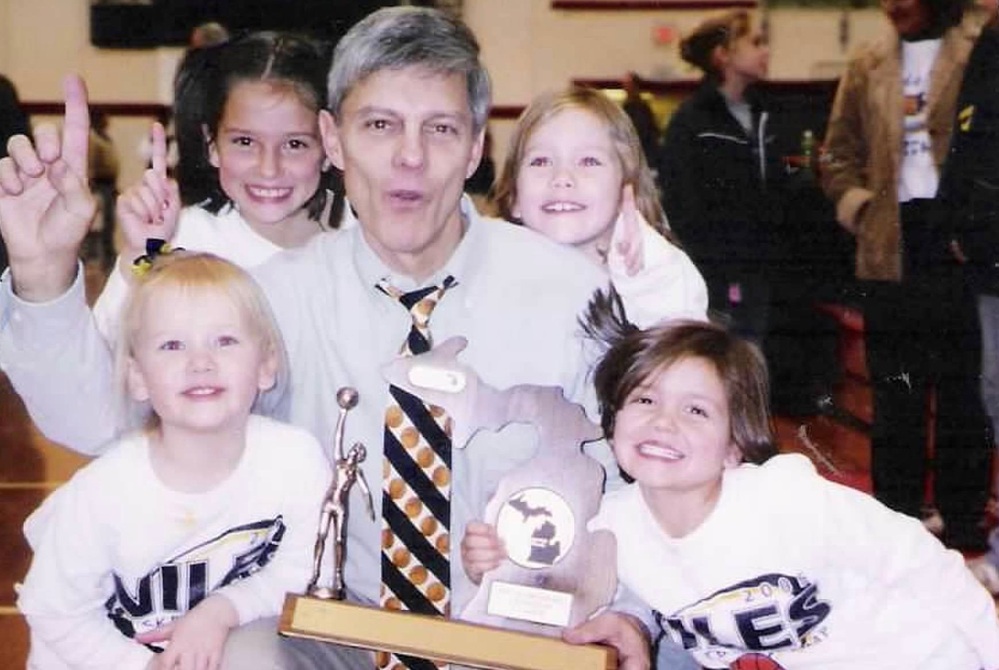
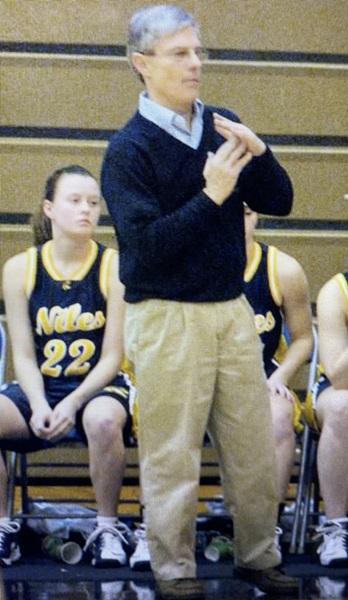
PHOTOS (Top) Jim Arnold poses for a photo with his granddaughters following a Niles girls basketball game. (Middle) Arnold signals for a timeout. (Below) Linda and Jim Arnold, seated (middle) take a photo with their daughters and their families. (Photos courtesy of the Niles athletic department and Arnold family.)