

New Math: Division & Multiplication Problems
July 25, 2017
By Jack Roberts
MHSAA Executive Director
This is the second part in a series on MHSAA tournament classification, past and present, that will be published over the next two weeks. This series originally ran in this spring's edition of MHSAA benchmarks.
High school tournament classifications went viral before there was social media and most of us knew what “viral” meant.
Much as a virus infects computers today or has created epidemics of disease around the world for centuries, high school tournament classification – once introduced – tends to spread uncontrollably. Once started, it tends to keep expanding and rarely contracts.
While we are still some distance from providing every team a trophy as a result of expanding high school tournament classification across the country, there is criticism nevertheless that we are headed in that direction – a philosophy which is supposed to exist only in local youth sports for our youngest children.
Michigan could be blamed for all this. Michigan is generally accepted as the first state to provide different classifications for season-ending tournaments for different sized schools. It started a century ago. Today, every state has various classifications for its tournaments in most if not all sports. And it is a bit ironic that Michigan – creator of the classification chaos – more than most other states has kept the number of tournament classes or divisions under control.
Yes, there is evidence that tournament classifications have expanded over the years in Michigan, especially with the relatively recent introduction of tournaments in football and the late 1990s’ move from classes to divisions in most MHSAA tournaments. But the MHSAA Representative Council has held true to its word when it expanded the playoffs for football from four classes to eight divisions: this is needed because of unique factors of football, factors that exist in no other sport; and all other sports should be capped at a maximum of four classes or divisions.
Kentucky is the preeminent defender of single-class basketball. All of its 276 high schools compete for the single state championship for each gender. In Indiana, there are still open wounds from its move in 1998 from one to four classes for its 400 schools in basketball.
Multi-class tournaments have tended to increase the number of non-public school champions, which some states are trying to lower through enrollment “multipliers,” and also tend to increase the number of repeat champions, which some states are trying to affect with “success factors” which lift smaller schools into classifications for larger schools if they take home too many trophies.
While there is considerable evidence that state tournaments do as much bad as good for educational athletics, state associations persist in providing postseason tournaments because, on balance, the experiences are supposed to be good for student-athletes. And once we reach that conclusion it is just a small leap to believe that if the tournaments are good for a few, they must be better for more – which leads to creating more and more tournament classifications. One becomes two classes, then three, then four and so forth.
While the argument is that more classifications or divisions provides more students with opportunities to compete and win, it is undeniable that the experience changes as the number of tournament classifications expands. It is not possible for state associations to provide the same level of support when tournament classifications expand to multiple venues playing simultaneously. For example, there is less audio and video broadcast potential at each venue, and less media coverage to each venue. Focus is diluted and fans diminished at each championship.
No one can argue reasonably that today's two-day MHSAA Football Finals of eight championship games has the same pizazz as the one-day, four-games event conducted prior to 1990.
In some states the number of divisions has grown so much that it is difficult to see much difference between the many season-ending state championship games and a regular-season event in the same sport.
It is a balancing act. And Michigan has been studying that balance longer than any other state, and charting a steadier course than most.
Addition by Division
The shift to Divisions for MHSAA Tournament play in numerous sports has added up to a greater number of champions for teams and individuals across the state. Following are the sports currently employing a divisional format, and the procedures for determining enrollment and classification.
In 23 statewide or Lower Peninsula tournaments, schools which sponsor the sport are currently divided into nearly equal divisions. They are:
- Baseball - 4 Divisions
- Boys Bowling - 4 Divisions
- Girls Bowling - 4 Divisions
- Girls Competitive Cheer - 4 Divisions
- LP Boys Cross Country - 4 Divisions
- LP Girls Cross Country - 4 Divisions
- LP Boys Golf - 4 Divisions
- LP Girls Golf - 4 Divisions
- Ice Hockey - 3 Divisions
- Boys Lacrosse - 2 Divisions
- Girls Lacrosse - 2 Divisions
- Boys Skiing - 2 Divisions
- Girls Skiing - 2 Divisions
- LP Boys Soccer - 4 Divisions LP
- Girls Soccer - 4 Divisions
- Girls Softball - 4 Divisions
- LP Boys Swimming & Diving - 3 Divisions
- LP Girls Swimming & Diving - 3 Divisions
- LP Boys Tennis - 4 Divisions
- LP Girls Tennis - 4 Divisions
- LP Boys Track & Field - 4 Divisions
- LP Girls Track & Field - 4 Divisions
- Wrestling - 4 Divisions
Lists of schools for each division of these 23 tournaments are posted on MHSAA.com approximately April 1. Listings of schools in Upper Peninsula tournaments for their sports are also posted on MHSAA.com. The lists are based on school memberships and sports sponsorships in effect or anticipated for the following school year, as known to the MHSAA office as of a date in early March.
In football, the 256 schools which qualify for MHSAA 11-player playoffs are placed in eight equal divisions annually on Selection Sunday. Beginning in 2017, the 8-player divisions will be determined in a like manner on Selection Sunday as well, with 32 qualifying schools placed in two divisions.
Schools have the option to play in any higher division in one or more sports for a minimum of two years.
The deadlines for "opt-ups" are as follows:
- Applications for fall sports must be submitted by April 15
- Applications for winter sports must be submitted by Aug. 15
- Applications for spring sports must be submitted by Oct. 15
Subsequent to the date of these postings for these tournaments, no school will have its division raised or lowered by schools opening or closing, schools adding or dropping sports, schools exercising the option to play in a higher division, or approval or dissolution of cooperative programs.
When the same sport is conducted for boys and girls in the same season (e.g., track & field and cross country), the gender that has the most sponsoring schools controls the division breaks for both genders.
Significance of Historic Run, Relationships Formed Live On for 1973 Unity Champs
By
Dean Holzwarth
Special for MHSAA.com
August 7, 2026
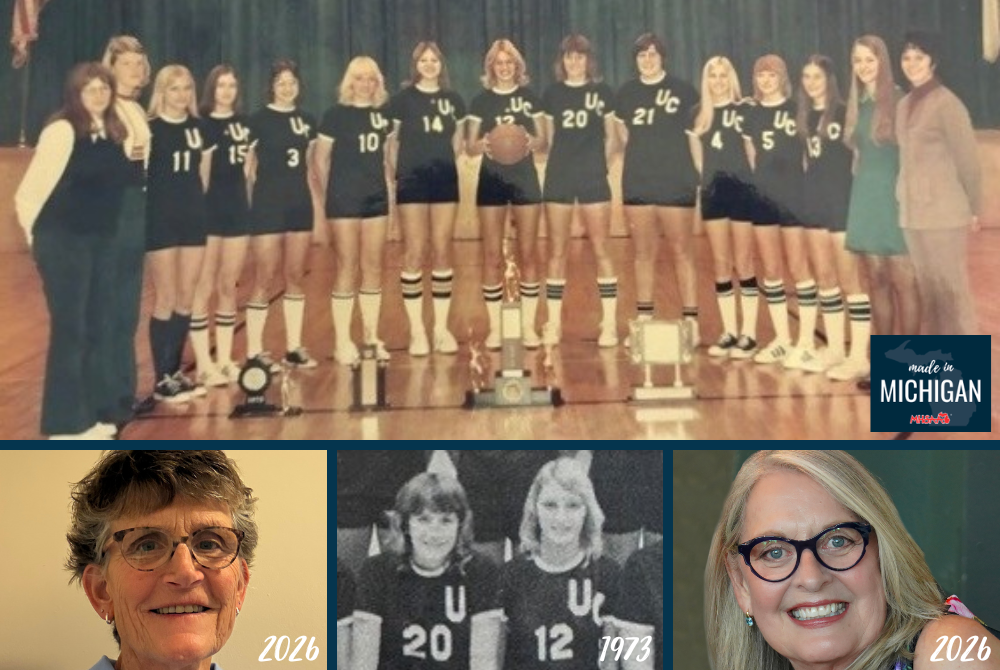
It has been more than five decades, but Kim Hansen and Marcia (Visser) Beutel can still recall certain moments from a historic night in mid-December when their Hudsonville Unity Christian girls basketball team accomplished a tremendous feat.
 On Dec. 15, 1973, at East Kentwood High School, the teammates helped the Crusaders win the first MHSAA Girls Basketball Finals championship in Class B.
Unity Christian defeated Saginaw MacArthur 49-45 before a crowd of 1,000.
“i just remember the team, the bus ride out there, and I remember just how excited we were to be together and what we had accomplished as a group,” Hansen said. “Our parents and friends were such big supporters through the whole process, and when I think back I see faces of pure joy.”
A total of 629 schools participated in that first tournament, which like now lasted three weeks and was divided into four classifications.
Cindy Masselink scored 17 points and Deb Aukeman added 16 points to lead the Crusaders to the championship win.
“For us, it was an excitingly significant day because we had been working hard throughout the season, and we, as women, could be the first winners of a state championship for our school and the state,” Beutel said. “A lot of us had been playing together since the sixth grade, and that camaraderie, that friendship, that teamwork and the work we had put in was going to end with a state championship.
“We were very blessed to be there, and we also knew that we were pioneers and trailblazers in the game.”
The Crusaders consisted of 11 girls, three managers and head coach Susan Contant.
An interesting sidenote from the Class B title game: As the home team, Unity Christian was to wear white uniforms. But the Crusaders didn’t own those.
“There were limited resources for women's sports back then so we had to wear the boys uniforms for the state championship,” Beutel said. “They didn't fit well so we had to wear T-shirts underneath them.”
One thing the 1973 squad possessed was size, which proved to be a benefit as the 3-point shot didn’t yet exist.
“We took each tournament game as it came to us and just kind of did our thing,” Hansen said. “I look back at our pictures, and we were huge. We had a starting five of 6-foot plus, and we were a big team. That definitely worked in our favor, and I really don't think that we were going to be denied.”
Beutel and Hansen, both 69, are organizing a night to recognize this special group of women.
 It will take place Dec. 11 during a Unity Christian girls and boys varsity game night.
“We are all much older and lives have happened and we are in different places, but I’m hoping that many of the teammates will come back for that,” Hasen said. “I know our head coach and her husband are going to come back for that, and I think that is just amazing. I haven't seen Sue since 1973.
“I got to see some of my teammates when we were recognized at Central Michigan for the 30-year anniversary, and I’m looking forward to seeing who is going to be able to make it and hoping that many do.”
Beutel lives in Toronto with her husband, Robert. She recently visited her old high school.
“They had a list of all the state championships on the wall, and the first one was us,” she said. “That was very emotional for me to see that, to see that recognition.”
Beutel met her husband at the University of Michigan, and they had three kids. One of their daughters, Sophie, played Division I basketball at Brown.
Beutel moved to Toronto in 1987 and coached basketball in a recreational league while helping grow the game. She was president of the Toronto Basketball Association, which has surged to 1,000 athletes.
The country needed to push for basketball representation and now has the NBA’s Toronto Raptors and the Toronto Tempo, currently playing its inaugural season in the WNBA.
“Back then it was a hockey country, so I had to search for basketball in Toronto,” Beutel said. “I got involved in it and expanded it on the girls side and always coached my kids.”
Now retired after a career as a health care executive, Beutel and her husband love adventures and have traveled to several countries. “There is so much more to experience in life,” she said.
While she stays active by playing tennis, cycling and kayaking, Beutel also plays clarinet in a band and volunteers at a cancer support group as a peer counselor after enduring two bouts of breast cancer.
After high school, Hansen played four years of basketball at Grand Valley State University before being drafted by the San Francisco Pioneers of the Women’s Professional Basketball League.
She played there one season before being traded to the Chicago Hustle. She also spent time with the Minnesota Fillies before the league went bankrupt and disbanded in 1981.
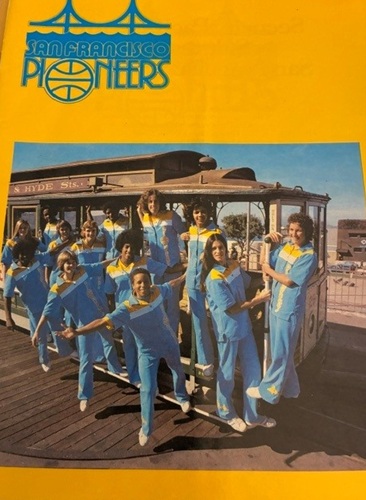 “I think I made $7,000 for my salary and the season was very short, but it was such an amazing experience and San Francisco was a very good franchise,” Hansen said. “They had good ownership and we flew all over the place and stayed in really nice hotels. They had a good practice facility, and we were treated really well.”
Prior to a game scheduled in Chicago on March 21, 1981, Hansen and her Fillies teammates walked off the court before the starting lineups were announced in a protest over unpaid salaries.
“We planned to do our warm-up, go back to the locker room and then get back in vans and drive back to Minnesota because we weren’t getting paid,” Hansen said. “That was our way of showing that we were not happy with ownership and the only way that we could make a stand.”
Despite the disbanding of the league, Hansen said lifelong relationships were formed.
“The beauty of playing sports is relationships, and even relationships that we developed at Unity are still so strong, and relationships I developed while playing pro ball are still very active and to me that is the beauty of playing sports,” she said.
After the WPBL, Hansen went to graduate school at Lamar University in Texas and eventually became an educator and coach at several colleges and high schools, including Wichita State and North Central College (Ill.).
Her final stop was Cleveland Heights High School, where she coached and taught physical education and health. She lives in Kirtland, Ohio, and retired from teaching and coaching in 2024 although she still works part-time in the transportation department.
“I love coaching and I always loved practice,” Hansen said. “I just finished working with four seventh-grade boys and helping them with fundamentals and skills. I just enjoy that part of it so much.”
2026 Made In Michigan
Aug. 4: Work Ethic Continues to Drive Van Dyk's Endeavors as Co-Owner of Family Farm - Report
July 24: Hackett Mentor's Care Sparked Lifetime in Hoops for BCAM President White - Report
July 24: Mackey Leaving Court with 500+ College Hoops Wins, Many More Lessons Shared - Report
July 16: Country Day Two-Time Champ Moore Building Perennial Winner at Harvard - Report
July 9: Multi-Sport Career at TC West Helps Gillis Thrive as Pro in Game She Once Left Behind - Report
July 2: Inspired by Home, Eager to Give Back, Spencer Hosts Hoop City Alumni Games - Report
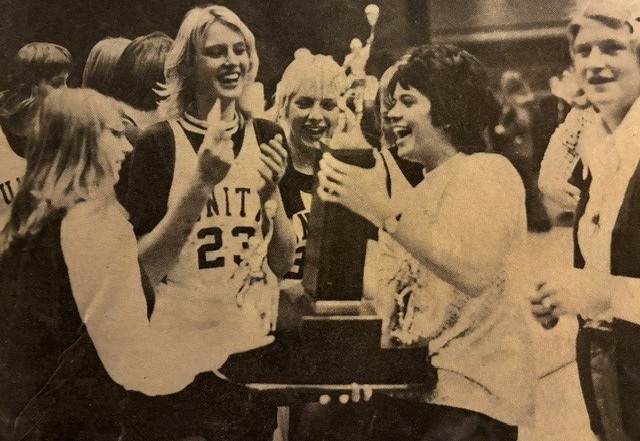
PHOTOS (Top) The 1973 Unity Christian girls basketball team poses for a team photo with its championship trophy; Kim Hansen (20) and Marcia Beutel (12) then and now. (Middle) Unity coach Susan Contant holds the championship trophy surrounded by her players after the clinching victory. (Below) Hansen stands for a photo with her San Francisco Pioneers teammates during the 1979-80 season. (Photos provided by Kim Hansen and Marcia Beutel.)