

MHSAA Teams Up for Leadership Training
October 2, 2014
By Rob Kaminski
MHSAA benchmarks editor
Nothing strengthens a community like neighbors working together. The same can be said for organizations whose missions and goals are closely aligned.
Welcome to East Lansing, where the MHSAA and the Michigan State University Institute for the Study of Youth Sports share geographical boundaries and the same philosophies for educational athletics.
The ISYS mission, as stated on its website, is as follows: “The mission of the Institute for the Study of Youth Sports is to provide leadership, scholarship and outreach that ‘transforms’ the face of youth sports in ways that maximize the beneficial physical, psychological, and social effects of participation for children and youth while minimizing detrimental effects.”
That should sound familiar to athletic leaders within the MHSAA.
Key to the relationship between the MHSAA and the ISYS was the hiring of Dan Gould to the MSU faculty in 2004. Director of the ISYS, he helped to facilitate one of the first major initiatives between the ISYS and the MHSAA, which was to revamp the coaches education program, replacing the PACE program with the Coaches Advancement Program (CAP). Dr. Larry Lauer of the ISYS was heavily involved in creation of the CAP under the direction of MHSAA Assistant Director Kathy Vruggink Westdorp.
At the same time, Dr. Gould also led a study with athletic directors and coaches throughout the state to understand the greatest issues in high school sports. Additionally, to continue the ISYS mission to disseminate research findings, Dr. Marty Ewing, Dr. Gould, and a number of the ISYS graduate students have been presenters at the MHSAA Women in Sport Leadership Conference.
Such services have now become a natural fit into the development of the MHSAA’s student leadership programs, providing huge dividends to those in the ISYS program and the MHSAA.
“The mutually beneficial relationship led to a joint project to enhance student-athlete development with a specific focus on leadership development,” said Scott Westfall, one of two ISYS graduate students who work closely with MHSAA Director of Brand Management Andy Frushour.
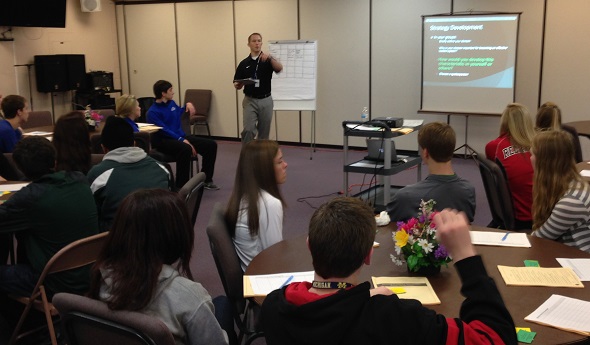
Frushour spearheads the student-based programs at the MHSAA with assistance from Andi Osters and Paige Winne. Among the first ISYS students to work with the MHSAA were Dana Voelker and Jed Blanton, who helped conceptualize the Captains Clinics curriculum. Today at the clinics, ISYS graduate students lead one-day seminars that provide student-athletes with insight on how to understand themselves as leaders, build key leadership skills and handle tough situations on their teams.
Currently, Westfall and Scott Pierce are the ISYS members providing their time and expertise with the MHSAA Student Advisory Council, Captains Clinics, and a new Online Captains Course set to debut this school year.
The Course is student-driven, with two SAC members serving as the faces of the program. Such peer delivery is vital to delivering the messages.
“Students often view leadership from teachers, coaches and administrators as regular, everyday activity. While adults are highly respected figures, students often see adults as outsiders who do not fully understand what it is like to walk a mile in their shoes,” Westfall said.
“The power is rooted in the peer-to-peer relationships and mutual empathy, as student-athletes are very close in age. Student-based leadership is often held with higher validity because the student leader is likely experiencing many of the same adversities and temptations as the peers on his or her team.”
Adding value and credence to the opinions of the ISYS staff is the fact they are steeped in research. The ISYS can gear its efforts to surveys and field studies that the MHSAA, due to staff constraints, cannot. It’s what the ISYS does; it’s the forte of its staff, and the findings help to shape CAP, the SAC and Captains Clinics.
“Research tells us that when kids get to middle school and high school, peer comparison has a really strong influence on how students and student-athletes act and behave,” said Pierce. “Based on this, we believe that student leaders can, and do, act as important role models on the field and in the classroom.
“It is not always easy for students to stand up as leaders because often times this means standing up and being different. So while student-based leadership is vitally important, it doesn't happen automatically. It needs to be talked about and developed over time.”
The MHSAA Captains Clinics and upcoming online course, it is believed, are examples of programs which can develop leaders.
“One of the leadership quotes we used in Tier 1 of the online student leadership course is from Vince Lombardi. It states: ‘Leaders are made, they are not born. They are made by hard effort, which is the price which all of us must pay to achieve any goal that is worthwhile,’” said Westfall. “This type of sentiment, combined with the joint belief between the ISYS and the MHSAA that leadership skills can be taught and cultivated, leads us to believe that leadership can be developed in an individual.”
Through such development, real inroads can be made to promote sportsmanship, teamwork and citizenship in school sports. It’s a worthwhile endeavor for participants, both attendee and instructor.
“Our staff finds the MHSAA Captains Clinics to be some of the most enjoyable and rewarding work that we do,” Pierce said. “The events focus on building leadership in the student-athletes, and give us (ISYS) an ideal opportunity to put our research and scientific knowledge into practice with the students and have a lot of fun doing so.”
Throughout the year, Frushour works with schools and conferences to schedule dates and locations for the clinics. For each day-long clinic, three to five ISYS staff lead a series of workshops for high school student-athletes. The workshops focus on building the four key pillars of leadership – motivation, communication, positive peer-modeling and team cohesion – and have the students involved in discussions, group activities, journaling and role plays.
“We are always trying to find new ways to integrate the new knowledge that we acquire about leadership and trying to reach as many students as possible,” said Pierce, alluding to the forthcoming Online Captains Course. “The online course aims to build off the great things the MHSAA and the ISYS have done with the Captains Clinics.”
A tremendous amount of enthusiasm surrounds the project, and for good reason. The track record of the MHSAA-ISYS partnership reflects a successful venture that might just be hitting stride.
“Over the past 15 years, the relationship between the ISYS and the MHSAA has blossomed. It is to the credit of the forward-thinking MHSAA staff members along with the ISYS faculty and graduate students that this relationship is stronger than ever,” Westfall said. “With the arrival of Dr. Karl Erickson to the ISYS this fall, the upcoming MHSAA coaching requirements for CAP courses, and the launch of the Online Captains Course, the future looks bright for the ISYS-MHSAA team.”
PHOTO: Scott Westfall from the Institute for the Study of Youth Sports conducts a Captains Clinic session as part of his work with the MHSAA.
Century of School Sports: Slogans & Logos Remain Unforgettable Parts of MHSAA History
By
Geoff Kimmerly
MHSAA.com senior editor
February 25, 2025
Logos and slogans are meant to stick in your mind – and the MHSAA has created several that have become synonymous with the story of school sports.
When was the first time you saw the MHSAA logo? For me, it was on a ticket to watch my school at the 1993 Girls Basketball Semifinals at Kellogg Arena.
And I thought “Good Sports Are Winners” was just something everybody said about all things sportsmanship. I had no idea it headlined as the first of now several memorable MHSAA statements meant to do precisely what it did inside my teenage head – bury itself in our minds so we would hopefully recall the importance of being a good sport whenever we heard it.
The MHSAA’s “Century of School Sports” have really included only about a half-century of this type of messaging and branding. But no matter if you’ve spent your time with us as an athlete, coach, administrator, official, fan or a combination of those roles, some of what follows should jog your memory – and hopefully stir up plenty of good ones as well.
- Good Sports Are Winners!
Jack Roberts was hired as the MHSAA’s fourth full-time executive director in 1986. His first hire was John Johnson as one of, if not the first-of-a-kind communications director at a high school athletic association in the nation. One of their first undertakings was a campaign to improve sportsmanship – and “Good Sports Are Winners!” became their first and perhaps still most recognizable phrase.
- Sportsmanship Begins At Home
- We Need You To Be A Good Sport!
Sportsmanship is an idea that never graduates, but it also needs to be reintroduced frequently as generations of families make their ways through middle school to high school graduation. These were two more messages meant to encourage appropriate behavior at sporting events.
- Help Wanted: Just Whistle
- You Can Be A Referee
Recruiting and retaining game officials also is an annual drive, and these became part of the slogan-sphere over the last 15 years as those efforts increased due to decreasing numbers. “Be the Referee” became a weekly segment of the “This Week in High School Sports” five-minute show that airs on radio stations all over the state during the fall and winter seasons, and they always end with the call out “You Can Be A Referee” to enlist those who might be interested.
- We Are The MHSAA
This carried a certain boldness when read over the microphone at tournament events, and summed up neatly what being part of the MHSAA was all about. Paraphrasing: “We are … Coaches … administrators … and officials. … We are your school. We promote and protect the privilege of interscholastic competition. We make rules and follow them as a condition of membership. … We Are The MHSAA.”
- Promoting The Value – And Values – Of Educational Athletics
This sums up the MHSAA’s work and remains perhaps the favorite of all slogans used to describe it. We believe educational athletics have value – to participants, to their communities, and to society as a whole because of the adults they help produce. We also believe that educational athletics are reliant on specific values – sportsmanship, scholarship, safety and scope.
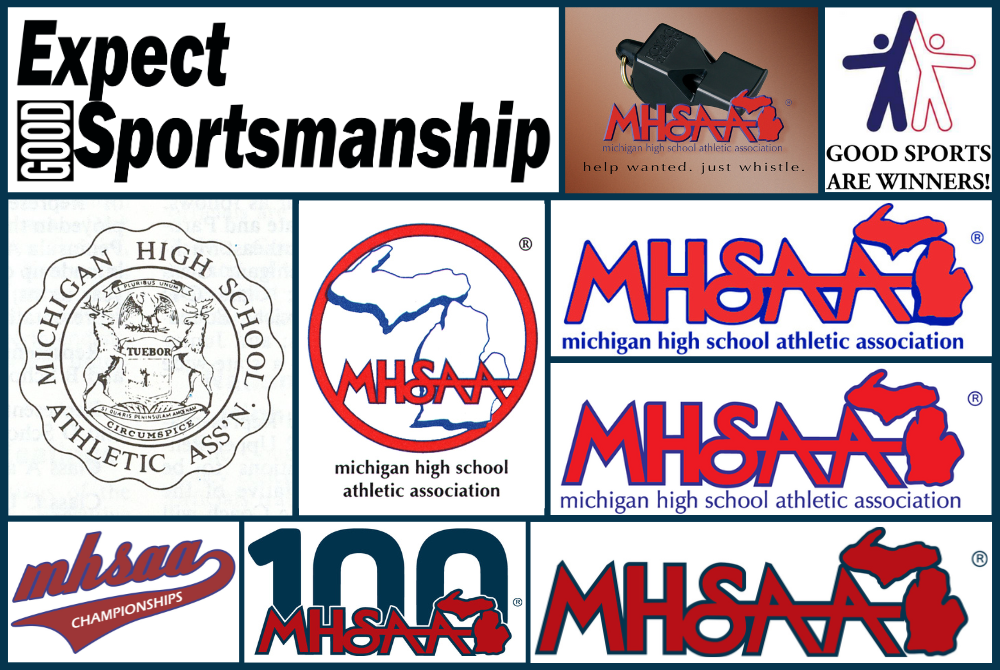
Those are the messages you’ve likely heard. But producing an identifiable image with the MHSAA and its work has been just as important – and below are explanations behind some of the familiar logos you see at the top of this page.
- First Logo: A Traditional Emblem (Last Used in 1987-88)
The first MHSAA logo featured the seal from the state flag, with “Michigan High School Athletic Association” surrounding it. It appeared on medals and official documents through the 1987-88 school year.
- The Round Logo: A Recognizable Symbol
In 1988, the MHSAA introduced a circular logo featuring Michigan’s Upper and Lower Peninsulas within a red border, with "MHSAA" prominently displayed.
- The Championship Logo: A Mark of Excellence
During the early 2000s, the MHSAA introduced a “championship” logo initially for tournament merchandise. Over time, it became the standard for all championship-related materials.
- The Modern MHSAA Logo: Evolving with Time
Debuting in 1987 – and designed by a pair of Sterling Heights Stevenson students as part of a contest – the modern logo introduced the bold "MHSAA" lettering with an interwoven "S" designed to convey motion and energy. Over time, its contours softened while maintaining its distinctive look. Initially, "Michigan High School Athletic Association" appeared beneath it, but in recent years, the text was removed for a cleaner, more streamlined design.
- The Centennial Celebration Logo
To mark its 100th anniversary, the MHSAA introduced a centennial logo, honoring its history. This commemorative design reflects a century of commitment to student-athletes and school communities.
Previous "Century of School Sports" Spotlights
Feb. 19: MHSAA Tickets Continue to Provide Fan-Friendly Value - Read
Feb. 11: We Recognize Those Who Make Our Games Go - Read
Feb. 4: WISL Conference Continues to Inspire Aspiring Leaders - Read
Jan. 28: Michigan's National Impact Begins at NFHS' Start - Read
Jan. 21: Awards Celebrate Well-Rounded Educational Experience - Read
Jan. 14: Predecessors Laid Foundation for MHSAA's Formation - Read
Jan. 9: MHSAA Blazes Trail Into Cyberspace - Read
Dec. 31: State's Storytellers Share Winter Memories - Read
Dec. 17: MHSAA Over Time - Read
Dec. 10: On This Day, December 13, We Will Celebrate - Read
Dec. 3: MHSAA Work Guided by Representative Council - Read
Nov. 26: Finals Provide Future Pros Early Ford Field Glory - Read
Nov. 19: Connection at Heart of Coaches Advancement Program - Read
Nov. 12: Good Sports are Winners Then, Now & Always - Read
Nov. 5: MHSAA's Home Sweet Home - Read
Oct. 29: MHSAA Summits Draw Thousands to Promote Sportsmanship - Read
Oct. 23: Cross Country Finals Among MHSAA's Longest Running - Read
Oct. 15: State's Storytellers Share Fall Memories - Read
Oct. 8: Guided by 4 S's of Educational Athletics - Read
Oct. 1: Michigan Sends 10 to National Hall of Fame - Read
Sept. 25: MHSAA Record Books Filled with 1000s of Achievements - Read
Sept. 18: Why Does the MHSAA Have These Rules? - Read
Sept. 10: Special Medals, Patches to Commemorate Special Year - Read
Sept. 4: Fall to Finish with 50th Football Championships - Read
Aug. 28: Let the Celebration Begin - Read