

Battle of the Fans: Halftime is G.R. Christian's Time
January 29, 2012
GRAND RAPIDS – For many high school hoops fans, halftime is a break – perhaps an opportunity to grab a pop or some popcorn, catch up with old friends, or at least take a seat and catch a breath.
But for the Grand Rapids Christian student cheering section, it’s no time for rest. Those 10 minutes might be when Eagle Nation does its best work.
For this “Battle of the Fans” finalist and its six senior leaders, halftime is their time. Some schools play music between halves, or run contests on the floor. At Grand Rapids Christian, everyone knows that after two quarters of supporting the play on the court, the halftime action is in the stands.
It’s cheer after cheer after cheer, with only a few 20-second breaks along the way.
“People get into it, and it’s over in a flash,” senior Jesse Ludema said.
“We frown on down time,” senior Evan Metcalf added. “You can have down time when you get home.”
Grand Rapids Christian is one of five finalists for the MHSAA Student Advisory Council’s “Battle of the Fans” competition. MHSAA staff visited both the Eagles and Reese on Friday after starting the tour Jan. 21 at Frankenmuth. Trips will be made to both Rockford and Petoskey over the next three weeks, with videos posted of all five finalists on the MHSAA Facebook page. After an online vote and SAC discussion, the winner will be announced on Feb. 24. Clips from all five MHSAA-produced videos will be shown during the Girls and Boys Basketball Finals in March at the Breslin Center.
Eagle Nation prides itself on bringing the same enthusiasm to every game. But it was tough to ignore the extra juice Friday, with Grand Rapids Christian facing rival East Grand Rapids. The schools are just 2.5 miles apart, and their two football games this fall received hype statewide.
Eagle Nation’s senior leaders contributed in those grudge matches as well – but from their spots in the stands. “Our school is better served with us in the stands than on the field,” senior Joe Schierbeek laughed.
Ludema sarcastically agreed: “They don’t need my ‘huge’ muscles; they need our loud voices.”
So what happened when Grand Rapids Christian’s second-quarter buzzer sounded?
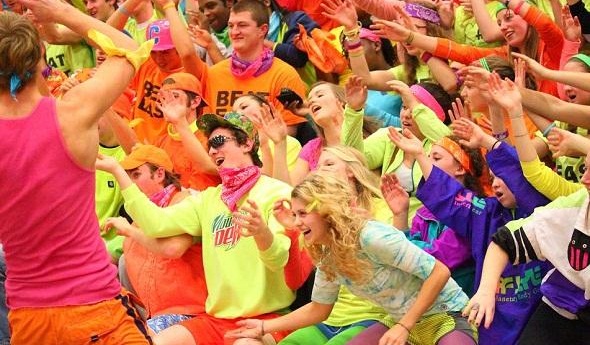
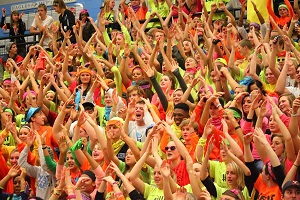 Students go bananas in a cheer led by costumed senior leader Cody Powers. Each Eagles class – seniors through freshmen – takes its turn doing a collective hip shake, a favorite in the Eagle’s Nest. A boxer throws left and right uppercuts before landing a knockout blow that falls the entire section backward. And on this night, Michigan State basketball coach Tom Izzo was in attendance and got some love from Eagle Nation – although it is only unconfirmed speculation that Izzo was there to check in on the “Battle of the Fans” craze.
Eagle Nation plans a theme for every home game, and Friday was all about neon. More than 400 students packed the sections behind the north basket, glowing in all hues of neon covering T-shirts, tank tops, pants, socks and head bands. Those six leaders each wore a hot pink tank top, with one letter painted on each spelling E-A-G-L-E-S. With help of the administration, the leaders even sold bright $1 bandannas to everyone in the student section to top off the neon look. Even the basketball team got into the act: Players surprised their classmates by wearing neon-green ankle tape and those same neon bandannas during warm-ups.
While Eagle Nation had been loud in the past, this level of organization debuted this school year. Before, the students were always told to just cheer louder, but without much of a plan. Now, there’s a Facebook group. Theme nights are mentioned with other school announcements. On Friday, leaders held a lunchtime pep assembly for student section members, and they had a similar training assembly with eighth graders earlier last week.
Leaders also take seriously the word “Christian” spelled out in the name on their team's uniforms. Being an example of their faith is a priority.
“People don’t see what happens in our school every day. And when they come to games, they see our student section, and they take that as an example of who we are as a school,” Powers said. “So we want to show them who are, and that’s why we value character.”
“That’s not to say we don’t get rowdy, though,” Schierbeek quickly interjected.
In the end, it’s all about having fun – a theme that played loudly in Frankenmuth as well. Metcalf watched the Frankenmuth video with a big smile. “Let’s visit them,” he said. "We can have a fan section dance party.”
But first the focus is on winning the “Battle of the Fans,” which to this student section is its “state finals.”
With his voice almost gone, Ludema gave some advice to the other finalists.
“Cheer loud,” he said. “And get some throat lozenges.”
View Grand Rapids Christian's application video, created by GRCHS senior Andrew Pruim.
PHOTOS by Grand Rapids Christian junior Janina Pollatz.Report by the MHSAA's Andy Frushour.
Winter Finals TV Announced
February 11, 2015
By John Johnson
MHSAA communications director
Five weekends of coverage of MHSAA Winter Championships will be featured beginning next week on the MHSAA.tv website.
The schedule begins Feb. 20-21 in Marquette with live video streaming from the Upper Peninsula Swimming and Diving Championships, and concludes on March 28 with live coverage of postgame awards and press conferences plus on-court halftime activities at the Boys Basketball Finals.
Here’s the complete schedule:
- Feb. 20-21 – Upper Peninsula Swimming & Diving Finals - Marquette
- Feb. 27-28 – Team Dual Wrestling Quarterfinals, Semifinals and Finals – Battle Creek
- March 5-7 – Individual Wrestling Finals – Auburn Hills
- March 6-7 – Girls Competitive Cheer Finals – Grand Rapids
- March 12-14 – Ice Hockey Semifinals and Finals – Plymouth
- March 13-14 – Girls Gymnastics Finals – Rockford
- March 14 – Lower Peninsula Boys Swimming & Diving Finals – Holland, Rochester, Ypsilanti
- March 19-20 – Girls Basketball Semifinals and Postgame Press Conferences – East Lansing
- March 20 – Postgame Awards and Press Conferences; Halftime Shooter’s Challenges; Women In Sports Leadership Award and Miss Basketball Award presentations at Girls Basketball Finals – East Lansing
- March 26-27 – Boys Basketball Semifinals and Postgame Press Conferences – East Lansing
- March 28 – Postgame Awards and Press Conferences; Halftime Shooter’s Challenges; Scholar-Athlete Award, Charles E. Forsythe Award and Mr. Basketball Award presentations at Boys Basketball Finals – East Lansing
All game coverage is live on MHSAA.tv on a subscription basis. All events become available for free On-Demand viewing 72 hours after the conclusion of each game. All of the awards, press conferences and on-court presentations at the Basketball Finals will be live and available at no charge. Video subscriptions run $9.95 for a Day Pass and $14.95 for a Month Pass. The purchase of a Month Pass during the Team Wrestling Finals, for example, would allow viewing through the Boys Basketball Semifinals.
It’s also another busy week for School Broadcast Program members, which will have cameras at more than 40 sporting events.
The School Broadcast Program gives members an opportunity to showcase excellence in their schools by creating video programming of athletic and non-athletic events, with students gaining skills in announcing, camera operation, directing/producing and graphics. The program also gives schools the opportunity to raise money through advertising and viewing subscriptions.
Here’s the schedule of School Broadcast Program members planning to cover varsity competition over the next week for broadcast at MHSAA.tv. The following events will have live streaming video unless otherwise indicated:
Wednesday, February 11
Boys Basketball – Central Lake at Onaway, 7 p.m.
Wrestling – Division 2 District Semifinal, Wayland vs. Plainwell, 6 p.m.
Wrestling – Division 2 District Final, Wayland/Plainwell vs. Byron Center, 7 p.m.
Thursday, February 12
Girls Basketball – Atlanta at AuGres-Sims, 6 p.m.
Girls Basketball – Lincoln Alcona at Hillman, 7 p.m.
Boys Basketball – Dryden at Montrose, 7 p.m.
Girls Basketball – Whittemore-Prescott at Rogers City, 7 p.m. (VOD)
Friday, February 13
Ice Hockey – Green Bay (WI) Notre Dame vs. Bloomfield Hills Cranbrook-Kingswood @ MIHL Showcase, 6 p.m.
Boys Basketball – Belding at Comstock Park, 6 p.m.
Girls Basketball – Flint Southwestern at Davison, 6 p.m.
Boys Basketball – Holt at East Lansing, 6 p.m. (VOD)
Boys Basketball – DeWitt at Haslett, 6 p.m. (HD)
Boys Basketball – Engadine at Newberry, 6 p.m.
Girls Basketball – Three Rivers at Plainwell, 6 p.m.
Boys Basketball – Edwardsburg at Dowagiac, 7 p.m.
Girls Basketball – Rogers City at Posen, 7 p.m.
Boys Basketball – Three Rivers at Plainwell, 7:15 p.m.
Girls Basketball – Belding at Comstock Park, 7:30 p.m.
Boys Basketball – Flint Southwestern at Davison, 7:30 p.m.
Girls Basketball – Holt at East Lansing, 7:30 p.m. (VOD)
Girls Basketball – DeWitt at Haslett, 7:30 p.m. (HD)
Saturday, February 14
Ice Hockey – Rochester vs. Bloomfield Hills Cranbrook-Kingswood @ MIHL Showcase, 4:40 p.m.
Monday, February 16
Girls Basketball – Houghton at Calumet, 7 p.m.
Girls Basketball – AuGres-Sims at Posen, 7 p.m.
Tuesday, February 17
Boys Basketball – L’Anse at Calumet, 7 p.m.
Ice Hockey – Houghton at Calumet, 7 p.m.
Boys Basketball – Grand Rapids Covenant Christian at Comstock Park, 7 p.m.
Girls Basketball – Ann Arbor Huron at Haslett, 7 p.m. (HD)
Boys Basketball – Mio at Rogers City, 7 p.m. (VOD)
Boys Basketball – Posen at AuGres-Sims, 7:15 p.m.
Girls Basketball – Coloma at Plainwell, 7:15 p.m.
Live stats of select basketball games also are available on MHSAA.tv. Check out the MHSAA.tv website on game night to see which schools are streaming live stats, or stop by to view stats following games on an On-Demand basis. A Day Pass to view live stats is $1.95.
All sporting events – live or delayed – are available on MHSAA.tv on a subscription basis for their first 72 hours online. A portion of each subscription is returned to the school originating the broadcast. Video subscriptions run $9.95 for a Day Pass and $14.95 for a Month Pass. Some schools also are offering Annual Passes at a discounted rate. All sporting events become available for free On-Demand viewing three days after they have been posted.
To view all of the recent School Broadcast Program productions, go to MHSAA.tv, click On-Demand on the nav bar of the left side of the page, and on the Filters tab at the top of next page, click on All States and then select Michigan.
Also available below is an SBP highlights package from the past week, including a 53-50 victory by Plainwell over Mattawan in a boys basketball contest, plus a 53-36 win for Calumet vs. Hancock in girls basketball.
Schools interested in becoming a part of the School Broadcast Program should contact John Johnson at the MHSAA Office.