


Title IX Continues to Fuel Growth of Girls and Women’s Sports, Olympic Dominance
By
Karissa Niehoff
NFHS Executive Director
September 24, 2021
To say that American female athletes dominated the recent Olympics in Tokyo would be an understatement.
Among the 66 medals earned by American female Olympians – most by any country in the history of the Games – were gold-medal performances by the U.S. basketball, volleyball, water polo and beach volleyball teams. Eighteen medals were earned by the U.S. women swimmers, female track and field athletes claimed 15 medals, and the U.S. women’s softball and soccer teams won silver and bronze medals, respectively.
In the past 30 years of the Olympic Games, the United States has dominated the women’s team sports of basketball (nine golds), soccer (four golds, one silver, one bronze) and softball (three golds, two silvers) — not to mention the untold number of medals in track and field. And this past summer, the U.S. women’s volleyball team claimed its first gold medal.
These performances by some of our nation’s most skilled female athletes never would have been possible without the passage of Title IX and the offerings of these sports through our nation’s schools. With the chance to play afforded by the landmark Title IX legislation in 1972, girls participation in several high school sports skyrocketed in the years that followed.
When the NFHS conducted its first participation survey in 1971, basketball and outdoor track and field were the primary girls sports, comprising about two-thirds of the 294,000 total. However, with the opportunity to play additional sports, girls flocked to volleyball and softball first, along with cross country and eventually soccer.
Soccer, in fact, has had the most remarkable growth. In 1971, only 700 girls were playing high school soccer. Twenty-five years later, that number had climbed to almost 210,000; and as the 50th anniversary of Title IX approaches, there are now almost 400,000 girls playing high school soccer – a staggering 56,200 percentage increase in 50 years. Soccer now ranks fourth in popularity among girls high school sports – all because of that opportunity in 1972.
There are many other success stories, however. The pre-Title IX survey in 1971 indicated that 1,719 girls were participating in cross country. With increases every year until 2015, today, there are 219,345 girls competing in high school programs and the sport ranks sixth in popularity.
Although participation numbers have leveled a bit the past 10 years, fast-pitch softball is another sport that flourished after the passage of Title IX. With fewer than 10,000 participants in 1971, the numbers quickly rose to 220,000 by 1985 and 343,000 by 2000, and softball is currently fifth among girls sports with 362,038 participants.
Since track and field and basketball were the primary sports in the early days of girls sports programs, increases in those sports have not been as dramatic; however, they remain the first and third most-popular sports, respectively, today. Volleyball, however, much like soccer, continues its upward climb.
Without a doubt, volleyball has seen the steadiest increases among girls high school sports the past 50 years. After starting with 17,952 participants in 1971, the numbers jumped to 300,810 by 1990 and 409,332 by 2010 and 452,808 by 2018. During its climb, volleyball surpassed basketball as the No. 2 girls sport.
And among the top six girls sports from 2010 to 2018 (numbers are not available the past two years due to the pandemic), volleyball has gained the most participants (43,476), followed by soccer (32,549). And all of this has occurred thanks to legislation passed in 1972 that was not fundamentally meant to address opportunities for girls to participate in high school sports.
The NFHS is leading a yearlong celebration of the 50th anniversary of Title IX, which officially occurs on June 23, 2022. “Title IX at 50 – Celebrating and Growing Opportunities” is highlighting the law’s impact by celebrating the inspirational individuals and landmark moments in the history of Title IX, and continuing to grow the educational and competitive opportunities for the future.
More information, including a Title IX Timeline, Title IX Milestones, The History and Importance of Title IX, Title IX Fact Sheet, Title IX Frequently Asked Questions and several Title IX videos, can be accessed on the NFHS Website.
Dr. Karissa L. Niehoff is beginning her fourth year as executive director of the National Federation of State High School Associations (NFHS) in Indianapolis. She is the first female to head the national leadership organization for high school athletics and performing arts activities and the sixth full-time executive director of the NFHS. She previously was executive director of the Connecticut Association of Schools-Connecticut Interscholastic Athletic Conference for seven years.
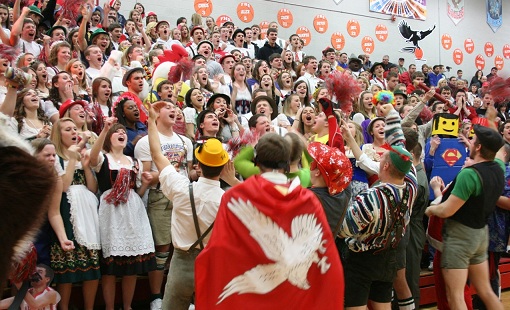
Battle of the Fans: Frankenmuth Dance Party
January 21, 2012
FRANKENMUTH -- The hometown Eagles hosted Freeland in a boys basketball game Saturday night.
And a 250-student chicken dance broke out.
Sure, Frankenmuth calls itself “Michigan’s Little Bavaria.” And things were a little ramped up for the student section's "German Night" -- which, by the way, was scheduled long before this game was announced as the first stop on the MHSAA's "Battle of the Fans" tour.
But the rest of the dancing and singing that made up most of the game’s two hours? That’s just the usual for this “Battle of the Fans” finalist. The Eagles student section turns every boys and girls basketball game into a dance party. And everyone in the gym, regardless of allegiance, is invited.
“That is what we are best at. That is what we are known for,” Frankenmuth senior Brennan Webb said. “Since we do it for every single game, all of these other student sections expect that. And when you come to our house, that’s what you’ve got to expect.”
MHSAA staff and its 16-member Student Advisory Council members also will visit "Battle of the Fans" finalists Reese, Grand Rapids Christian, Rockford and Petoskey over the next month and shoot videos that will be part of an online vote on the MHSAA's Facebook page. The winner will be announced Feb. 24, and clips from all five videos will be shown during the Girls and Boys Basketball Finals in March at the Breslin Center.
Eagles leaders met before this season and planned out themes for all 20 regular season games plus every one through a potential MHSAA Finals run. Super Hero night was pretty cool. So was Christmas night. And of course, German night was a hit.
But mostly, it comes back to singing and dancing. Usually, the students bring the music in the form of a boom box. This time, they had a DJ complete with lights flashing over that section of stands.
Webb carries a blue notecard with cheers listed on the front and back -- in case he needs a quick reference during the game. Saturday’s sing-along included some hip-hop, a Bob Seger tune and a Christmas carol. They have chants for specific players on their team, a German chant for after successful free throws, and a breakdown for timeouts “to keep the energy up.”
“The past few years we had pretty funny energetic people,” senior Jacob Fahrenbruch said. “So it kinda took over, and we made every single person come to every single basketball game.”
Someone comes to all of them -- even if the section numbered just five for a game an hour’s drive away and the night before exams earlier this month.
Officials and opposing coaches both have paid compliments to the section for the atmosphere it creates. Students chant “Come on over” to those from opposing cheering sections -- and have had some takers. Eagles cheerers played a half-serious game of red rover with Marysville students during their teams’ volleyball Quarterfinal this fall. Just like the players, the schools’ cheering sections also did a postgame handshake. “We like to make friends,” senior Zack Robinson laughed.
An informal student section has existed for a few years. Themes were set mostly by word of mouth. A group of seniors usually led, but nothing too organized.
This winter, the Eagles got serious.
Seniors Webb, Robinson, Nick Veitengruber, Evan Escott, Jeff Hillman and Fahrenbruch make up a big part of the leadership assembly. They created a Facebook page for announcements. They also take advantage of a 15-minute weekly in-school televised news broadcast to teach cheers to their classmates.
Consider: Roughly 6,500 people live in Frankenmuth and the surrounding township. So during Saturday's halftime, when the Eagles’ student section emptied onto the floor and started chicken dancing, those fans accounted for roughly half of the student body -- and nearly four percent of the school district's population.
Frankenmuth's cheerers have caught some occasional grief from opposing fans when they go on the road. But their enthusiasm, positivity and open invite to join in has led students from other schools to say they wish they could be a part. And, of course, a little making fun of one's self goes a long way.
After a big Freeland shot Saturday, Eagles cheeres chanted, "In our faces!" And after Frankenmuth standout Kent Redford air-balled a shot, his classmates directed the usual "Air ball" chant at him -- all in good fun.
“It usually takes a while, but then we break them in,” Webb said. “That’s how we usually make friends. We make fun of ourselves. (They think) these guys are idiots, but they’re pretty funny. We’ll hang out with them.”