

Century of School Sports: MHSAA Work Guided by Representative Council
By
Geoff Kimmerly
MHSAA.com senior editor
December 3, 2024
One of the most common misconceptions about the MHSAA over its 100-year history is that all decisions regarding school sports in Michigan are made by the staff in the East Lansing office.
The MHSAA truly is an organization built upon its membership, with its Representative Council the legislative body that has produced the rules and tournament schedules currently in place to provide structure in athletics for more than 750 high schools and hundreds more middle schools across the state.
The Representative Council is the 19-member legislative body of the MHSAA. All but five members are elected by member schools. Four members are appointed by the Council to facilitate representation of females and minorities, and the 19th position is occupied by the Superintendent of Public Instruction or designee.
The Council considers all proposals brought before it from MHSAA sport and other appointed committees that meet throughout the year, and also makes decisions on a variety of eligibility rules, postseason tournament and operational issues. The Council regularly considers 30 committee proposals during its Spring meeting alone, along with a handful of others during Fall and Winter meetings which otherwise are primarily opportunities for discussion of topics that may come up for action at a later date.
Eight representatives are elected across four regions – two apiece from the Northern Lower Peninsula, Southeastern Michigan, Southwestern Michigan and the Upper Peninsula – and also based on school enrollment, with one representative from each of those regions from the larger Class A and B-sized schools and one representative from each region from the smaller Class C and D-sized schools. There are also two statewide at-large positions, two representing junior high/middle schools, and elected representatives from Detroit Public Schools and private and parochial schools.
All Representative Council members must be representatives of a member school, as faculty or board of education members. Every Council candidate must have superintendent or principal approval in writing and be qualified for the position for which that person is running.
Elections take place every fall after names of candidates are submitted and published to the MHSAA Website by April 15 the preceding spring. Ballots are mailed to schools in September and must be postmarked no later than two weeks after they were sent by the MHSAA office. A Board of Canvassers appointed annually counts the ballots, which must be signed by the principal and superintendent of that member school (except for private and parochial schools, which require signature by the principal only).
Council members are selected by majority vote.
Terms for elected Council representatives are two years long. Appointed members also serve two-year terms and may not serve longer than two successive terms.
The Council meets three times annually. Council officers – president, vice president and secretary-treasurer – are elected during the Fall meeting for the full Council.
Five members of the Council also convene monthly during the school year to form the MHSAA’s Executive Committee, which reviews appeals of Handbook regulations by member schools. Those five include the three elected officers.
Previous "Century of School Sports" Spotlights
Nov. 26: Finals Provide Future Pros Early Ford Field Glory - Read
Nov. 19: Connection at Heart of Coaches Advancement Program - Read
Nov. 12: Good Sports are Winners Then, Now & Always - Read
Nov. 5: MHSAA's Home Sweet Home - Read
Oct. 29: MHSAA Summits Draw Thousands to Promote Sportsmanship - Read
Oct. 23: Cross Country Finals Among MHSAA's Longest Running - Read
Oct. 15: State's Storytellers Share Fall Memories - Read
Oct. 8: Guided by 4 S's of Educational Athletics - Read
Oct. 1: Michigan Sends 10 to National Hall of Fame - Read
Sept. 25: MHSAA Record Books Filled with 1000s of Achievements - Read
Sept. 18: Why Does the MHSAA Have These Rules? - Read
Sept. 10: Special Medals, Patches to Commemorate Special Year - Read
Sept. 4: Fall to Finish with 50th Football Championships - Read
Aug. 28: Let the Celebration Begin - Read
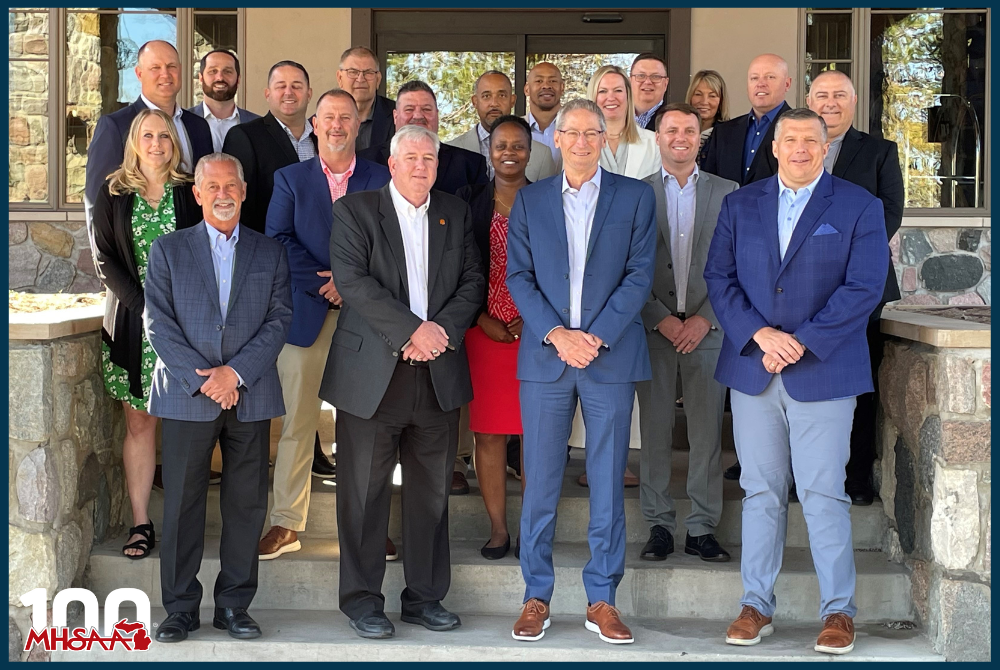
PHOTO The MHSAA Representative Council and Executive Director Mark Uyl (front row, far right) take a group photo during its Spring Meeting in May. (Photo by Jon Ross.)
This Week In High School Sports: 2/7/20
February 6, 2020
This week’s show highlights Trenton swimmer Michael Wolsek, presents Game Balls to Traverse City Central hockey's Charlie Douglass and Perry basketball's Alyssa Welsh, discusses differences in high school and college hockey rules and addresses the importance of increasing the number of women in leadership positions in athletics.
The 5-minute program, powered by MI Student Aid, leads off each week with feature stories from around the state from the MHSAA’s Second Half or network affiliates. "Be The Referee," a 60-second look at the fine art of officiating, comes in the middle of the show and is followed by a closing MHSAA "Perspective."
Listen to this week's show by Clicking Here.
Past editions
Jan. 31: Utica Ford bowling's Kensington Holland, winter lessons on civility - Listen
Jan. 24 White Pigeon multi-sport standout Claycee West, 2020 Youth Football Forum - Listen
Jan. 17: Promoting and protecting youth football, amateurism in educational athletics - Listen
Jan. 10: Livonia Stevenson hockey's Seth Lause, multi-media and social media impacts - Listen
Dec. 27: Mona Shores "Sailor Nation" life-saving success - Listen
Dec. 20: Battle of the Fans IX, details on purchasing Finals broadcasts - Listen
Dec. 13: Port Huron United hockey, what matters most in high school sports - Listen
Dec. 6: Highlights from 2019 11-Player Football Finals, instant replay in review - Listen
Nov. 29: Highlights from 2019 8-Player Football, Girls Volleyball and Girls Swimming & Diving Finals - Listen
Nov. 22: Ida volleyball record-setter Taylor Wegener, new Football Finals video review - Listen
Nov. 15: Reading lineman Nick Affholter, coaches as leaders in sportsmanship - Listen
Nov. 8: Lower Peninsula Cross Country and Boys Soccer Finals highlights - Listen
Nov. 1: Muskegon Orchard View football, bolstered MHSAA broadcast schedule - Listen
Oct. 25: Grand Rapids NorthPointe Christian girls golf, MHSAA Football Playoff selection - Listen
Oct. 18: Mendon volleyball's title drive, recognition for longtime announcer Erik O. Furseth - Listen
Oct. 11: Negaunee cross country's Emily Paupore, MHSAA mental health awareness efforts - Listen
Oct. 4: South Lyon soccer's Josh Mason, improving youth football - Listen
Sept: 27: Utica Eisenhower golfer Ariel Chang, adult fan behavior - Listen
Sept: 20: Pinckney football inspiration, decisions made at the local level - Listen
Sept. 13: Muskegon's offensive line, soccer substitution rule change - Listen
Sept. 6: Jenison girls golf's inspiration, new football practice contact restrictions - Listen
Aug. 30: St. Johns quarterback-now-coach Andy Schmitt, benefits of a multi-sport experience - Listen