


Leadership: A Skill that can be Taught
January 30, 2013
 By Jed Blanton
MSU Institute for the Study of Youth Sports
At the MHSAA and the ISYS, in the milieu of work we conduct centered on understanding and developing leadership in young athletes, there is one definition that seems to govern our approach and serve as a foundation for the research questions and training clinics that follow it.
Penned by Peter Northouse, that definition states “leadership is a process, whereby an individual influences a group of individuals to achieve a common goal.”
Choosing to frame ‘leadership’ as a process, rather than as some personality characteristic destined only for those naturally-born leaders, allows the concept of leadership to be utilized and taught as a skill, or set of skills. If a coach can agree with the philosophy that leadership can be learned, we can begin to design a series of strategies to enhance leadership in our young athletes.
First, I’m going to discuss what most coaches already know about teaching skills. Teaching skills is essentially an effort of behavior modification. A coach sometimes is able to choose athletes who already possess a certain level of competency within the skills necessary for their sport; sometimes coaches must work with whoever shows up on the first day of practice.
In either case, coaches tend to conduct a subconscious assessment of skills that must be learned (that they must teach), whether complex strategies or mere fundamentals. When teaching athletic skills to young people, coaches must break down the multitude of steps involved.
Think about a lay-up in basketball or the high jump in track & field. Either skill itself is actually a combination of several skills, and the ability to pay attention to very specific cues in the environment. Coaches teach the approach, the proper hand/arm placement, the essential cues to focus on, and the follow-through. Coaches can devote segments or entire practices to particular skills – breaking down all the steps, creating drills to practice the steps, and offering the full practice of the skill in a competition-like environment.
During this episode of developing a skill in our athletes, to get them to perform in a very specific way, our interactions often mirror what behavioral psychology has known for decades: People respond to reinforcements and punishments. Coaches positively reinforce their athletes with compliments, clapping hands, and congratulations. Our words and actions shape how the individual learning the skill makes adjustments to receive more praise.
These shifts of their body and miniscule changes in their actions to get to the desired behavior of their instructor are “learning.” Similarly, coaches often threaten punishment of extra sprints or difficult drills to give athletes a clue as to what behaviors they should avoid. Often, something as simple as a disapproving glance can be reinforcing enough to change whatever behavior the athlete shouldn’t be practicing. The simple “good job” or the threat of sprints essentially shapes how our athletes behave athletically.
This same approach can work toward leadership development.
What would it look like for a coach to reinforce and punish athletes toward leadership development in the same vein they develop athletic skills? If coaches could determine what three or four behaviors they’d like their athlete leaders to showcase, and then positively reinforce those skills with compliments and thanks, and potentially punish athletes with disapproving glances or even lectures after practice, leadership can be learned like any other athletic skill.
Phil Jackson, the multiple championship-winning NBA coach, has been quoted saying he would try to give two compliments for every criticism with his professional teams. The Positive Coaching Alliance – a national nonprofit organization that strives to educate coaches on ways to enhance the youth sport experience – suggests a ratio of five positive comments to every negative criticism. Research has consistently shown that people respond better and more rapidly to positive reinforcement than to punishment.
All too often, coaches wait for leaders to emerge, rather than teach the leadership they desire. Imagine if coaches waited for players to figure out the offensive plays and strategies instead of teaching players where to move, how to move, and why they are moving there. Adopting a similar approach with your athlete has the potential to expedite the behaviors you’d most ideally want them to possess. Using tactics of positive reinforcement can help these young players to become excellent leaders in a shorter period of time than merely hoping someone steps up.
I’ll leave you with a simple list of suggestions of how coaches can teach leadership, just like they teach any other necessary athletic skill.
- Develop goals with your athletes regarding leadership. What kinds of things do your athletes value or feel would help the team? How can they practice leading their teammates in that way?
- Develop your own goals toward teaching leadership. What would it look like if a coach made it a goal to compliment three players on specific leadership behaviors each practice? Think about the ultimate team captain for your team, and develop strategies to teach your players how to be that captain.
- Break down leadership skills into smaller and easier to practice chunks, just like an athletic skill. Then create an environment where the athletes can practice these skills. By organizing your team into smaller groups, or even partners, you can assign leadership roles within each group. Asking certain players to lead various parts of practice (stretches, lay-ups, circuit training), you are giving them a sense of ownership over their athletic experiences and responsibility over their teammates.
- Positively reinforce the desired behaviors. How would it make a player feel if their coach pulled them aside and thanked them for their specific leadership behavior after a practice or game? A “job well done” or an approving thank you can go a long way in making a young athlete feel they are developing into the leader you desire them to be.
Blanton is a doctoral candidate at Michigan State University in the department of Kinesiology, specializing in the PsychoSocial Aspects of Sport and Physical Activity, and a research assistant for MSU's Institute for the Study of Youth Sports. He has served as a facilitator at MHSAA Captains Clinics the last three years and currently is assisting the association with its student leadership programs.
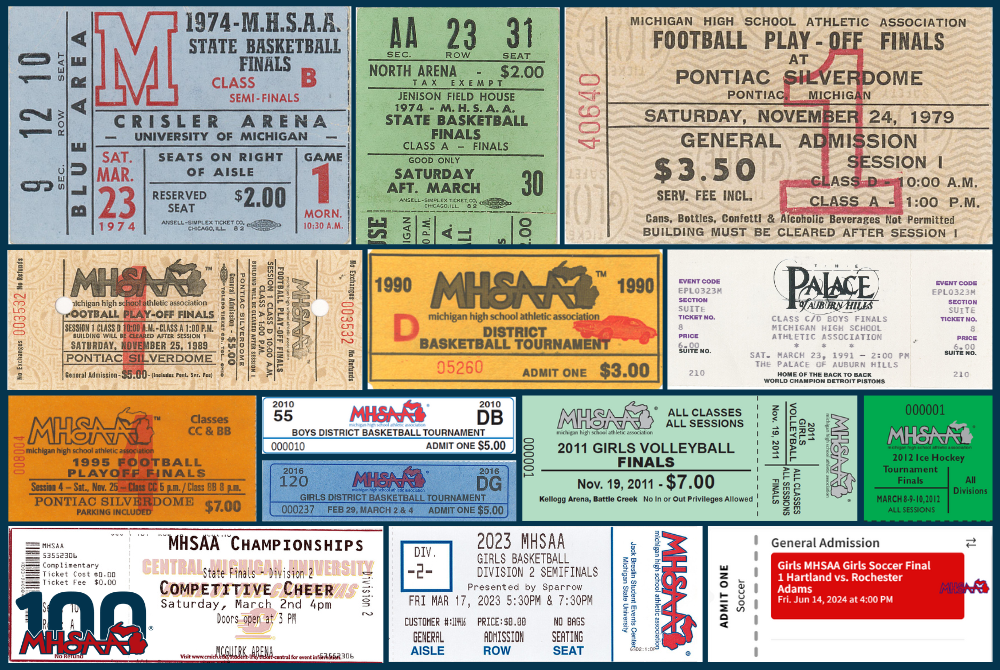
Century of School Sports: MHSAA Tickets Continue to Provide Fan-Friendly Value
By
Geoff Kimmerly
MHSAA.com senior editor
February 19, 2025
A buck went a lot farther a century ago, and a family of four wishing to watch the MHSAA Class A Boys Basketball Final in 1928 could have done so, at the minimum, for a grand total of $2 – or $6 if they were looking to splurge on the best seats.
Of course, relating the value of money 100 years ago to now is not apples to apples. But for Michigan school sports, a deal like that is meant to last forever.
The MHSAA has made it part of long-standing philosophy to keep ticket prices for its tournament events as low as possible, continuing to provide opportunities for entire families to attend together, and hoping to provide the best bargain as tickets to sporting events at other levels have climbed much more rapidly over the decades.
For the sake of comparison, consider tickets over the years for the Boys Basketball Tournament – the first event hosted by the newly-created MHSAA in 1925.
In 1928 (the first year for which cost of admission could be found), ticket prices for the MHSAA Boys Basketball Finals at the Olympia in Detroit were listed at 75 cents, $1 and $1.50, and a newspaper report after noted that in fact the cheapest seats were sold for 50 cents apiece instead. One ticket was good for all four games.
Less than 30 years later, $1.50 still got a fan two championship games – reserved seats for 1955 Boys Basketball Finals at Jenison Field House cost $1.50 per session, with Class C and B Finals in the afternoon and Class A and D in the evening. A decade after that, in 1965, tickets still cost $1.50 per session – although sessions were now split into the Class B game in the morning, Class D and C games in the afternoon, and a Class A session that night.
Sixty years later, prices have continued to rise incrementally – but again, while prioritizing keeping them as low as possible.
These days for boys basketball, District tickets cost $7, Regional tickets cost $9, Quarterfinals cost $10, and Semifinals and Finals tickets cost $12 per two-game session.
On its face, that’s quite a jump from the 1960s, much less the 1920s. But consider: Multiple inflation calculators say that $1.50 ticket for two games in 1955 would be worth more than $17 for two games now, meaning MHSAA Finals ticket prices have grown at a much slower rate.
Consider as well MHSAA ticket prices against Consumer Price Index data over the last 20 years. The U.S. Bureau of Labor Statistics reported in 2023 that admission costs to sporting events nationally had doubled over the previous two decades – literally going up 100 percent – yet price increases for the MHSAA Boys Basketball Tournament since 2005-06 have increased just 40 percent at the District level, where 60 percent of our boys basketball tickets are sold. Ticket prices for Regionals and Finals also have grown slower than that national rate.
And it remains tough to argue with what spectators get for their money at the MHSAA Tournament level.
For the 2024-25 school year, tickets for all District and Regional competitions – and some Quarterfinals and Semifinals – remain in the $7-$9 range. Finals tickets cost $10-$12, except for Individual Wrestling Finals ($18) and 11-Player Football Finals ($20) both at Ford Field – and one ticket for those is good to watch championships in five divisions in wrestling and four football championship games over one day, respectively.
In fact, the most recent change to ticketing has had nothing to do with the price – but instead, the move away from the paper tickets you see above. All tournament tickets are now digital, which keeps the MHSAA current with what’s done in college and pro sports and other forms of entertainment and assists in efficiency by taking cash out of the equation.
Previous "Century of School Sports" Spotlights
Feb. 11: We Recognize Those Who Make Our Games Go - Read
Feb. 4: WISL Conference Continues to Inspire Aspiring Leaders - Read
Jan. 28: Michigan's National Impact Begins at NFHS' Start - Read
Jan. 21: Awards Celebrate Well-Rounded Educational Experience - Read
Jan. 14: Predecessors Laid Foundation for MHSAA's Formation - Read
Jan. 9: MHSAA Blazes Trail Into Cyberspace - Read
Dec. 31: State's Storytellers Share Winter Memories - Read
Dec. 17: MHSAA Over Time - Read
Dec. 10: On This Day, December 13, We Will Celebrate - Read
Dec. 3: MHSAA Work Guided by Representative Council - Read
Nov. 26: Finals Provide Future Pros Early Ford Field Glory - Read
Nov. 19: Connection at Heart of Coaches Advancement Program - Read
Nov. 12: Good Sports are Winners Then, Now & Always - Read
Nov. 5: MHSAA's Home Sweet Home - Read
Oct. 29: MHSAA Summits Draw Thousands to Promote Sportsmanship - Read
Oct. 23: Cross Country Finals Among MHSAA's Longest Running - Read
Oct. 15: State's Storytellers Share Fall Memories - Read
Oct. 8: Guided by 4 S's of Educational Athletics - Read
Oct. 1: Michigan Sends 10 to National Hall of Fame - Read
Sept. 25: MHSAA Record Books Filled with 1000s of Achievements - Read
Sept. 18: Why Does the MHSAA Have These Rules? - Read
Sept. 10: Special Medals, Patches to Commemorate Special Year - Read
Sept. 4: Fall to Finish with 50th Football Championships - Read
Aug. 28: Let the Celebration Begin - Read