

NFHS Voice: We Must Act on Vaping
September 13, 2019
By Karissa Niehoff
NFHS Executive Director
The issue of vaping has reached a crisis stage across the United States, and leaders in our nation’s schools must take immediate steps to stop the use of these electronic cigarette products by our nation’s youth – particularly the more than 12 million participants in high school athletics and performing arts programs.
On Tuesday, CBS News reported that Kansas health officials confirmed the first death in that state linked to vaping. The CBS News release stated that last week, officials in Indiana, California and Minnesota reported deaths in their states linked to vaping. Previous deaths had been reported in Illinois and Oregon.
Also this week, The Associated Press reported that public health officials confirmed two people in Idaho had developed a serious lung disease linked to vaping. The outbreak of vaping-related lung disease has sickened about 450 people in at least 33 states, according to the Centers for Disease Control and Prevention (CDC), causing the CDC to urge people to consider stopping vaping as the number of cases of severe lung illnesses continues to rise.
In February 2019, the CDC reported a 78-percent increase in high school students vaping from 2017 to 2018. Youth e-cigarette use has been called an epidemic by major public health officials.
Students in our nation’s schools have been sold a false bill of goods that vaping is a safe alternative to cigarette smoking – particularly by industry giant JUUL, which held a 76-percent share of the e-cigarette market at the end of 2018 and has wooed the youth market with its products that contain flavors such as cotton candy, chocolate, gummy bear, strawberry and many others.
While the U.S. Food and Drug Administration (FDA) is giving e-cigarette companies until sometime next year to demonstrate that their products can help people stop smoking cigarettes, leaders in our nation’s school activities programs must do everything possible to stop the use of these products by our nation’s youth now – not in 2020.
One educational tool that schools can use immediately is the online course “Understanding Vaping and E-Cigarettes” created by the NFHS with support from the Office of the U.S. Surgeon General. The free course is available on the NFHS Learning Center at www.NFHSLearn.com.
Several articles related to vaping will appear in the September issue of High School Today, which will be posted on the NFHS website.
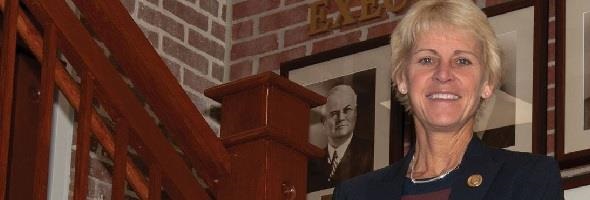
Dr. Karissa L. Niehoff is beginning her second year as executive director of the National Federation of State High School Associations (NFHS) in Indianapolis, Indiana. She is the first female to head the national leadership organization for high school athletics and performing arts activities and the sixth full-time executive director of the NFHS, which celebrated its 100th year of service during the 2018-19 school year. She previously was executive director of the Connecticut Association of Schools-Connecticut Interscholastic Athletic Conference for seven years.
This Week in High School Sports: 2/5/25
By
Jon Ross
MHSAA Director of Broadcast Properties
February 5, 2025
In this week's edition, we detail ways to watch MHSAA Tournament competition this winter, award Game Balls to high achievers in basketball and hockey, and highlight the growth of girls sports in Michigan.
 The 5-minute program each week includes feature stories from MHSAA.com or network affiliates, along with "Be the Referee," a 60-second look at the fine art of officiating.
"This Week in High School Sports" is powered by MI Student Aid, a division within the Department of Lifelong Education, Advancement, and Potential (MiLEAP).
Listen to this week's show by Clicking Here.
Previous 2024-25 Editions
Jan. 29: 2024-25 Scholar-Athlete Award finalists, 1958 Hall of Fame matchup - Listen
Jan. 22: Salem legend Dena Head, MHSAA's Sam Davis selected to Wrestling Hall of Fame - Listen
Jan. 15: MHSAA.com history, officials recruitment news - Listen
Jan. 8: MHSAA Basketball Tournament schedule, 2023-24 attendance report - Listen
Dec. 18: Ice Hockey season underway, Representative Council presidential succession - Listen
Dec. 11: 2024-25 MHSAA Winter Tournament schedule, inaugural girls wrestling team title - Listen
Dec. 4: 11-Player Football Finals review - Listen
Nov. 27: 8-Player Football Finals review, 1975 Football Finals recollection - Listen
Nov. 20: 8-Player Football Finals history, Southwest 10 Conference Legacy officials - Listen
Nov. 13: "Flashback 100" series, flashback to Escanaba's football championship - Listen
Nov. 6: Boys Soccer Finals, Lower Peninsula Cross Country Finals review - Listen
Oct. 30: 2024 Football Playoffs, Lower Peninsula Boys Tennis Finals review - Listen
Oct. 23: Lower Peninsula Girls Golf Finals, Upper Peninsula Cross Country Finals reviews - Listen
Oct. 16: MHSAA Football Playoffs primer, MHSAA/Farm Bureau Scholar-Athlete Awards - Listen
Oct. 9: National High School Hall of Fame, Upper Peninsula Girls Tennis Finals - Listen
Oct. 2: MHSAA record book, 2024 Boys Soccer Tournament schedule - Listen
Sept. 25: NFHS Network streaming, DeWitt's high-scoring football matchup - Listen
Sept. 18: Cheboygan broadcaster Mike Grisdale, Michigan's national participation ranking - Listen
Sept. 11: MHSAA baseball stars in MLB, 2024 Boys Soccer Tournament - Listen
Sept. 5: Highlighting MHSAA record setters, 50th Football Playoffs - Listen
Aug. 28: MHSAA Summer Olympians, "Century of School Sports" celebration - Listen