


Friday Nights Always Memorable as Record-Setter Essenburg Begins 52nd Year as Official
By
Steve Vedder
Special for MHSAA.com
August 31, 2023
GRAND RAPIDS – All Tom Essenburg could think of was the warmth of a waiting bus.
Five decades later, that's what Essenburg – then a senior defensive back at Holland High School – remembers most about a stormy Friday night before 2,100 thoroughly drenched fans at Riverview Park. He recalls having a solid night from his position in the Dutch secondary. He remembers a fourth-quarter downpour, Holland eventually winning the game and trudging wearily through the lakes of mud to the team's bus.
But what never dawned on Essenburg until much later was that he had been the first to accomplish something only three defenders in the history of Michigan high school football have ever done:
Intercept five passes in a single game.
"I knew after the game that I had a bunch of them, but (at the time) we were in a 0-0 game and my mind was on just don't get beat (on a pass) and we lose 7-0," he said of the Sept. 21, 1962, contest against Muskegon Heights.
It wasn't until the next morning's story in the Holland Evening Sentinel that Essenburg grasped what exactly had happened. He didn't realize until then that he had picked off five passes in all, including two over the last 1:52 that sealed a 12-0 win over Muskegon Heights. One of the interceptions went for a 37-yard touchdown, which Essenburg does vividly remember.
"I remember thinking to myself that I had to score," said Essenburg, who has been involved with high school sports in one fashion or another for more than 60 years. "There was a Muskegon Heights guy who had the angle on me and I pretty much thought I was going to get tackled, but I got in there."
Essenburg's recollection of the first three interceptions is a bit hazy after 61 years, but the next day's newspaper account pointed out one amazing fact. The Muskegon Heights quarterback had only attempted six passes during the entire game, with five of them winding up in the hands of the 5-foot-8, 155-pound Essenburg – who had never intercepted a single pass before that night. He would later intercept two more in the season finale against Grand Rapids Central.
It wasn't until the middle 1970s that Essenburg began wondering where the five-interception performance ranked among Michigan High School Athletic Association records. What he remembers most about the game was the overwhelming desire to find warmth and dry out.
"I just wanted to get to the bus and get warm. We were all soaked," he said. "For me it was like, 'OK, game over.' I was just part of the story."
Curiosity, however, eventually got the better of Essenburg. A decade later he contacted legendary MHSAA historian Dick Kishpaugh, who in an attempt to confirm the five interceptions, wrote to Muskegon Heights coach Okie Johnson, who quickly verified the mark.
It turns out that at the time in 1962, nobody had even intercepted four passes in a game. And since Essenburg's record night, only Tony Gill of Temperance Bedford on Oct. 13, 1990, and then Zach Brigham of Concord on Oct. 15, 2010, have matched intercepting five passes in one game.
Three years after Essenburg's special night, Dave Slaggert of Saginaw St. Peter & Paul became the first of 17 players to intercept four passes in a game.
 Essenburg laughs about it now, but his five interceptions didn't even earn him Player of the Week honors from the local Holland Optimist Club. Instead, the club inexplicably gave the honor to a defensive lineman.
It was that last interception Essenburg cherishes the most. His fourth with 1:52 remaining at the Holland 17-yard line had set up a seven-play, 83-yard drive that snapped a scoreless tie. Then on Muskegon Height's next possession, Essenburg grabbed an errant pass and raced 37 yards down the sideline to seal the game with 13 seconds left.
In those days, running games dominated high school football and defensive backs were left virtually on their own, Essenburg said.
"I kept thinking don't let them beat you, don't let them beat you. No one can get beyond you. In those days, once a receiver got in the secondary, they were gone," said Essenburg, who describes himself as a capable defender but no star.
"I wasn't great, but I guess I was pretty good for those days," he said. "I'm proud that I'm in the record book with a verified record."
Essenburg's Holland High School career, which also included varsity letters in tennis and baseball, is part of a lifelong association with prep sports. After playing tennis at Western Michigan, he became Allegan High School's athletic director in 1971 while coaching the tennis team and junior varsity football from 1967-73.
But he's most proud of being a member of the West Michigan Officials Association for the last 47 years. During that time, Essenburg estimates he's officiated more than 400 varsity football games and nearly 1,000 freshman and junior varsity contests. In all, he's worked 83 playoff games, including six MHSAA Finals, the most recent in 2020 at Ford Field. An MHSAA-registered official for 52 years total, he's also officiated high school softball since 1989.
Essenburg also worked collegiately in the Division III Michigan Intercollegiate Athletic Association and NAIA for 35 years, including officiating the 2005 Alonzo Stag Bowl.
Essenburg said the one thing that's kept him active in officiating is being a small part of the tight community and family bonds that make fall Friday nights special.
"I enjoy being part of high schools' Friday night environment," he said. "All that is so good to me, especially the playoffs. It's the small schools and being part of community. I used to say it was the smell of the grass, but now, of course, it's turf.
"I can't play anymore, but I can play a part in high school football in keeping the rules and being fair to both teams. That's what I want to be part of."
While it can be argued high school football now is a far cry from Essenburg's era, he believes his even-tempered attitude serves him well as an official. It's also the first advice he would pass along to young officials.
"My makeup is that I don't get rattled," he said. "Sure, I hear things, but does it rattle me? No. I look at it as part of the game. My goal is to be respected.
"I've never once ejected a coach. It's pretty much just trying to be cool and collected in talking to coaches. It's like, 'OK Coach, You've had your say, let's go on."
While Essenburg is rightly proud of his five-interception record, he believes the new days of quarterbacks throwing two dozen times in a game will eventually lead to his mark falling by the wayside. And that's fine, he said.
"It'll get beaten, no question. It's just a matter of when," he said. "Quarterbacks are so big now, like 6-4, 200 pounds, and they are strong-armed because of weight programs. They throw lots of passes now, so there's no doubt it's going to happen."
Until Essenburg is erased from the record book, he'll take his satisfaction from his connection with Friday Night Lights.
"I love high school sports and being with coaches and players," he said. "My goal was once to work for the FBI or be a high school coach, but now I want to continue working football games on Friday nights until someone says no more."
PHOTOS (Top) Tom Essenburg holds up a copy of the program from the 1962 game during which he intercepted a record five passes for Holland against Muskegon Heights. (Middle) Essenburg, left, and Al Noles officiate an Addix all-star game in Grand Rapids. (Photos courtesy of Tom Essenburg.)
1st & Goal: 2026 Week 9 Review
By
Geoff Kimmerly
MHSAA.com senior editor
October 26, 2026
Every game counts. Week 9 provided 11 more examples of why.
 As Michigan’s high school football teams concluded their regular-season schedules – and more than 300 took the field for the last time in 2026 – a total of 11 teams earned opportunities to continue playing this week, with 11 also falling out of the final playoff mix.
We detail several of those deciders below, as well as a few final league championship games and others that helped determine how brackets were drawn for our title drives beginning Friday with 11-Player Districts and 8-Player Regionals.
Bay & Thumb
HEADLINER Port Huron 13, Port Huron Northern 10 The Red Hawks stacked memorable accomplishments with this win. They defeated rival Northern for the first time since 2023. They finished the regular season 9-0 for the first time since 1952, according to Michigan-football.com. (Port Huron also was perfect during the COVID-shortened 2020 regular season, over six games). And the Red Hawks held onto the top spot on the Division 3 playoff-points list, giving them home games for the first three rounds.
Watch list Marine City 21, Marysville 6 The Mariners (9-0) capped a perfect regular season for the first time since 2021, and they did so by defeating another league champion in Marysville (5-4) while holding the Vikings to their season-low scoring total.
On the move Goodrich 28, Gladwin 20 The Martians (9-0) ran their regular-season winning streak to 26 going back to Week 1 of 2024, and also did so by defeating another league champion in Gladwin (5-4). Grand Blanc 31, Macomb Dakota 24 The Bobcats’ 9-0 regular-season finish also was their second straight and moved them up to No. 7 on the Division 1 playoff-points list. Ubly 30, Cass City 8 The Bearcats (6-3) bounced back from a Week 8 loss to avenge last season’s 42-6 defeat to Cass City (6-3) and secure the possibility of playing home games this week and next.
Greater Detroit
HEADLINER Bloomfield Hills Brother Rice 31, Detroit Catholic Central 25 (OT) The regular season ended with this Catholic High School League Prep Bowl stunner, as Deondre Hills scored the game-winner in overtime to give the Division 1 Shamrocks (8-1) their only loss. DCC still ended up sharing the CHSL Central championship with Toledo Central Catholic, and the Warriors (7-2) tied for third but jumped six spots to No. 9 on the Division 2 playoff-points list – giving them the possibility of three home playoff games. Click for more from the Detroit Free Press.
UPSET ALERT 💥 BROTHER RICE GETS THE OVERTIME WIN! Powered by @LawrenceTechU https://t.co/FHLinnwnh4
— STATE CHAMPS! Michigan (@statechampsmich) October 25, 2026
Watch list Dearborn Divine Child 28, Jackson Lumen Christi 21 The Falcons (8-1) won a matchup of 2025 Finals champions in another Prep Bowl battle, clinching the CHSL AA title with a second league win by seven points this fall. Divine Child is lined up to host two playoff games, while Lumen Christi (7-2) would be home through its Division 6 Regional Final.
On the move Gibraltar Carlson 17, Allen Park 10 Carlson (9-0) navigated a third win this fall by seven points or fewer to finish a fourth-straight outright championship in the Downriver League and sixth-straight including shared titles. Milford 31, Walled Lake Western 28 Milford (8-1) battled back from a Week 4 loss to South Lyon to share the Lakes Valley Conference title with the Lions, while ending that opportunity for Western (7-2). Romeo 56, Oxford 24 Romeo (9-0) finished its first perfect regular season since 1977, moving up to a tie for No. 2 on the Division 1 playoff-point list, and against an Oxford team that ranks No. 6 at 7-2.
Mid-Michigan
HEADLINER Beal City 29, Ithaca 26 Only one team could finish the regular season undefeated, but both will be championship contenders next month. Beal City clinched the perfect regular season and will be home for the first three rounds at No. 5 on the Division 8 playoff-points list, while Ithaca (8-1) did take the slim loss but fell only one spot to No. 11 on the Division 7 list. Click for more from WJRT.
Beal City Aggies (9-0) take down the Ithaca Yellow Jackets (8-1) 29-26 in the @ABC12WJRT #highlightzone game of the week https://t.co/jD8gPLFhi9
— Justin Dierkes (@DierkesTV) October 24, 2026
Watch list Howell 35, Northville 22 The Highlanders avenged last season’s loss to Northville to claim a third-straight Kensington Lakes Activities Association overall championship – and more. Howell held onto the top spot on the Division 1 playoff-points list, guaranteeing three home playoff games in a bracket that also includes undefeated East Kentwood and Grand Ledge.
On the move Portland 28, Hudsonville Unity Christian 24 The Raiders (9-0) have won 43 straight regular-season games after finishing perfect for the fourth-straight year – and with this their second-closest win this season but third-closest during the 43-game run. Grand Ledge 35, Temperance Bedford 7 The Comets finished 9-0 for the first time since 2015, winning their toughest two games the last two weeks by downing Bedford (7-2) and DeWitt in Week 8. Mason 24, Harper Woods 18 The Bulldogs (8-1) bounced back from a Week 8 loss and avenged last season’s defeat to Harper Woods (7-2), although they could see each other again in a Division 2 Semifinal.
Northern Lower Peninsula
HEADLINER Harbor Springs 34, East Jordan 29 Harbor Springs (8-1) broke a five-game losing streak against the Red Devils (7-2) to clinch a share of the Northern Michigan Football Conference title along with East Jordan, and Maple City Glen Lake as well. The championship was Harbor Springs’ first since 1987, according to the Petoskey News-Review.
Watch list Traverse City West 38, Traverse City Central 27 The annual Patriot Game didn’t disappoint, as West (6-3) was able to clinch a share of the Saginaw Valley League North title and both teams qualified for the Division 2 playoffs on opposite sides of their Regional bracket.
On the move Oscoda 22, Frankfort 21 The Owls (6-3) were 0-6 against Frankfort (5-4) this decade, but they picked a great time for a first win as this one helped secure their spot in the Division 7 playoff field. McBain 29, Fowler 28 McBain (7-2) survived a major challenge from a Fowler team that finished 6-3 with its losses to Division 7 opponents with a combined 23-3 record. Manistee 34, Ludington 28 Manistee (4-5) jumped 11 spots to No. 17 on the Division 7 playoff-point list and earned a home game this week with this impressive win over Division 4 Ludington (7-2), one of seven teams on the Mariners’ schedule to finish with a winning regular-season record.
Southeast & Border
HEADLINER Clinton 52, Monroe Jefferson 28 Over the last three weeks, Clinton has turned away Ida to remain in contention in the Lenawee County Athletic Association, then defeated Adrian Madison to clinch a share of the title, and Friday handed Jefferson (8-1) its only loss in a big way – which also sent the Redwolves (8-1) up to No. 9 on the Division 6 playoff-points list. Huron League champ Jefferson is still set to host three games in Division 5. Click for more from the Adrian Daily Telegram.
Watch list Hudson 39, Berrien Springs 0 The Tigers (8-1) haven’t given up a point in three weeks, and after also clinching a share of the LCAA title in Week 8 handed Berrien Springs (8-1) its only defeat. The Shamrocks entered the game averaging 44 points per contest.
On the move Chelsea 56, Linden 48 Chelsea (9-0) finished its first perfect regular season since 2021, defeating five playoff teams along the way including Linden (6-3). Monroe St. Mary Catholic Central 42, Hanover-Horton 6 SMCC (8-1) missed out on the Huron League title but bounced back from a Week 8 defeat to down Cascades Conference overall champion Hanover-Horton (7-2) – with these two potentially meeting again in a Division 7 Regional Final. Adrian 35, New Boston Huron 22 The Maples (8-1) bumped up to No. 12 on the Division 4 playoff-points list with this win over Division 3 Huron (6-3) and will host league foe Tecumseh to open the postseason.
Southwest Corridor
HEADLINER Portage Central 28, St. Joseph 14 This matchup of Southwestern Michigan Athletic Conference division champions ended with Portage Central (8-1) becoming the first of the pair to win this rivalry game for a second-straight year since St. Joseph claimed four in a row from 2017-20. St. Joseph (7-2) is set to be home for three playoff rounds in Division 3, while Central will be home this week but may travel after as the fourth seed in its Division 1 Regional. Click for more from WSJM.
Watch list Paw Paw 14, Vicksburg 7 They ended up finishing second and third, respectively, in the Wolverine Conference, as Edwardsburg finished an outright championship with a win over Niles. But this did affect who the Eddies see next – they’ll face Vicksburg (7-2) after Paw Paw (8-1) moved past the Bulldogs on the Division 4 playoff-points list.
On the move Decatur 32, Parchment 24 The Raiders (9-0) capped their first perfect regular season since 2002 with their closest win since Week 1. Parchment ended 5-4, a two-win improvement from a year ago. Schoolcraft 35, Lawton 7 Schoolcraft (7-2) finished third in the Southwestern Athletic Conference but fourth on the Division 7 playoff-points list, earning the opportunity to be home for both District rounds including a possible rematch with Lawton (5-4) in two weeks. Stevensville Lakeshore 21, Portage Northern 14 Lakeshore (8-1) has enjoyed a phenomenal comeback season after winning a combined six games over the last two. This avenged last year’s 25-point loss to Northern (5-4).
Upper Peninsula
HEADLINER Kingsford 42, Marquette 26 The Flivvers (9-0) won this matchup of league champions, in doing so finishing off their second perfect regular season over the last three and jumping five spots to No. 3 on the Division 5 playoff-points list. Amazingly, these former Great Northern Conference rivals have split their last 16 games, with Marquette (7-2) last season’s winner. Click for more from Upper Michigan’s Source.
Watch list Iron Mountain 21, Negaunee 20 After opening this season 1-2, Iron Mountain has strung together six straight wins (including a forfeit victory), with this over the Division 5 Miners (5-4) the big one. It helped push the Mountaineers (7-2) past East Jordan on the Division 8 playoff-points list, giving Iron Mountain the home game in their matchup this week.
On the move Menominee 38, Bark River-Harris 30 The Maroons (8-1) bounced back from a league-deciding loss in Week 8 to defeat another league’s champion and will be home in the Division 7 playoffs until Semifinals. Hancock 16, Houghton 10 The Bulldogs (4-5) ended a six-game losing streak against Houghton with this Copper Bowl win, capping a season of improvement after Hancock won a combined three games over the last three years. Calumet 50, L’Anse 8 The Copper Kings (6-3) closed the regular season with three wins over their last four games, this one over another playoff qualifier in L’Anse (4-5).
West Michigan
HEADLINER East Kentwood 42, Hudsonville 14 East Kentwood (9-0) clinched the outright Ottawa-Kent Conference Red championship, ending Hudsonville’s two-year reign and climbing into a tie for the No. 2 spot on the Division 1 playoff-points list, earning the Falcons home games this week and next. East Kentwood broke away during a massive fourth-quarter run to cap its first perfect regular season since 2002 and send the Eagles to 6-3. Click for more from WOOD TV.
Watch list Grand Rapids Kenowa Hills 44, Coopersville 0 Kenowa Hills (8-1) finished a repeat run in the River Cities Alliance in a big way, downing Coopersville (8-1) in a winner-take-all for the championship. Kenowa Hills has given up a combined 67 points over the last eight games after allowing 59 in a season-opening loss to DeWitt.
On the move Spring Lake 35, Zeeland West 26 In upsetting the Dux (7-2), Spring Lake vaulted from No. 35 on the Division 4 playoff-points list into the field tied for the No. 27 spot. Grand Rapids Christian 24, Holland Christian 22 This win gave the Eagles (4-5) a similar jump, from No. 36 on the Division 4 list into the field in the No. 32 slot. Grand Rapids South Christian 42, Grand Rapids Catholic Central 26 These two enter as contenders in their respective playoff divisions, South Christian (8-1) at No. 5 on the Division 4 playoff-points list and Catholic Central (7-2) still holding down the top line in Division 5 by a substantial margin.
8-Player
HEADLINER Mio 26, Rogers City 14 Mio clinched the North Star League Big Dipper championship outright in claiming this winner-take-all, and also jumped from a tie for the No. 16 spot into the field for sure at No. 13. The league title was Mio’s second straight after it shared the Little Dipper championship in 2025. Click for more from the Bay City Times.
Watch list Powers North Central 55, Crystal Falls Forest Park 36 This rivalry added a chapter that won’t soon be forgotten, as North Central’s second-straight win in the annual series improved the Jets to 7-2 and sent Forest Park out of the Division 1 playoff field with a final record of 6-3.
On the move Gaylord St. Mary 54, Indian River Inland Lakes 6 The Snowbirds (9-0) capped their first perfect regular season since 2017 having given up a combined 14 points over eight games played (one win was a forfeit) – and having pushed Inland Lakes (5-4) out of the Division 1 bracket. St. Ignace 62, Central Lake 40 St. Ignace finished off a second 8-1 season over the last four years, moving up to No. 5 on the Division 2 playoff-points list while keeping Central Lake (6-3) from moving into the Division 1 field. Portland St. Patrick 35, Dansville 7 The Aggies (7-2) moved to 8-player football this season and have found great success, but St. Patrick (9-0) earned the win in this first matchup with Dansville since 2011 in 11-player.
MHSAA.com's weekly “1st & Goal” previews and reviews are powered by MI Student Aid, a division within the Department of Lifelong Education, Advancement, and Potential (MiLEAP). MI Student Aid encourages students to pursue postsecondary education by providing access to student financial resources and information. MI Student Aid administers the state’s scholarship and grant programs that help make college Accessible, Affordable and Attainable for you. Click to connect with MI Student Aid and find more information on Facebook and Twitter @mistudentaid.
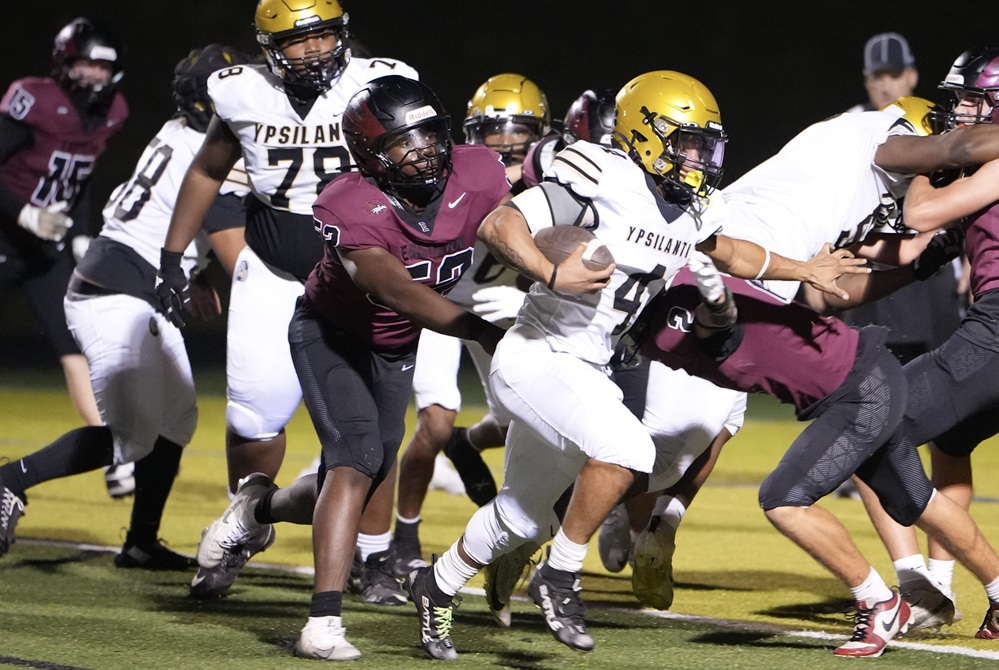
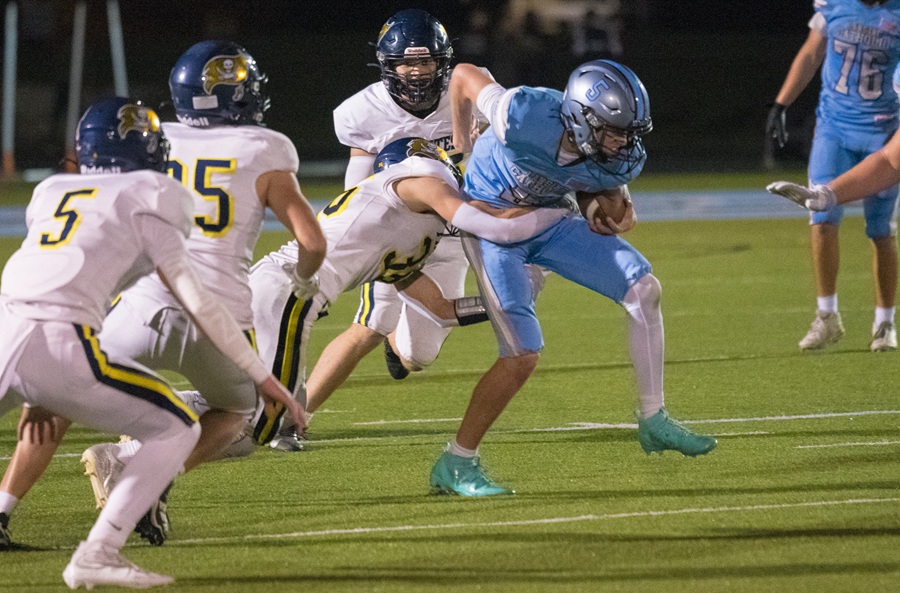
PHOTOS (Top) Ada Forest Hills Eastern defenders close in on a Ypsilanti Community ball carrier during the Hawks' 46-22 win on Friday. (Middle) A Lansing Catholic ball carrier works to break away as Pewamo-Westphalia defenders swarm during a 35-13 victory. (FHE/Ypsilanti photo by Michigan Sports Media. Lansing Catholic/P-W photo by TCP Photography.)