

Calumet Invite Produces Northern Stars
September 18, 2013
By Geoff Kimmerly
Second Half editor
The Calumet Invitational dates back roughly 30 years as an annual staple of the cross country schedule for schools at the northernmost tip of Michigan's Upper Peninsula.
A creative move by the Copper Kings last year added some statewide prestige to the event.
 Last week, for the second season, Calumet ran the series of races at Keweenaw Mountain Lodge, a resort near Copper Harbor and the northern bank of the Keweenaw Peninsula.
Calumet is the northernmost high school in Michigan. And moving this race another 35 miles northeast more or less guaranteed it's the northernmost event run in the state.
"We figured it was pretty safe. We're the northernmost school in the state, and you can only go four more miles and you're in Lake Superior," Calumet athletic director Sean Jacques said. "Nobody else is going to do anything more north than that."
A total of 10 schools were represented this fall in the races for boys and girls varsity, junior varsity and middle schoolers.
Jacques said the event formerly was run at a golf course in Calumet. But a few years ago, Calumet graduate and former Copper Kings cross country runner Dan Harri moved home from Florida to become general manager at the Mountain Lodge (he's also a renowned chef and has owned restaurants in Miami with Hall of Fame Dolphins coach Don Shula).
Harri had asked a few times about bringing a cross country or golf event to the lodge. Jacques told him last year they'd give it a try, so Harri set up a course that includes golf course, a couple of bridges, trails and finishes with a climb on the No. 1 fairway. It also provides various points for fans to watch runners go by, not always available on other courses.
"We were looking for a little bit of a change, and it's a beautiful course," Jacques said. "We thought if people were willing to make the extra drive, it would be really nice."
Calumet won the boys race this season, just ahead of runner-up Houghton. Houghton's girls were victorious, followed by the host Copper Kings.
Click to read more about this year's event from the Houghton Mining Gazette.
Michigan's claim to an NFL evolution
As part of its NFL preview this month, Sports Illustrated reported on one of the most significant developments for offenses over the last few decades – the silent snap count, which is used regularly by visiting teams because offensive linemen can’t hear the quarterback calling for the ball over the clamor of the home crowd.
And the article explained that the silent snap count might’ve gotten its start at one of Michigan’s smallest high schools – Flint’s Michigan School for the Deaf.
Offensive linemen during the 1980s were feasted on by pass rushers like Lawrence Taylor and Bruce Smith, who built record sack totals by blasting past blockers who seemed a step slow. Turns out, that was true. Defensive players were getting an edge by attacking as soon as they saw the ball move. But blockers (especially offensive tackles), focused instead on the defensive ends and linebackers lined up across from them, and didn’t have the luxury of watching the ball – and since they also couldn’t hear the snap count, started each play a step behind.
Enter the silent count. The quarterback signals to the center that he is ready to receive the ball (with a pat on the back, by raising a foot, etc.). The center then raises his head, and after a predetermined count of at least one second snaps the ball without a sound. This means an offensive tackle doesn’t have to listen for a snap count – he just counts after seeing the center get set.
The SI report recognized longtime offensive line coach Howard Mudd as the guru of the silent snap count. But Mudd recalled a conversation he’d had while working for the Seattle Seahawks with another coach, the late Andy MacDonald, who also had coached early in his career at a school for the deaf in Michigan.
The article doesn’t mention Michigan School for the Deaf by name. But it seems to make sense that the Tartars were the first to use the now-revolutionary count. MacDonald – who played at Central Michigan University and went on to coach at Michigan State and four other colleges and also for the Buffalo Bills – grew up in Flint and attended Flint Northern before playing for the Chippewas from 1950-53. The historical web site Michigan-football.com has results for Flint’s Michigan School for the Deaf dating to 1950, making it a decent assumption that MacDonald might’ve gotten in a little early coaching experience at the school down the road from his home.
Click for the SI story and go to page 4 for the mention of Michigan’s school.
Michigan mourns trooper, running standout
The law enforcement community is mourning the death of Michigan State Police trooper Paul Butterfield, who was shot Sept. 9 during a traffic stop in Mason County. He also was a well-known distance runner during the 1980s and the MHSAA Class A cross country champion running for Bridgeport in 1987.
According to a Ludington Daily News report, Butterfield continued running after high school at the University of Tennessee, and also competed at the 1989 Pan American Junior Games in Argentina.
Butterfield was stationed in Hart after previously serving in Manistee, and lived in Mason County. He also had served in the U.S. Army. Click to read more from the Ludington Daily News.
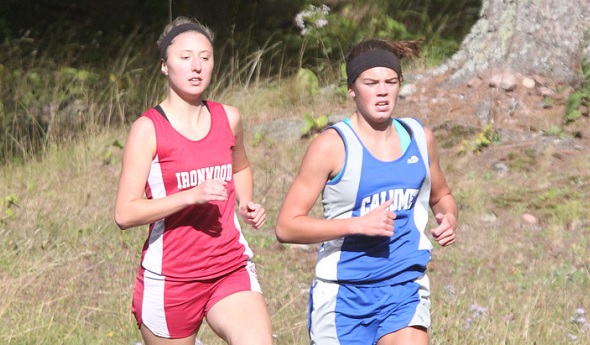
PHOTO: Calumet's Chelsea Jacques (right) won this season's Calumet Invitational with a time of 21:08.06, just ahead of Ironwood's Jessica Gering at 21:46.16. (Photo courtesy of Calumet athletic department.)
Block Party: 2025 Girls Volleyball Week 3 Report
By
Geoff Kimmerly
MHSAA.com senior editor
September 10, 2025
We’re having a party, and volleyball fans everywhere are invited.
Volleyball has become Michigan’s most popular girls high school sport, with nearly 20,000 high school players last season. “Block Party” is our newest MHSAA.com endeavor, and we’ll be providing glances at some of the best and brightest on courts all over the state during the buildup to our annual Finals weekend at Battle Creek’s Kellogg Arena.
We hope these weekly reports – as they have for football and basketball – shine more light on the week-in, week-out competition that shapes every season, and on programs you may already know about but also several more than maybe you’ll read about for the first time.
This season's first matches were played Aug. 20, making this the midst of our third week (and hence, our Week 3 Report). Records, results and schedules below are based on what’s posted for teams and used to calculate Michigan Power Ratings (MPR) on MHSAA.com. Rankings noted below reflect the latest polls posted by the Michigan Interscholastic Volleyball Coaches Association (MIVCA).
Week in Review
The countdown of last week’s five most intriguing results:
1. North Branch d. Monroe St. Mary Catholic Central (25-17, 25-19) The Division 2 No. 3 Broncos finished 6-0 at the Pontiac Notre Dame Prep Invitational, with this toppling of the No. 2-ranked team in Division 3 its best victory.
2. Rockford d. Grand Rapids Christian (25-19, 25-21) The Rams downed the Division 2 No. 2 Eagles and also No. 7 Grand Rapids South Christian among other notables during its Rockford Rumble.
3. Traverse City St. Francis d. Roscommon (25-23, 23-25, 25-20) The Division 3 No. 8 Gladiators’ win over top-ranked Roscommon made a big wave, although St. Francis did also fall to Division 1 Midland Dow on this night.
4. Bloomfield Hills Marian d. Utica Eisenhower (29-23, 19-25, 15-9) This was arguably Division 1 No. 3 Marian’s most impressive win during a MI Elite Program Cup run that also included a two-set sweep of No. 9 Brighton. Eisenhower was ranked No. 6.
5. Monroe St. Mary Catholic Central d. Imlay City (25-18, 20-25, 15-11) SMCC’s only loss at Notre Dame Prep was to North Branch (above), and the Kestrels earned a notable victory over Division 2 No. 5 Imlay City along the way.
Watch List
With an eye toward November, here are two teams in each division making sparks:
DIVISION 1
Bloomfield Hills (15-1-0) The No. 4-ranked Black Hawks did suffer their first loss of the season last week – in two sets to Marian. But they’ve otherwise have been unbeatable with wins over No. 5 Farmington Hills Mercy, honorable mentions Lake Orion and Novi and another Tuesday over Orchard Lake St. Mary’s, which ended Bloomfield Hills’ season last fall in a District Final. The Black Hawks will see Marian again Thursday.
Rockford (16-0-0) As noted above, the top-ranked Rams cruised through their Rockford Rumble, never dropping a set during victories over South Christian, East Grand Rapids, Grand Rapids Christian and Division 1 honorable mention Mattawan. The win over the Eagles was Rockford’s second this fall; they’ve also downed No. 8 Grand Haven, honorable mention Byron Center and Division 2 No. 4 Holland Christian among several impressive squads over the first three weeks.
DIVISION 2
Grand Rapids Christian (7-4-0) The Eagles’ losses have all come to ranked Division 1 teams – twice to Rockford and once apiece to Grand Haven and honorable mention Hudsonville. Meanwhile, Grand Rapids Christian defeated Division 1 No. 7 Jenison and Mattawan at Rockford over the weekend, and most recently Grand Rapids South Christian and Holland Christian at a power-packed tri last week. South Christian had ended the Eagles’ season with a five-set Regional Final loss last year.
Parma Western (9-0-1) The Panthers will pick up Thursday after a two-week match break and are ranked No. 10 in Division 2 coming off last season’s Regional Final run. Their only non-win was a two-set draw with Division 4 honorable mention Adrian Lenawee Christian, and wins over Division 3 No. 4 Pewamo-Westphalia to start the season and No. 9 Hanover-Horton at the Chelsea Invitational stand out most. Parma Western will see No. 9 Tecumseh on Thursday.
DIVISION 3
Monroe St. Mary Catholic Central (10-1-1) The reigning Division 3 champion is off to another fast start, with that loss to North Branch over the weekend and an early two-set tie against New Boston Huron their only non-victories this fall – and the Kestrels have defeated Huron twice since including 25-18, 25-17, 25-12, on Tuesday. SMCC has lost only four sets total, and only one during an eventual match win.
Saginaw Valley Lutheran (9-2-1) The Chargers aren’t ranked at this time but may get some looks soon. They opened the season with a loss to Division 4 No. 7 Crystal Falls Forest Park at the Mount Pleasant Sacred Heart Invitational, but came back to defeat the Trojans in the semifinals that day before falling to still-undefeated Division 1 Greenville in the championship match. Valley Lutheran has lost only one set over six matches since, to Division 2 Williamston at the Owosso Tournament where the Chargers finished 4-0-1.
DIVISION 4
Hancock (8-1-1) The Bulldogs have followed up last season’s run to the Division 4 Semifinals with a fast start, finishing 4-1-1 at the Kingsford Invitational against a field including several larger opponents after finishing 1-2-1 at the same event in 2024. Hancock will have another chance to improve on last season when it heads to The Rock Invite on Saturday at Gladstone – where it went 1-1-1 in 2024.
Mendon (12-1-1) The Hornets are coming off their toughest weekend of these first few, having finished 3-1-1 at the Cereal City Classic with a loss to Division 1 Battle Creek Lakeview and draw with Division 2 Pennfield but wins over Division 1, 3 and 4 opponents. They also opened the fall with a 5-0 run through the St. Joseph County Tournament as they look to build on last season’s Regional Final run.
Can’t-Miss Contests
Be on the lookout for results of these matches and tournaments coming up:
Wednesday – Flint Powers Catholic (7-5-1), Yale (14-2-0), Traverse City St. Francis (9-6-0) at Essexville Garber (9-6-2) – This quad features the No. 8 team in Division 3 – St. Francis – and the Division 2 honorable mention Dukes.
Thursday – Fowler (7-2-1) at Mount Pleasant Sacred Heart (8-3-3) – The Division 4 top-ranked Eagles visit No. 8 Sacred Heart, which reached the Semifinals last season.
Thursday – Frankenmuth (3-3-4), Rochester (1-6-0), Temperance Bedford (9-1) at North Branch (11-0-0) – In addition to North Branch being ranked No. 3 in Division 2, Frankenmuth is No. 8 and Bedford always is a top team in Division 1.
Saturday – Motor City Power Series at UWM Sports Complex in Pontiac – Division 1 No. 4 Bloomfield Hills, honorable mention Northville, previously-mentioned North Branch, Canton, and White Lake Lakeland will make for an intriguing field.
Saturday – Makayla Kohn Memorial Invitational at Caledonia – The field of Mattawan, Edwardsburg, Byron Center, Grand Rapids Forest Hills Northern, Ionia, Portage Central, Cadillac, Ada Forest Hills Eastern, Grand Rapids Forest Hills Central and Traverse City St. Francis includes ranked teams from Divisions 1, 2 and 3.
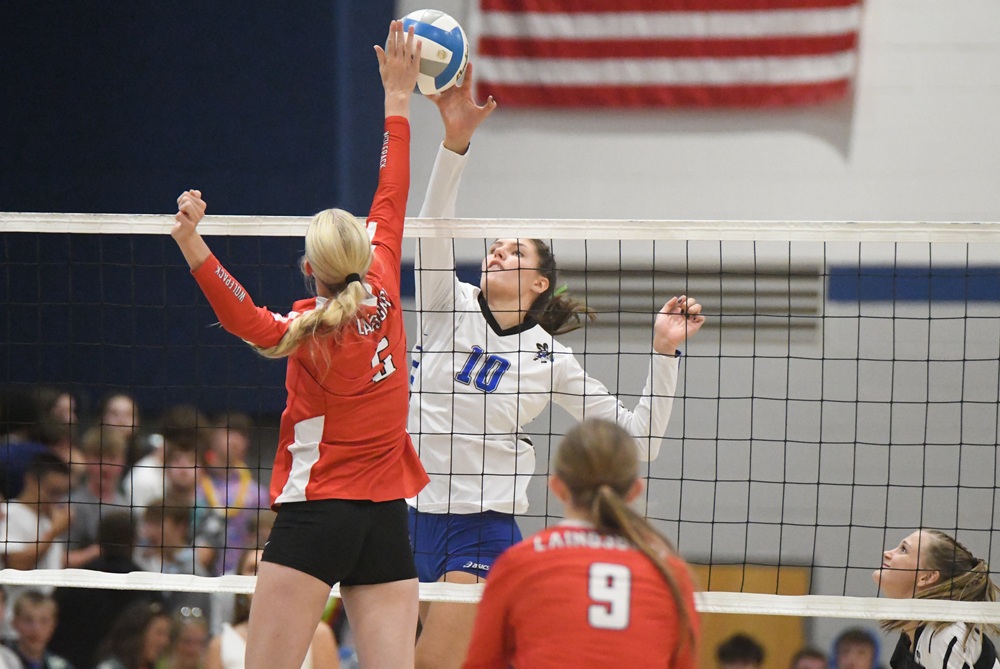
PHOTO Laingsburg and Bath volleyball players meet over the net while connecting with the ball during a match Aug. 27. (Photo by John Johnson.)