


Title IX Continues to Fuel Growth of Girls and Women’s Sports, Olympic Dominance
By
Karissa Niehoff
NFHS Executive Director
September 24, 2021
To say that American female athletes dominated the recent Olympics in Tokyo would be an understatement.
Among the 66 medals earned by American female Olympians – most by any country in the history of the Games – were gold-medal performances by the U.S. basketball, volleyball, water polo and beach volleyball teams. Eighteen medals were earned by the U.S. women swimmers, female track and field athletes claimed 15 medals, and the U.S. women’s softball and soccer teams won silver and bronze medals, respectively.
In the past 30 years of the Olympic Games, the United States has dominated the women’s team sports of basketball (nine golds), soccer (four golds, one silver, one bronze) and softball (three golds, two silvers) — not to mention the untold number of medals in track and field. And this past summer, the U.S. women’s volleyball team claimed its first gold medal.
These performances by some of our nation’s most skilled female athletes never would have been possible without the passage of Title IX and the offerings of these sports through our nation’s schools. With the chance to play afforded by the landmark Title IX legislation in 1972, girls participation in several high school sports skyrocketed in the years that followed.
When the NFHS conducted its first participation survey in 1971, basketball and outdoor track and field were the primary girls sports, comprising about two-thirds of the 294,000 total. However, with the opportunity to play additional sports, girls flocked to volleyball and softball first, along with cross country and eventually soccer.
Soccer, in fact, has had the most remarkable growth. In 1971, only 700 girls were playing high school soccer. Twenty-five years later, that number had climbed to almost 210,000; and as the 50th anniversary of Title IX approaches, there are now almost 400,000 girls playing high school soccer – a staggering 56,200 percentage increase in 50 years. Soccer now ranks fourth in popularity among girls high school sports – all because of that opportunity in 1972.
There are many other success stories, however. The pre-Title IX survey in 1971 indicated that 1,719 girls were participating in cross country. With increases every year until 2015, today, there are 219,345 girls competing in high school programs and the sport ranks sixth in popularity.
Although participation numbers have leveled a bit the past 10 years, fast-pitch softball is another sport that flourished after the passage of Title IX. With fewer than 10,000 participants in 1971, the numbers quickly rose to 220,000 by 1985 and 343,000 by 2000, and softball is currently fifth among girls sports with 362,038 participants.
Since track and field and basketball were the primary sports in the early days of girls sports programs, increases in those sports have not been as dramatic; however, they remain the first and third most-popular sports, respectively, today. Volleyball, however, much like soccer, continues its upward climb.
Without a doubt, volleyball has seen the steadiest increases among girls high school sports the past 50 years. After starting with 17,952 participants in 1971, the numbers jumped to 300,810 by 1990 and 409,332 by 2010 and 452,808 by 2018. During its climb, volleyball surpassed basketball as the No. 2 girls sport.
And among the top six girls sports from 2010 to 2018 (numbers are not available the past two years due to the pandemic), volleyball has gained the most participants (43,476), followed by soccer (32,549). And all of this has occurred thanks to legislation passed in 1972 that was not fundamentally meant to address opportunities for girls to participate in high school sports.
The NFHS is leading a yearlong celebration of the 50th anniversary of Title IX, which officially occurs on June 23, 2022. “Title IX at 50 – Celebrating and Growing Opportunities” is highlighting the law’s impact by celebrating the inspirational individuals and landmark moments in the history of Title IX, and continuing to grow the educational and competitive opportunities for the future.
More information, including a Title IX Timeline, Title IX Milestones, The History and Importance of Title IX, Title IX Fact Sheet, Title IX Frequently Asked Questions and several Title IX videos, can be accessed on the NFHS Website.
Dr. Karissa L. Niehoff is beginning her fourth year as executive director of the National Federation of State High School Associations (NFHS) in Indianapolis. She is the first female to head the national leadership organization for high school athletics and performing arts activities and the sixth full-time executive director of the NFHS. She previously was executive director of the Connecticut Association of Schools-Connecticut Interscholastic Athletic Conference for seven years.
Battle of the Fans: Halftime is G.R. Christian's Time
January 29, 2012
GRAND RAPIDS – For many high school hoops fans, halftime is a break – perhaps an opportunity to grab a pop or some popcorn, catch up with old friends, or at least take a seat and catch a breath.
But for the Grand Rapids Christian student cheering section, it’s no time for rest. Those 10 minutes might be when Eagle Nation does its best work.
For this “Battle of the Fans” finalist and its six senior leaders, halftime is their time. Some schools play music between halves, or run contests on the floor. At Grand Rapids Christian, everyone knows that after two quarters of supporting the play on the court, the halftime action is in the stands.
It’s cheer after cheer after cheer, with only a few 20-second breaks along the way.
“People get into it, and it’s over in a flash,” senior Jesse Ludema said.
“We frown on down time,” senior Evan Metcalf added. “You can have down time when you get home.”
Grand Rapids Christian is one of five finalists for the MHSAA Student Advisory Council’s “Battle of the Fans” competition. MHSAA staff visited both the Eagles and Reese on Friday after starting the tour Jan. 21 at Frankenmuth. Trips will be made to both Rockford and Petoskey over the next three weeks, with videos posted of all five finalists on the MHSAA Facebook page. After an online vote and SAC discussion, the winner will be announced on Feb. 24. Clips from all five MHSAA-produced videos will be shown during the Girls and Boys Basketball Finals in March at the Breslin Center.
Eagle Nation prides itself on bringing the same enthusiasm to every game. But it was tough to ignore the extra juice Friday, with Grand Rapids Christian facing rival East Grand Rapids. The schools are just 2.5 miles apart, and their two football games this fall received hype statewide.
Eagle Nation’s senior leaders contributed in those grudge matches as well – but from their spots in the stands. “Our school is better served with us in the stands than on the field,” senior Joe Schierbeek laughed.
Ludema sarcastically agreed: “They don’t need my ‘huge’ muscles; they need our loud voices.”
So what happened when Grand Rapids Christian’s second-quarter buzzer sounded?
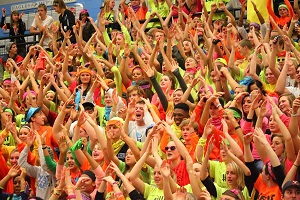 Students go bananas in a cheer led by costumed senior leader Cody Powers. Each Eagles class – seniors through freshmen – takes its turn doing a collective hip shake, a favorite in the Eagle’s Nest. A boxer throws left and right uppercuts before landing a knockout blow that falls the entire section backward. And on this night, Michigan State basketball coach Tom Izzo was in attendance and got some love from Eagle Nation – although it is only unconfirmed speculation that Izzo was there to check in on the “Battle of the Fans” craze.
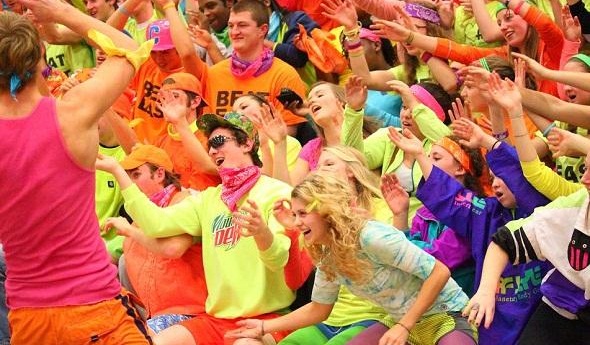
Eagle Nation plans a theme for every home game, and Friday was all about neon. More than 400 students packed the sections behind the north basket, glowing in all hues of neon covering T-shirts, tank tops, pants, socks and head bands. Those six leaders each wore a hot pink tank top, with one letter painted on each spelling E-A-G-L-E-S. With help of the administration, the leaders even sold bright $1 bandannas to everyone in the student section to top off the neon look. Even the basketball team got into the act: Players surprised their classmates by wearing neon-green ankle tape and those same neon bandannas during warm-ups.
While Eagle Nation had been loud in the past, this level of organization debuted this school year. Before, the students were always told to just cheer louder, but without much of a plan. Now, there’s a Facebook group. Theme nights are mentioned with other school announcements. On Friday, leaders held a lunchtime pep assembly for student section members, and they had a similar training assembly with eighth graders earlier last week.
Leaders also take seriously the word “Christian” spelled out in the name on their team's uniforms. Being an example of their faith is a priority.
“People don’t see what happens in our school every day. And when they come to games, they see our student section, and they take that as an example of who we are as a school,” Powers said. “So we want to show them who are, and that’s why we value character.”
“That’s not to say we don’t get rowdy, though,” Schierbeek quickly interjected.
In the end, it’s all about having fun – a theme that played loudly in Frankenmuth as well. Metcalf watched the Frankenmuth video with a big smile. “Let’s visit them,” he said. "We can have a fan section dance party.”
But first the focus is on winning the “Battle of the Fans,” which to this student section is its “state finals.”
With his voice almost gone, Ludema gave some advice to the other finalists.
“Cheer loud,” he said. “And get some throat lozenges.”
View Grand Rapids Christian's application video, created by GRCHS senior Andrew Pruim.
PHOTOS by Grand Rapids Christian junior Janina Pollatz.Report by the MHSAA's Andy Frushour.