

5 Tips to Prevent Sports-Related Injuries
December 3, 2019

Henry Ford Health System
Participating in sports provides so many benefits to kids and teens. There are the obvious benefits of physical fitness and promoting regular exercise. Then, there are also the character-building lessons learned from being part of a team, working hard toward a goal, celebrating tough competition and gracefully accepting defeat. But sports don’t come without some risk.
Sports-related injuries are the leading cause of emergency room visits for kids ages 12-17, according to the Centers for Disease Control and Prevention (CDC).
These injuries impact twice as many males as females. Not surprisingly, contact sports also have higher injury rates. Football, basketball, baseball and soccer account for roughly 80 percent of all sports-related emergency room visits for children.
Sports injuries depend on the age of the athlete and the type of sport played, according to Bridget McArdle, D.O., a Henry Ford pediatrician. Generally, she says, sports injuries are divided into two groups: injuries from overuse like strains and tendonitis, and acute injuries such as concussions, fractures and tears.
The teen years pose special hazards, too. The adolescent growth spurt places teens at higher risk for injuries.
“The growth plates could still be open, which increases the risk for damage,” Dr. McArdle says. “This can lead to long-term problems.”
5 Important Injury Prevention Tips
Fortunately, many sports-related injuries can be prevented — the CDC estimates that as many as half of them could be avoided.
Here are Dr. McArdle’s tips for injury prevention for parents and coaches:
1. Ease into training. It’s important to start gradually in order to decrease the chance of sports injuries. “When you train too quickly at full peak, you are more likely to get hurt. Ease into it – and don’t overdo it,” says Dr. McArdle.
2. Cross train. Changing up the way your child trains is one way to help prevent sports injuries. “Taking a break from one sport to play another is important,” she recommends. Training a different way and using different muscles decreases the strain placed on the same body parts. Practicing gentle stretching exercises such as yoga or Pilates can also help, she adds.
3. Use the right equipment. Everything from the proper shoes and appropriate, properly fitted safety gear for the particular sport are essential for minimizing the risk of injury, as well.
4. Avoid excessive heat. The American Academy of Pediatrics (AAP) recommends young athletes avoid heat illness by wearing light clothing and drinking plenty of fluids before, during and after exercise or play. Coaches should decrease or stop practices during high heat or high humidity periods.
5. Take time to recover. If a sports injury does occur, taking time to recover is very important. Returning to play too soon increases the risk of making the injury worse, and increases the chance of long-term consequences. “Make sure the injury is completely healed before returning. Don’t allow your child to play through pain,” advises Dr. McArdle.
If you have questions or concerns about your child’s readiness to play, be sure to get a sports physical and talk with your pediatrician or primary care provider.
Dr. Bridget McArdle is a board-certified pediatrician, seeing patients at Henry Ford Medical Center – Sterling Heights.
Want to learn more? Henry Ford Health System sports medicine experts are treating the whole athlete, in a whole new way. From nutrition to neurology, and from injury prevention to treatment of sports-related conditions, they can give your athlete a unique game plan.
Visit henryford.com/sports or call (313) 972-4216 for an appointment within 24 business hours.
Flashback 100: One Last Look Back as We Turn Focus Toward Future
July 10, 2025
We hope you’ve enjoyed this school year's retrospective on some of the most iconic athletes and personalities who began their journeys in MHSAA sports. While we’ve done our best to highlight a diverse range of individuals across various sports and professions, a single year simply isn’t enough to capture every standout story.
Michigan high schools have produced an incredible array of talent — and the following, in addition to those we've wrote about over the last 10 monrths, are just another glimpse of that legacy:
- Kirk Gibson (Waterford Kettering) – The 1988 National League MVP also played a pivotal role in the Detroit Tigers’ 1984 World Series championship and starred in football as well at Michigan State.
- Jake Long (Lapeer East) – Selected as the NFL’s No. 1 overall draft pick in 2008, he's among a distinguished list of Michigan high school alums to go early in the draft, including Braylon Edwards (Harper Woods Bishop Gallagher, No. 3 in 2005), Carl Banks (Flint Beecher, No. 3 in 1984), Jerome Bettis (Detroit Mackenzie, No. 10 in 1993), and Tyrone Wheatley (Dearborn Heights Robichaud, No. 17 in 1995).
- Jeff Daniels (Chelsea) – Before becoming a renowned actor with credits like The Newsroom, Escanaba in da Moonlight, and Dumb and Dumber, Daniels was a high school baseball player.
- Lisa Byington (Portage Northern) – A trailblazing broadcaster, she serves as the play-by-play voice for the Milwaukee Bucks and regularly appears on CBS during NCAA Basketball Tournaments.
- Kristin Haynie (Mason) – She was first athlete to play in both the NCAA Women’s Division I Basketball Championship and the WNBA Finals in the same calendar year.
- Jalen Rose, Voshon Lenard, and Howard Eisley – This trio of NBA professionals once shared the court at Detroit Southwestern, making it one of the most talent-rich high school teams in state history.
- Jim Abbott (Flint Central) – Born without a right hand, Abbott defied the odds to pitch for 10 seasons in Major League Baseball.
- Earl Morrall (Muskegon) – He was named NFL MVP in 1968 and enjoyed a long and successful pro football career.
- Charlie Gehringer (Fowlerville) and Hal Newhouser (Detroit Wilbur Wright) – Both legends of Major League Baseball, each captured MVP honors during their Hall of Fame careers.
- Kate Markgraf (Detroit Country Day) – A champion at every level of soccer, she earned titles in high school and college, an Olympic Gold Medal, and a FIFA World Cup victory.
- Allison Schmitt (Canton) – One of the most decorated American swimmers of all time, Schmitt has earned 10 Olympic medals.
- Jason Richardson (Saginaw Arthur Hill) and Charles Rogers (Saginaw) – Both were drafted among the top five in their respective college sports (Richardson to the NBA in 2001, Rogers to the NFL in 2003) and faced off against each other as part of one of the state's most historic basketball rivalries.
- Staying with the city of Saginaw, Draymond Green (Saginaw) won a basketball championship in high school (2007) and then four in the NBA (2015, 2017, 2018, 2022) after being drafted in the second round of the 2012 draft by the Golden State Warriors.
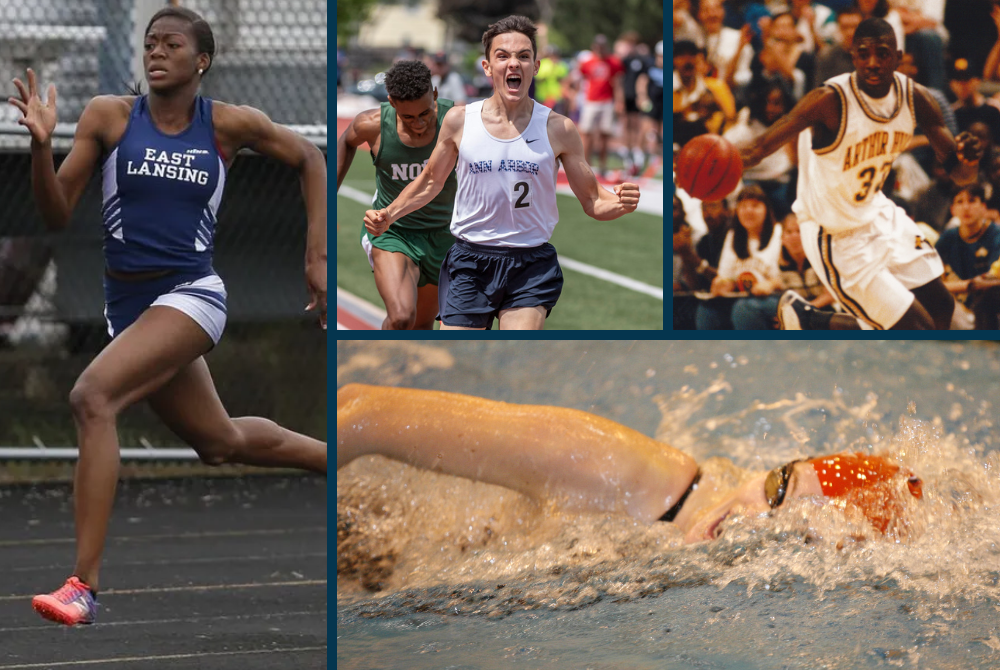
And the legacy continues. Olympic gold medal dreams are alive in track & field standouts like Taylor Manson (East Lansing), Hobbs Kessler (Ann Arbor Skyline), and Grant Fisher (Grand Blanc), who are already well-accomplished on the worldwide stage.
So, who’s next?
Who will be the next MHSAA athlete selected on draft night? Hoisting an MVP trophy? Standing atop the podium as a champion?
We don’t know yet — but as we close the book on the first 100 years of MHSAA history, we can’t wait to see what the next century will bring.
Previous "Flashback 100" Features
June 23: Hutchinson's Dominance Starts as Multi-Sport Divine Child Standout - Read
June 10: Wagner's Dream of Going on Tour Realized - with Greta Van Fleet - Read
May 23: Tarpley's Legendary Run Began as Portage Central's Miss Soccer - Read
May 16: Scane’s Record-Setting Lacrosse Run Began at Cranbrook Kingswood - Read
May 8: Duckett's High School Domination Extended to Shot Put Circle - Read
May 6: MHSAA Titles Just Start for NCAA Champion, Olympian Stark - Read
May 1: Legendary Actor Played Multiple Sports Roles at Country Day - Read
April 23: Legacy Program Provided Start for Pioneering NBA Official Schroeder - Read
April 11: Rice's Championship-Winning Ways Started at Flint Northwestern - Read
March 28: Youngquist's Times Still Among MHSAA's Fastest - Read
March 18: After 40 Years, Coles' Shot Remains Among Century's Most Famous - Read
March 7: Walled Lake Northern's Hellebuyck Reigns as NHL's Elite Netminder - Read
Feb. 27: Zeerip's Mat Stats Remain Rarely-Challenged Chart Toppers - Read
Feb. 21: Before TV Stardom, Kerwin Excelled as All-State Skier - Read
Feb. 14: Detroit Central Star Voted into Pro Football Hall of Fame - Read
Feb. 6: Multi-Sport Star Look Becomes Super Bowl Officiating Legend - Read
Jan. 31: Johnson Family Put Magical Stamp on Michigan High School Hoops - Read
Jan. 24: Future Hall of Famers Face Off First in MHSAA Class A Final - Read
Jan. 17: First-Ever WNBA Draft Pick Rocked at Salem, Won Titles at Tennessee - Read
Jan. 10: Despite Launching Before 3-Point Line, Smith Still Tops Scoring List - Read
Jan. 3: Edison's Jackson Earns Place Among State's All-Time Elite - Read
Dec. 20: Future Olympian Piper Leads Grosse Pointe North to Historic Heights - Read
Dec. 13: The Other Mr. Forsythe in Michigan School Sports - Read
Dec. 6: Coleman's Legendary Heroics Carry Harrison Through Repeat - Read
Nov. 29: Harbaugh Brothers' Football Roots Planted in Part at Pioneer - Read
Nov. 22: 8-Player Football Finals Right at Home at Superior Dome - Read
Nov. 15: Leland Career Helps Set Stage for Glass' International Stardom - Read
Nov. 8: Future Baseball Pro Led Escanaba's Legendary Football Title Run - Read
Nov. 1: Michigan High School Baseball Trio Provide World Series Voices - Read
Oct. 25: Before Leading Free World, Ford Starred for Champion GR South - Read
Oct. 18: Mercy Links Legend Becomes World Golf Hall of Famer - Read
Oct. 11: Fisher Races to Finals Stardom on Way to U.S. Olympic First - Read
Oct. 4: Lalas Leaves High School Legacies on Ice & Pitch - Read
Sept. 27: Tamer's History-Making Run Starts in Dexter, Continues to Paris - Read
Sept. 20: Todd Martin’s Road to Greatness Starts at East Lansing - Read
Sept. 13: James Earl Jones, Dickson High Hoops to Hollywood Legend - Read
Sept. 6: Pioneers' Unstoppable Streak Stretches 9 Seasons - Read
Aug. 30: Detroit dePorres Rushes to 1995 Class CC Football Championship - Read
PHOTOS Clockwise from left: Taylor Manson sprints for East Lansing, Hobbs Kessler wins a race for Ann Arbor Pioneer, Jason Richardson plays in a Class A Basketball Final for Saginaw Arthur Hill and Allison Schmitt swims a championship race for Canton. (Manson photo courtesy of the Lansing State Journal; Kessler photo by RunMichigan.com. Others are MHSAA file photos.)