

Navigating Twists, Turns Of Ankle Sprains
November 30, 2020

Henry Ford Health System
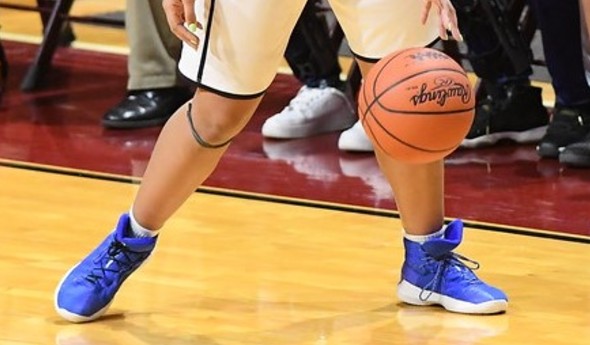
Oh, how the ankle turns! If you’ve had a misstep or wrong turn result in a sprained ankle, you know how painful this injury can be. Henry Ford podiatric surgeon Paul Di Liddo, DPM, discusses ankle sprains and treatments.
Ankle Injury 101
From risk factors to treatments (and nearly everything in between), here’s what to know — and do — about ankle sprains.
Sprained Ankles Are Painfully Common
In fact, they’re among the most frequent injuries in the United States, with up to 25,000 people per day spraining their ankles. Although often associated with sports, ankle sprains can happen to anyone, anywhere. “I see ankle sprains from tripping over curbs, stepping in holes in a yard or simply walking,” says Dr. Di Liddo. “Ankle sprains — like accidents — happen.”
Ankle Sprains Injure Ligaments
“Ankle sprains occur when the ankle suddenly and forcefully twists or rolls past a point that the ankle ligaments can tolerate,” remarks Dr. Di Liddo. “The ankle ligaments will stretch or tear, either partially or completely.” An ankle can twist, turn or roll during a fall, jump or change of direction, while walking on uneven ground and more.
A Weak Ankle Is A Vulnerable Ankle
Most sprained ankles heal without long-term concern. In some cases, however, ligaments may not fully heal, resulting in a weak or unstable ankle. “A weak or unstable ankle can make an individual more susceptible to repeated ankle sprains,” explains Dr. Di Liddo.
High Arches Can Be Risky Business
People who have high-arched feet are more at risk of rolling — and therefore spraining — their ankles. So are people who have “loose joints,” because the ankle can overstretch with a seemingly minor twist. People who are at-risk for ankle sprains should take extra precautions when playing sports or performing other activities.
Some Sprains Can Be Treated At Home — Emphasis On Some
How you treat a sprained ankle depends on the severity of the injury. Minor sprains can be treated at home with the RICE method. The RICE method include:
- Rest by avoiding use of the injured ankle
- Ice applied to the ankle (without touching the skin) for no more than 20 minutes every three to four hours
- Compression with an elastic bandage
- Elevation above the heart
Ice, compress and elevate your ankle for the first few days. Rest and refrain from sports until ankle pain and swelling have subsided.
At-home treatments aren’t right for everyone — or every ankle injury. “A swollen ankle is typical if you have experienced a sprain,” says Dr. Di Liddo. “However, if you have severe ankle swelling, are in extreme pain or notice an odd ankle appearance, seek medical attention.” This is also true if you can’t walk more than a few steps or have limited ankle mobility. A foot and ankle specialist can diagnose your injury and begin treatment.
Ankle Treatments Abound
Ankle sprain treatments are designed to decrease pain and swelling, while protecting the ligaments from further injury. Treatments include wearing an ankle brace, walking boot or cast. Physical therapy to strengthen the ankle and maintain range of motion may also be incorporated after the ligaments have started to heal.
“Of course, for more severe injuries, a thorough physical exam and X-rays are necessary,” says Dr. Di Liddo. “This helps ensure that there is no other underlying injury, such as a fractured ankle or Achilles tendon rupture.”
Healing Times Vary
The recovery time for a sprained ankle depends on the severity of the injury. Sprains with minimal ligament stretching and no tear require one to three weeks. Partially torn ankle ligaments may take up to six to eight weeks to heal. A fully torn ligament can take several months to fully heal.
What To Do When Ankle Problems Persist
For people who continue to experience ankle instability, there are a host of options. “Physical therapy is the first step — but not the only one,” says Dr. Di Liddo. “If physical therapy has not been beneficial, we can discuss surgical approaches.”
Surgical options include:
- Ligament repair or reinforcement via an outpatient procedure
- Osteotomy, which is surgical cutting of bone, to lower arches when ankle instability is caused by high arches
For those with frequent ankle sprains or instability, a medical assessment is necessary and may include:
- Physical exam
- X-rays to assess bones and joints
- MRI to evaluate ankle ligaments
With this information in mind, you can prevent — or address — the twists and turns of ankle sprains.
Want to learn more? Henry Ford Health System sports medicine experts are treating the whole athlete, in a whole new way. From nutrition to neurology, and from injury prevention to treatment of sports-related conditions, they can give your athlete a unique game plan.
Visit henryford.com/sports or call (313) 972-4216 for an appointment within 24 business hours.
Century of School Sports: MHSAA Programs Prioritize Health & Safety
By
Geoff Kimmerly
MHSAA.com senior editor
April 29, 2025
Rank the top 10 conversations anyone would choose to have when it comes to school sports – be it talking up top teams, the latest stars, past champs, etc. – and advances in health & safety probably come in somewhere around No. 27.
But no topic has been or will remain more important to generating and maintaining successful athletic programs at every level of sport – including the high school and junior high/middle school levels administered by the MHSAA.
From the start of organized school athletics in Michigan more than 100 years ago, health and safety have been priorities. Sports safety concerns – especially in football – helped drive the creation of organized sport administration. Longtime policies – like the one ceasing activity for 30 minutes for lightning or thunder – have become part of daily life in athletics. Other measures, like MHSAA-provided insurance coverage to assist families who experience catastrophic injuries in school practices and competitions, aren’t even known by most – but can be life-altering for those who require those benefits.
For most of this century, the MHSAA’s health & safety initiatives have focused on the “4 Hs” coined by retired executive director Jack Roberts – Health Histories, Heads, Heat and Hearts. Those were the drive of much of his work especially over the final decade of his tenure before he retired in 2018 after 32 years.
Current executive director Mark Uyl’s time leading the association has seen the MHSAA begin work in mental health and create a Sports Medicine Advisory Committee (SMAC) during the 2019-20 school year. He also led the MHSAA through its successfully safe return to play amid COVID-19 and the pandemic’s aftermath.
Health and safety information is contained in every preseason coaches meeting, which all coaches (head and assistant) are required to take. The MHSAA also has a strong relationship with the Michigan Athletic Trainer’s Society (MATS), who have a representative serving on every MHSAA sport committee along with the SMAC.
Along the lines of major initiatives, here are highlights:
Histories: Although pre-participation physicals long have been required, the MHSAA took a significant step incorporating student and family history with the introduction of new physical forms in 2011. The current form includes several questions not only about the participant receiving the physical, but also heart-related questions about family members.
Heads: The MHSAA was among the first states to adopt a return-to-play protocol requiring an athlete to be cleared by a doctor, physician’s assistant or nurse practitioner, with that protocol also not allowing the athlete to return to participation until at least the next day after a possible head injury. At the start of the 2015-16 school year, the MHSAA launched the largest state-led sideline testing pilot program for concussions, providing a pair of screening tests so those injuries could be detected during practice and competition. Also since 2015-16, the MHSAA has required member high schools to report all potential head injuries and several details including when they took place (practice or competition) and how long students were treated before returning to activity – another first-of-its-kind initiative nationally. The MHSAA currently works with the University of Michigan Concussion Center to provide the most up-to-date information on the subject.
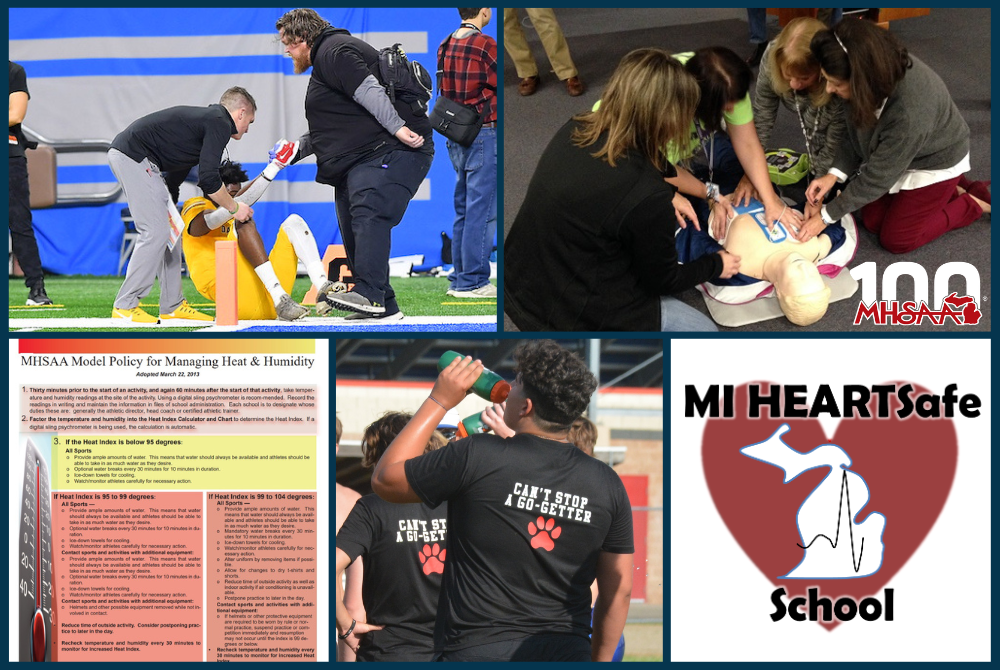
Heat: Long a megaphone for hydration and other best practices for preventing heat-related illnesses, the MHSAA took a major step with the creation of its “Model Policy for Heat and Humidity” for the 2013-14 school year that designates limits to activities (including a complete stop) based on heat index. While the policy is mandated for MHSAA Tournament activity, several schools have adopted the policy for the regular season as well. The MHSAA continues annually to renew awareness of heat management with its “Heat Ways” preseason guide for fall sports.
Hearts: The MHSAA has focused on providing tools so that as many people as possible are prepared to help during a cardiac event. Beginning with the 2015-16 school year, all varsity head coaches have been required to have CPR certification – and that requirement has been extended to head coaches at all high school and junior/middle school levels, ensuring that at least one person on site for every game and practice is trained in this life-saving technique. The MHSAA also has worked with MI HEARTSafe to in part get more AEDs into schools. Beginning this school year, the MHSAA required schools to build emergency action plans (EAPs) specific to sport and venue. And, as noted above, the preparticipation physical also asks questions about an athlete’s family history of heart health, so medical professionals can identify early situations that may require further investigation.
Mental Health: Annual rules meetings include required training in the be nice. program provided by the Mental Health Foundation of West Michigan. The MHSAA also has worked with Ithaca athletic director Terry Hessbrook to promote his B#4 Foundation and its work in suicide prevention and mental health awareness.
Sports Medicine Advisory Committee: The SMAC, made up of experts from the medical and educational communities, meets twice a year to consider topics and make recommendations relevant to health and safety in school sports.
Insurance: All the way back in 1940-41, the MHSAA became one of the first state associations nationally to provide accident benefit insurance to its constituents. The insurance provided over the years has evolved into a catastrophic claims policy beginning with the 1970-71 school year, and then in 2015-16 to include benefits specific to head injuries. The MHSAA’s insurance policy continues to cover deductibles and co-pays left unpaid by other policies for head injuries resulting during school practices or competitions, and at no cost to either schools or families.
There have been other notable moments over the years. Often, the MHSAA has taken action on health and safety issues before other governing bodies have produced mandates – for example, during the 1999-2000 season, MHSAA ice hockey players were required for the first time to wear neck guards that did not become mandatory nationally until this past winter.
More recently, the MHSAA instituted acclimatization rules specific to football and also limits on the amount of practice contact – to the minute – allowed per week. The MHSAA also has chimed in on air pollution created by wildfires, mosquito-borne eastern equine encephalitis and other situations that could potentially impact school sports, and partners with the United Dairy Industry of Michigan to provide nutrition information and awareness at events and on the MHSAA website.
These aren’t the first subjects that come to mind when fans talk about school sports – and that’s fine. But it’s our job, with school administrators, coaches and officials, to always have them front of mind – and we gladly do so to keep sports as safe as possible for hundreds of thousands of athletes whose achievements remain our favorite topics of conversation as well.
Previous "Century of School Sports" Spotlights
April 23: Patches Signify Registered Officials' Role in MHSAA Story - Read
April 16: Student Advisory Council Gives Voice to Athletes - Read
April 9: State's Storytellers Share Spring Memories - Read
April 2: Sharp Leadership Synonymous with MHSAA Success - Read
March 25: Athletic Directors Indispensable to Mission of School Sports - Read
March 18: 2025 Finals Begin Next Half-Century of Girls Hoops Championships - Read
March 11: Boys Basketball's Best 1st to Earn MHSAA Finals Titles - Read
March 5: Everything We Do Begins with Participation - Read
Feb. 25: Slogans & Logos Remain Unforgettable Parts of MHSAA History - Read
Feb. 19: MHSAA Tickets Continue to Provide Fan-Friendly Value - Read
Feb. 11: We Recognize Those Who Make Our Games Go - Read
Feb. 4: WISL Conference Continues to Inspire Aspiring Leaders - Read
Jan. 28: Michigan's National Impact Begins at NFHS' Start - Read
Jan. 21: Awards Celebrate Well-Rounded Educational Experience - Read
Jan. 14: Predecessors Laid Foundation for MHSAA's Formation - Read
Jan. 9: MHSAA Blazes Trail Into Cyberspace - Read
Dec. 31: State's Storytellers Share Winter Memories - Read
Dec. 17: MHSAA Over Time - Read
Dec. 10: On This Day, December 13, We Will Celebrate - Read
Dec. 3: MHSAA Work Guided by Representative Council - Read
Nov. 26: Finals Provide Future Pros Early Ford Field Glory - Read
Nov. 19: Connection at Heart of Coaches Advancement Program - Read
Nov. 12: Good Sports are Winners Then, Now & Always - Read
Nov. 5: MHSAA's Home Sweet Home - Read
Oct. 29: MHSAA Summits Draw Thousands to Promote Sportsmanship - Read
Oct. 23: Cross Country Finals Among MHSAA's Longest Running - Read
Oct. 15: State's Storytellers Share Fall Memories - Read
Oct. 8: Guided by 4 S's of Educational Athletics - Read
Oct. 1: Michigan Sends 10 to National Hall of Fame - Read
Sept. 25: MHSAA Record Books Filled with 1000s of Achievements - Read
Sept. 18: Why Does the MHSAA Have These Rules? - Read
Sept. 10: Special Medals, Patches to Commemorate Special Year - Read
Sept. 4: Fall to Finish with 50th Football Championships - Read
Aug. 28: Let the Celebration Begin - Read