


NFHS Voice: Participants Show Resilience
September 28, 2020
By Karissa Niehoff
NFHS Executive Director
The resiliency of players, coaches and leaders in high school activity programs the past seven months has been amazing. As attempts continue to offer all sports and performing arts this year, these individuals are making the most of tough times and demonstrating great resolve to change.
No doubt, high school juniors and seniors involved in high school sports and performing arts would have preferred a less turbulent end to their high school days, but many have been willing to go to great lengths to have an opportunity to participate.
In Michigan, when football was initially moved to the spring, student-athletes had two choices: be upset that their sport was postponed or seize the moment and look for new opportunities. Royce Daugherty of Watervliet High School chose the latter.
A 6-foot-3, 300-pound two-way starter last year as a freshman on the Watervliet football team, Daugherty opted to join the cross country team! He said he decided to run cross country because it would help him get tougher mentally and physically.
Daugherty’s decision was perhaps predictable given that he played four sports – football, wrestling, basketball and baseball – as a freshman. Although the switch was short-lived with Michigan reinstating football a couple of weeks ago, Daugherty’s resilience is remarkable and a good predictor of future success.
In Colorado, with football on hold this fall, members of the Limon High School two-time defending Class 1A state football championship team petitioned the school administration to resurrect the golf program.
“Sports are our lifeline,” said Andy Love, the school’s baseball coach who agreed to coach the golf team, in an article posted on CHSAANow. “Our community follows our sports so strongly. It gives our kids this great atmosphere and environment whether it’s the football field, the basketball court or whatever. Our community rallies around our kids.”
Turning a problem into an opportunity, the Limon High School football players and staff demonstrated the never-give-up spirit of high school activities.
In Kansas, with the heading of “the show must go on,” the Goodland High School athletic director and superintendent stepped in to coach the football team a few weeks ago because the head coach and assistant coach were quarantined during the week. The result? Goodland, a Class 3A school, defeated Liberal High School, a Class 5A school!
Coaches have demonstrated resiliency as well by finding new ways to conduct competition and keep students engaged. In Minnesota, at a swimming meet between Chaska High School and Bloomington Kennedy High School, Chaska swimmers occupied lanes 1 to 4, while Kennedy swimmers were in lanes 5 to 8 for social distancing purposes.
In the same state, the South Suburban Conference decided to conduct virtual swim meets this fall. Each team competes in 11 races in their own pool, and the coaches compare times to determine scoring. Two methods in the same state, both done to keep students engaged but to minimize risks of the virus.
On the performing arts side, teachers and leaders have benefited from an aerosol study conducted by the NFHS and more than 125 other organizations to determine best practices. In some cases, band and other music programs were moved to the spring, but leaders continued to engage with students in many innovative ways.
Larry Friend, assistant principal of Caesar Rodney High School in Camden, Delaware, in a Dover Post article, told his students, “This is not the time to put the instruments aside. This is not the time to stop singing. This is not the time to run away from your passion. This is an opportunity to run toward your passion and to find what it is that motivates you to reconnect.”
Band directors in Michigan – like those in many other states – are finding new ways to keep music going during the pandemic – from outdoor band camps to all-virtual rehearsals.
“We have some really incredible band directors doing some really neat things locally,” said Josh Bartz, director of bands at Portage Northern High School in an interview with WWMT-TV in Kalamazoo.
In the same interview, Chris Ludwa, assistant professor of music at Kalamazoo College, said, “I think you will always find ways to make art. Oftentimes, when in society there is deep need, deep pain, struggle, oppression – that’s the time when art flourishes.”
These are but a few of the great stories that have occurred across the country as players, coaches, administrators, officials, parents and fans are making the most of tough times. While these student participants may not become stellar athletes at the next level or excel at higher levels in the arts, their resiliency through these tough times will play a major role in their future success.
High school activity programs – building resilient people for the future of our nation.
Dr. Karissa L. Niehoff is starting her third year as executive director of the National Federation of State High School Associations (NFHS) in Indianapolis, Indiana. She is the first female to head the national leadership organization for high school athletics and performing arts activities and the sixth full-time executive director of the NFHS, which celebrated its 100th year of service during the 2018-19 school year. She previously was executive director of the Connecticut Association of Schools-Connecticut Interscholastic Athletic Conference for seven years.
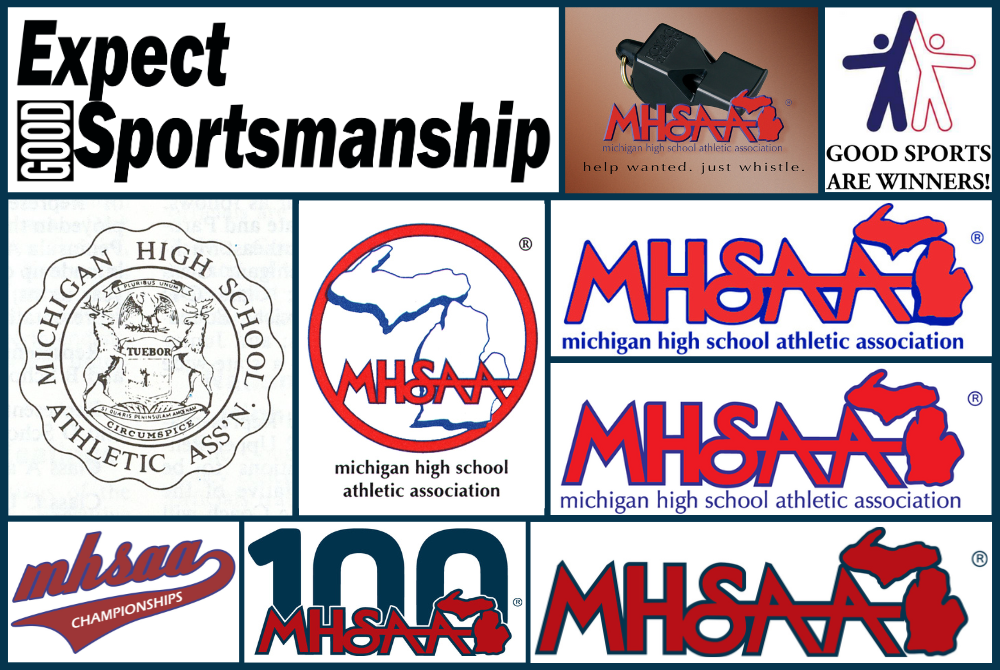
Century of School Sports: Slogans & Logos Remain Unforgettable Parts of MHSAA History
By
Geoff Kimmerly
MHSAA.com senior editor
February 25, 2025
Logos and slogans are meant to stick in your mind – and the MHSAA has created several that have become synonymous with the story of school sports.
When was the first time you saw the MHSAA logo? For me, it was on a ticket to watch my school at the 1993 Girls Basketball Semifinals at Kellogg Arena.
And I thought “Good Sports Are Winners” was just something everybody said about all things sportsmanship. I had no idea it headlined as the first of now several memorable MHSAA statements meant to do precisely what it did inside my teenage head – bury itself in our minds so we would hopefully recall the importance of being a good sport whenever we heard it.
The MHSAA’s “Century of School Sports” have really included only about a half-century of this type of messaging and branding. But no matter if you’ve spent your time with us as an athlete, coach, administrator, official, fan or a combination of those roles, some of what follows should jog your memory – and hopefully stir up plenty of good ones as well.
- Good Sports Are Winners!
Jack Roberts was hired as the MHSAA’s fourth full-time executive director in 1986. His first hire was John Johnson as one of, if not the first-of-a-kind communications director at a high school athletic association in the nation. One of their first undertakings was a campaign to improve sportsmanship – and “Good Sports Are Winners!” became their first and perhaps still most recognizable phrase.
- Sportsmanship Begins At Home
- We Need You To Be A Good Sport!
Sportsmanship is an idea that never graduates, but it also needs to be reintroduced frequently as generations of families make their ways through middle school to high school graduation. These were two more messages meant to encourage appropriate behavior at sporting events.
- Help Wanted: Just Whistle
- You Can Be A Referee
Recruiting and retaining game officials also is an annual drive, and these became part of the slogan-sphere over the last 15 years as those efforts increased due to decreasing numbers. “Be the Referee” became a weekly segment of the “This Week in High School Sports” five-minute show that airs on radio stations all over the state during the fall and winter seasons, and they always end with the call out “You Can Be A Referee” to enlist those who might be interested.
- We Are The MHSAA
This carried a certain boldness when read over the microphone at tournament events, and summed up neatly what being part of the MHSAA was all about. Paraphrasing: “We are … Coaches … administrators … and officials. … We are your school. We promote and protect the privilege of interscholastic competition. We make rules and follow them as a condition of membership. … We Are The MHSAA.”
- Promoting The Value – And Values – Of Educational Athletics
This sums up the MHSAA’s work and remains perhaps the favorite of all slogans used to describe it. We believe educational athletics have value – to participants, to their communities, and to society as a whole because of the adults they help produce. We also believe that educational athletics are reliant on specific values – sportsmanship, scholarship, safety and scope.
Those are the messages you’ve likely heard. But producing an identifiable image with the MHSAA and its work has been just as important – and below are explanations behind some of the familiar logos you see at the top of this page.
- First Logo: A Traditional Emblem (Last Used in 1987-88)
The first MHSAA logo featured the seal from the state flag, with “Michigan High School Athletic Association” surrounding it. It appeared on medals and official documents through the 1987-88 school year.
- The Round Logo: A Recognizable Symbol
In 1988, the MHSAA introduced a circular logo featuring Michigan’s Upper and Lower Peninsulas within a red border, with "MHSAA" prominently displayed.
- The Championship Logo: A Mark of Excellence
During the early 2000s, the MHSAA introduced a “championship” logo initially for tournament merchandise. Over time, it became the standard for all championship-related materials.
- The Modern MHSAA Logo: Evolving with Time
Debuting in 1987 – and designed by a pair of Sterling Heights Stevenson students as part of a contest – the modern logo introduced the bold "MHSAA" lettering with an interwoven "S" designed to convey motion and energy. Over time, its contours softened while maintaining its distinctive look. Initially, "Michigan High School Athletic Association" appeared beneath it, but in recent years, the text was removed for a cleaner, more streamlined design.
- The Centennial Celebration Logo
To mark its 100th anniversary, the MHSAA introduced a centennial logo, honoring its history. This commemorative design reflects a century of commitment to student-athletes and school communities.
Previous "Century of School Sports" Spotlights
Feb. 19: MHSAA Tickets Continue to Provide Fan-Friendly Value - Read
Feb. 11: We Recognize Those Who Make Our Games Go - Read
Feb. 4: WISL Conference Continues to Inspire Aspiring Leaders - Read
Jan. 28: Michigan's National Impact Begins at NFHS' Start - Read
Jan. 21: Awards Celebrate Well-Rounded Educational Experience - Read
Jan. 14: Predecessors Laid Foundation for MHSAA's Formation - Read
Jan. 9: MHSAA Blazes Trail Into Cyberspace - Read
Dec. 31: State's Storytellers Share Winter Memories - Read
Dec. 17: MHSAA Over Time - Read
Dec. 10: On This Day, December 13, We Will Celebrate - Read
Dec. 3: MHSAA Work Guided by Representative Council - Read
Nov. 26: Finals Provide Future Pros Early Ford Field Glory - Read
Nov. 19: Connection at Heart of Coaches Advancement Program - Read
Nov. 12: Good Sports are Winners Then, Now & Always - Read
Nov. 5: MHSAA's Home Sweet Home - Read
Oct. 29: MHSAA Summits Draw Thousands to Promote Sportsmanship - Read
Oct. 23: Cross Country Finals Among MHSAA's Longest Running - Read
Oct. 15: State's Storytellers Share Fall Memories - Read
Oct. 8: Guided by 4 S's of Educational Athletics - Read
Oct. 1: Michigan Sends 10 to National Hall of Fame - Read
Sept. 25: MHSAA Record Books Filled with 1000s of Achievements - Read
Sept. 18: Why Does the MHSAA Have These Rules? - Read
Sept. 10: Special Medals, Patches to Commemorate Special Year - Read
Sept. 4: Fall to Finish with 50th Football Championships - Read
Aug. 28: Let the Celebration Begin - Read