

School Sports Reflection: Play to Learn
December 7, 2018
By Christopher Mundy
Special for benchmarks
Christopher Mundy is a graduate of Manton High School and Michigan State University and the principal of Mundy Advisors Group in Chicago. This commentary previously was published this summer in the Traverse City Record-Eagle.
What are sports really about today? And are today's parents missing the point? Time, money, effort and energy. All for what? Trophies, medals, first place, a college scholarship or that top-five draft pick and that multi-million dollar contract that come with it. Fortune and fame?
Why does American society have such an obsession with sports, and are the true values of the games being lost in the “new” modern era of sports?
What if the games kids played were for the pure values of competition, hard work, camaraderie, trust, respect, discipline, communication and relationship building? Even just expressing these words and phrases seems healthier than the win-at-all-cost, everyone-gets-a-trophy, playing for the “end game” society we currently live in.
What messages are we instilling/infusing in our future leaders? It has become a strong and consistent message across all fronts – the arms race to be the best and win at all costs.
Families sacrificing their most precious resources, time and money, for what? For the golden child, the chosen child ... that special one. A glimmer of hope that becomes a burning obsession (for the parent). Are parents attempting to right their wrongs of their playing days or relive their youth through their child? It is an easy and complex trap.
I don’t have children, but I have played sports for nearly 40 years. I have coached, officiated, watched and listened closely at all levels. A spectator with an intense passion for the lessons to learn and a strong curiosity of why and how. I guess at 45 I am old ... or maybe just old-school.
Being raised on an isolated farm in Northern Michigan with a dirt driveway and a makeshift basketball hoop created the love affair with sports. Games of pig, horse or around-the-world with my father are some of my fondest memories. He has since passed. He would always shoot with his off-hand or easy bunny shots to finish me off. And Dad always told me, if you want to play in the fourth quarter, be a 90-percent free-throw shooter and the coach has to put you in.
Baseball would entail games of rain on the roof by myself and a homemade batting tee to hit home runs into the pasture. Football was either offense-defense (three-person football, with my father as quarterback) against my older sister or breakaway running plays against my aggressive dogs; a stiff-arm was my best defense. No video games or cable television on our farm, maybe this fueled my fire or forced my hand. It sure did not make friends want to come over for sleepovers.
Small town America was a great place to be raised. I am biased in that regard. I do think it takes a village to raise a child. Sports was and is the fiber of these communities; it was reality TV before reality TV, and what Friday Night Lights was based on. Kids playing a game for a common goal. It could not be more simple or pure. They are called “games” for a reason. When did we start taking it so seriously? Where did we go wrong?
In high school, we were pretty good. You put kids together since kindergarten and they kind of know and trust each other, they know each other’s strengths and weaknesses. They know more than this. They know each other’s families. And extended families. They pretty much know everything about each other. Which family is broken and which one may have a little more love at their dinner table. Good or bad, this is the reality of being raised in a small town.
Our basketball team was so good we received a top-five ranking, and legendary Detroit Free Press writer Mick McCabe compared us to Hickory, Indiana, in the movie “Hoosiers.” No Hollywood ending for Manton in 1991 though.
This is where the lessons of sports become real; the harsh reality of your childhood fantasies begin to fade, and fade quickly. The hours spent in that driveway will lead to no state championships. The early morning trips to the gym to play against your adult coaches would lead to no college scholarships. And the thousands of hours in the weight room lifting, jumping rope and wearing ankle weights would lead to no multi-million dollar contract. Devastating. Crushing. The end?
No. This is just the beginning.
This is the beginning of life’s toughest lessons being learned. This is where the sweat of your youth meets the tears of maturity, leading to a wisdom that is worth more than any trophy. Maturity is processing these challenging life lessons, learning from them and moving on. If you do not let go of these failures, the burdens can lead you to a life of regret or maybe becoming that aggressive parent trying correct his or her shortcomings through a son or daughter. You know these parents from your kid's games, and I hope you are not one of them.
It has often been stated more is learned from losing than winning. The lessons from failure burn deep, etched into our soul, this pain more powerful than the glory of victory. These lessons and scenarios easily translate to our personal relationships and work life. Memorable. Powerful anecdotes that become part of us. Part of or history. Part of our story. Erase these chapters from our lives, and what are we left with? A shell of a person. A half-written book. A journey half-walked. Perspective with no depth.
These kinds of lessons can’t be learned in a textbook, cannot be explained by a parent or modeled by a teacher in a classroom. The field, the court, the rink is where these lessons are learned. Where family values are refined. Manners are taught. And respect is earned.
Or is it?
This is the crossroads we are at as a society. I cannot think of any other vehicle that offers so much potential and opportunity for the building of character. It starts with the family. And where does it go from there? School, church, a job. The military. A fraternity. Volunteering? An internship or apprenticeship? A civic organization?
Nope. Sports.
Sports is the most dynamic and able tool to build character. The kind of character we need right now as a country and society. Polished. Refined. Character with a sharp edge. An edge called courage. But the reality is sports has become about money, power and control. Are these qualities desirable? Have they corrupted the innocence of sports? Do we worship false idols? Is this generation entitled? Have we given them too much? Made it to easy?
Are the kids having fun? What do the kids want? Do kids have and show a genuine passion for a sport? Have we dared to ask them? Have we prepped them with the appropriate answer? Or do we answer for them? Do we hear them OR do we listen to them? To clarify, listening is an active process of hearing and then processing. Coach Tom Izzo starts each basketball camp with, “Learn to listen ... and listen to learn.” It is that simple.
I do think communication is vital to this process. Communication between all parties: athletic directors, coaches, parents and players. Governing bodies. All stakeholders. A real and raw dialogue on what we collectively want out of sports. Because somehow we have gotten lost, and the many headlines and feature stories confirm the crossroads where we’ve arrived.
Do we as leaders, adults, parents care enough to look into the mirror and ask the tough questions? Or is it just easier to proceed as is? If you believe sports has a larger impact than trophies, medals and ribbons, a larger value than money, then I encourage you to start the conversation with those around you. Our communities’ futures depend on these conversations.
We may soon reach a point of no return, and this would be a catastrophic failure for our generation. When playing for the “love of the game” is just a marketing tagline and not a real opportunity for our kids. For our children’s sake, I hope this is not the case. I know I am a better athlete, better professional and better human from all the losses in my life.
Play hard. Play to compete. Play with passion. Play to learn.
Century of School Sports: From Nearly A to Z, Schools Repped by 221 Nicknames
By
Geoff Kimmerly
MHSAA.com senior editor
May 20, 2025
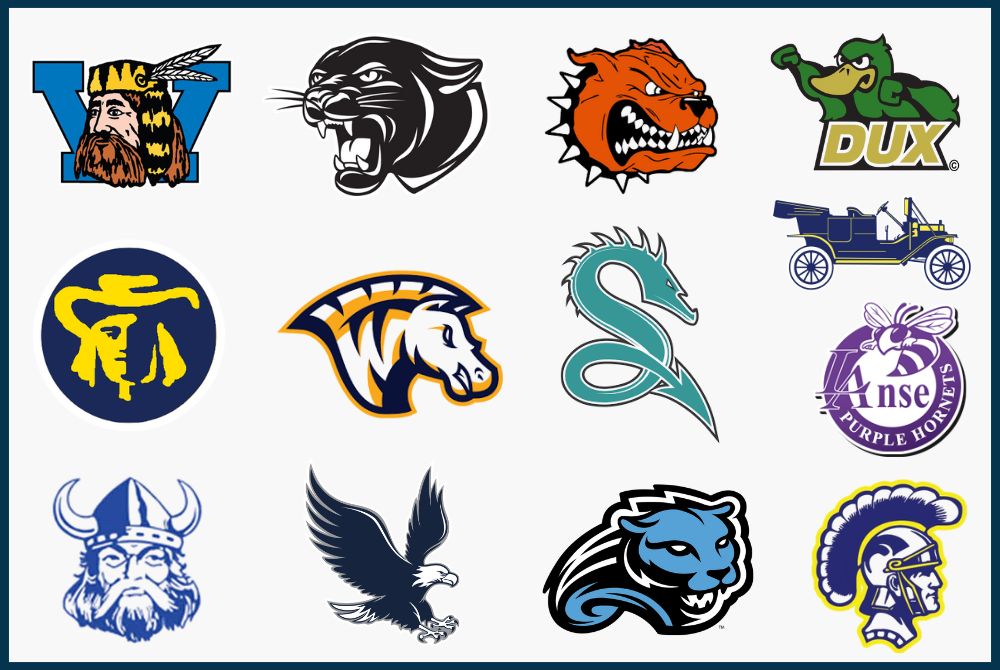
Combine all the Bronchos, Cubs, Loggers, Purple Hornets and Tractors running around Michigan’s sports fields on any given day, and they still would have some work to catch up with the wide scattering of Eagles representing their Michigan high schools across the state.
There are a combined 221 mascots representing the MHSAA’s 754 member high schools this 2024-25 school year.
A total of 127 schools have a mascot reserved all to themselves, including those five listed above – Holly (Bronchos), Detroit U-D Jesuit (Cubs), Boyne Falls (Loggers), L’Anse (Purple Hornets) and Dearborn Fordson (Tractors).
And then there are the Eagles. A total of 48 schools are represented by the fearsome birds of prey, and that’s not counting the Golden Eagles (Brooklyn Columbia Central), Aztec Eagles (Detroit Cesar Chavez Academy) and Soaring Eagles (Hannahville Nah Tah Wahsh).
The next-most popular nickname – Panthers – is adorned by 28 schools, followed by 26 Bulldogs, 23 Vikings and 22 Wildcats. Rounding out the top 10 are Falcons and Cougars (both 20 schools), Trojans (19), and Tigers and Warriors (both 18). The Mustangs (15 schools), Pilots (11) and Comets, Lakers and Spartans (10) also reach double digits.
There have been several mascot changes of late as a number of schools have moved away from Native American names and imagery. Those have resulted in a few new sets of Red Devils, Red Wolves/Wolves, and RedHawks/Red Hawks as the most popular selections among those making a switch.
Another fun fact: Every letter but “U” and “X” start at least one MHSAA member high school nickname.
Big assist to the Quakers (Lansing Eastern) and Zebras (Wayne Memorial) for cutting down that list – and keep an eye out for Underdogs and Xylophones coming to a school near you.
Previous "Century of School Sports" Spotlights
May 13: These Record-Setters were Nearly Impossible to Defeat - Read
May 6: 200+ Representatives Fill All-Time Council Roster - Read
April 29: MHSAA Programs Prioritize Health & Safety - Read
April 23: Patches Signify Registered Officials' Role in MHSAA Story - Read
April 16: Student Advisory Council Gives Voice to Athletes - Read
April 9: State's Storytellers Share Spring Memories - Read
April 2: Sharp Leadership Synonymous with MHSAA Success - Read
March 25: Athletic Directors Indispensable to Mission of School Sports - Read
March 18: 2025 Finals Begin Next Half-Century of Girls Hoops Championships - Read
March 11: Boys Basketball's Best 1st to Earn MHSAA Finals Titles - Read
March 5: Everything We Do Begins with Participation - Read
Feb. 25: Slogans & Logos Remain Unforgettable Parts of MHSAA History - Read
Feb. 19: MHSAA Tickets Continue to Provide Fan-Friendly Value - Read
Feb. 11: We Recognize Those Who Make Our Games Go - Read
Feb. 4: WISL Conference Continues to Inspire Aspiring Leaders - Read
Jan. 28: Michigan's National Impact Begins at NFHS' Start - Read
Jan. 21: Awards Celebrate Well-Rounded Educational Experience - Read
Jan. 14: Predecessors Laid Foundation for MHSAA's Formation - Read
Jan. 9: MHSAA Blazes Trail Into Cyberspace - Read
Dec. 31: State's Storytellers Share Winter Memories - Read
Dec. 17: MHSAA Over Time - Read
Dec. 10: On This Day, December 13, We Will Celebrate - Read
Dec. 3: MHSAA Work Guided by Representative Council - Read
Nov. 26: Finals Provide Future Pros Early Ford Field Glory - Read
Nov. 19: Connection at Heart of Coaches Advancement Program - Read
Nov. 12: Good Sports are Winners Then, Now & Always - Read
Nov. 5: MHSAA's Home Sweet Home - Read
Oct. 29: MHSAA Summits Draw Thousands to Promote Sportsmanship - Read
Oct. 23: Cross Country Finals Among MHSAA's Longest Running - Read
Oct. 15: State's Storytellers Share Fall Memories - Read
Oct. 8: Guided by 4 S's of Educational Athletics - Read
Oct. 1: Michigan Sends 10 to National Hall of Fame - Read
Sept. 25: MHSAA Record Books Filled with 1000s of Achievements - Read
Sept. 18: Why Does the MHSAA Have These Rules? - Read
Sept. 10: Special Medals, Patches to Commemorate Special Year - Read
Sept. 4: Fall to Finish with 50th Football Championships - Read
Aug. 28: Let the Celebration Begin - Read