Preview: Classic Clashes and Broken Records Expected
By
Geoff Kimmerly
MHSAA.com senior editor
June 5, 2021
The attention that will be paid to one of the Lower Peninsula Boys Track & Field Finals on Saturday will go past usual interest in just a local school or single division.
Many eyes will be turned to the Division 1 meet, featuring among many Ann Arbor Skyline senior Hobbs Kessler, who has made national news over the last few weeks by setting the national high school record in the 1,500 (3:34.36) and qualifying for the Olympic Trials in the event.
But he’ll be facing some familiar competition in his distance races at East Kentwood – including Hartland junior Riley Hough, who edged Kessler by two seconds in the Division 1 cross country final this past fall.
Their matchup is just one of many stories worth tuning in for this weekend. Events at all four sites begin at 10 a.m. (EDT) and tickets to attend can be purchased online only at GoFan. The meets also will be broadcast on MHSAA.tv and viewable with subscription. Click to watch each division: LPD1 | LPD2 | LPD3 | LPD4.
Below is a glance at team contenders and individuals to watch in all four divisions.
Division 1 at East Kentwood
Top Regional scores: Macomb Dakota 160, Traverse City West 145½, Northville 136, Novi 136.
Team forecast: East Kentwood won the last three championships before COVID, with Ann Arbor Pioneer finishing runner-up in both 2018 and 2019. Dakota is an interesting possibility this time with qualifiers throughout the meet. Fenton has top-three seeds in six events, and Zeeland West is another team with scoring opportunities in a variety of events.
Trey Gardette, Ann Arbor Huron: The senior sprint star has taken amazing strides over the last two years and may be on the verge of an unforgettable finish to his high school career. Gardette’s top-seed 10.5 in the 100 is a blink faster than the LPD1 Finals record of 10.53, and he’s second-seeded in the 200 and also will run on the 400 relay.
Riley Hough, Hartland: The I-96 corridor has been the center of distance running this school year, and Hough hopes to follow his Division 1 cross country championship in the fall with titles in the 1,600 and 3,200. He’s seeded first in the former with a 4:13.93.
Hobbs Kessler, Ann Arbor Skyline: He’s slated to run the 800, 1,600 and 3,200 and on the top-seeded 3,200 relay (7:53.30) Saturday. He won all three of those open races at his Regional, and so while he isn’t top-seeded in any that likely means little as he could drop major time.
Tamaal Myers II, Detroit Cass Tech: The Technicians standout junior has the top 110 hurdles seed time (14.06) by nearly a second and is tied for the top seed time in the 300 (39.32). He’ll also run the 400 and on the 1,600 relay.
Brandon Miller, Fenton: He finished fifth in the 200 as a sophomore in 2019, but he can take a massive leap Saturday as his top seed time in that race (21.25) is five hundredths of a second off the meet record. He’s also the second seed in the 100 with a seed time of 10.60 that is seven hundredths of a second off that meet record. And he’ll also run on contending 400 and 800 relays.
Division 2 at Zeeland
Top Regional scores: Orchard Lake St. Mary’s 216½, Dearborn Divine Child 186, Frankenmuth 164.
Team forecast: Four teams have won this championship over the last four seasons. Flint Powers Catholic is a possibility to make it five as it runs for its first team title led by sprint standouts and relays. Frankenmuth with top qualifiers in the sprints, relays and field events is another to watch in what lines up to be a low-scoring team race. A total of 10 schools won championships in this division over the previous 11 seasons before 2020 was canceled.
Ryan Brenner, Frankenmuth: The senior Eagles hurdler is the top seed in the 300 with a time of 40.1 and also will run on the top-seeded 1,600 relay (3:28.44) and high jump.
Jamal Hailey, Berrien Springs: The standout junior sprinter has the top seed time in the 100 (11.04) and the third-fastest in the 200, and he’ll also run on the second-seeded 400 relay.
Austin Hamlin, Flint Powers Catholic: The Chargers sophomore would play a major role in any team title pursuit, entering with the top seed in the 200 (22.5), third-fastest in the 100 and as part of the top-seeded 400 relay (43.3) and fourth-seeded 800 relay. That 400 relay time is a second off the meet record.
Alex Mansfield, Monroe Jefferson: The junior thrower is another who has made a major move over the last two years. He enters Saturday with the top seed in the shot put (56-3) by two feet and the top seed in the discus (163-11) by nearly 10.
Luke Stowasser, Edwardsburg: The junior Eddies jumper also is top-seeded in both of his events, with a 22-6½ in the long jump and 6-10 in the high jump. That high jump is six inches better than the field and two off the meet record. He was the high jump runner-up as a freshman.
Division 3 at Jenison
Top Regional scores: Grass Lake 132, Caro 129, Pewamo-Westphalia 126 1/3.
Team forecast: Grass Lake will be pursuing its first team title since 1970 and has six top-four seeds leading the way. Figuring the next few contenders is difficult with points looking to be spread among a number of teams.
Brennan Bargesser, Grass Lake: A drive for the team championship would include significant points from Bargesser, who is seeded first in the 200 (21.98) and 400 (49.34) and second in the 100 for his final high school meet. He’ll also run on the top-seeded 400 relay (44.14) – that seed time is one second off the meet record.
Hunter Jones, Benzie Central: The sophomore standout has two Division 3 cross country championships to his credit and will make his Track Finals debut as the top seed in the 3,200 (9:37.42) and a likely contender in the 1,600 and 800 as well.
Josh Jones, Harrison: He’ll close his high school career running the 800, 1,600 and 3,200, with his 1,600 seed time (4:19.84) topping that event list.
Brenden Quackenbush, Chesaning: He’s set to establish himself in both throws at this level Saturday, with the top seed in the discus (143-0) by nearly two feet and the third seed in the shot put.
Derrick Voltz, Carrollton: A qualifier in the 100 as a freshman in 2019, he could cap his junior season as a two-event champion. He’s seeded first in the long jump (23-2) by nearly a foot with that leap only five inches off the meet record. He’s also the top seed in the 100 (11.11) just ahead of Bargesser.
Division 4 at Hudsonville
Top Regional scores: Lutheran Westland 171, Reading 170, Carson City-Crystal 147.
Team forecast: Kalamazoo Hackett Catholic Prep was the back-to-back champion before COVID, and Saugatuck was the Division 3 runner-up in 2019 but is back in Division 4. Saugatuck won’t run a relay this weekend but has favorites in the hurdles and distance events, and Breckenridge’s strengths in the sprints and relays should make it a team title contender as well as it seeks its first championship.
Coleman Clark, Carson City-Crystal: The lone returning champion in this division won the 3,200 as a sophomore in 2019 and will run that race along with the 800 and 1,600 and as part of the top-seeded 3,200 relay (8:19.40).
Benny Diaz, Saugatuck: The junior sprint/hurdles standout could make a run at four individual titles Saturday or next season. He’s the top seed in both hurdles races this time (15.01 in the 110 and 40.59 in the 300), and the fourth seed in the 200 and seventh in the 100. He was third in Division 3 in the 300 as a freshman.
Zane Forist, Carson City-Crystal: He was the runner-up in the discus and eighth in the shot put as a freshman two years ago, and he’s aiming for much more this time. His top-seed throws of 196-8 and 64-4, respectively, would both set LPD4 championship meet records – both by roughly six feet.
Nik Pettinga, Saugatuck: A top distance runner in cross country the last few seasons, he is looking to finish as a champion in his last high school meet and enters as the top seed in the 1,600 (4:26.99) and second seed (to junior teammate Max Sharnas) in the 3,200.
Charlie Steinhaus, Breckenridge: The speedy senior would help lead any charge for a team championship, entering as the top seed in the 100 (11.01) and second in the 200. He’ll also run on the top-seeded 400 relay (44.51) and second-seeded 800 relay.
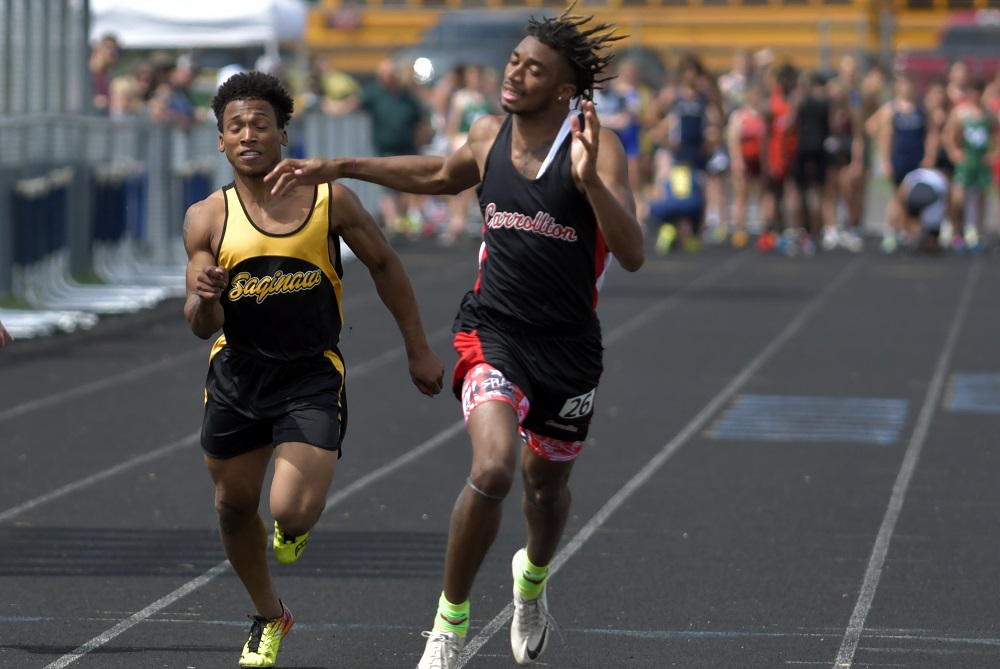
PHOTO: Carrollton’s Derrick Voltz, right, breaks across the finish line during the 100-meter preliminaries at his Division 3 Regional at Shepherd last month. (Click for more from High School Sports Scene.)
Century of School Sports: Boys Basketball's Best 1st To Earn MHSAA Finals Titles
By
Ron Pesch
MHSAA historian
March 11, 2025
Administratively, the world changed when the present Michigan High School Athletic Association was formed in the fall of 1924. That October, Battle Creek High School’s Alden W. ‘Tommy’ Thompson was hired on a full-time basis as state director.
“This position, which is a new one in Michigan, has for its purpose the centralizing of authority over all secondary school athletics in the state, including public high schools, and all private and parochial institutions,” noted the Battle Creek Enquirer at the time of his hiring. “It will take the place of the old Michigan Interscholastic Athletic Association, which was composed of the principals of the high schools of the state.”
Coach and director of athletics at Battle Creek since 1919, Thompson moved to Lansing following the close of Battle Creek’s football season and began his new position on November 17. While the job included full management of tournaments, there was little time to alter processes and procedures for the winter season. So, the 1925 basketball tournament – now celebrating its 100th year under guidance from the MHSAA – really did not look much different from the year previous.
Tournaments to name Michigan boys basketball champions date back to 1916. A recent enlargement of Waterman Gymnasium at the University of Michigan prompted the school to host a tournament in 1917. With four available courts, it was felt that the tournament could handle more than 60 teams and still be run in three days.
In 1920, the Michigan Interscholastic Athletic Association took control of prep athletics and the tournament. Among its first actions was to split the finals between Ann Arbor and East Lansing each year. That year, Class A final-round games were played at U of M in Ann Arbor, while Class B games were hosted at Michigan Agricultural College (M.A.C.) – now Michigan State University – in East Lansing. Sites were reversed in 1921. The addition of Class C, segmenting the tournament further, came in 1922, and those games were played in the same city as Class B. (The pattern was followed until 1926, when Thompson and staff added a championship round for Class D to the mix.)
The Mechanics of a Tournament
In January, Director Thompson announced that District tournaments (sometimes referred to as sectional) would be held at six locations across the state, designed to reduce the field of contenders to 24 teams for the final three rounds of the tournament. They would be held at Central Normal in Mount Pleasant (two teams advancing each from Class A, B, and C), Western State Normal in Kalamazoo (two teams each from Class A, B, and C), Michigan State Normal in Ypsilanti (two teams each from Class A, B, and C), the Detroit public schools (two from Class A), Petoskey (one from Class B and two from Class C), and Northern State Normal at Marquette in the Upper Peninsula (one regardless of Class to play in Class B) in mid-March.
The final rounds of the 1925 games were scheduled for March 26–28. Continuing the set-up of rotating sites, winners and runners-up in the Class A Districts received invitations to the playoff at M.A.C. while the Class B and C pairs were invited to the tourney at U of M.
Class A was defined as schools with enrollments of 500 or more students, Class B – 175 to 499, and Class C – 100 to 174. Schools with enrollments of fewer than 100 students comprised Class D and had the option to play in the Class C tournaments. Those hard and fast enrollment numbers meant an imbalance of teams in each class. Simply put, there were fewer schools in Class A and Class B than there were in Class C, and hence, fewer games needed to establish a final field of teams.
This method for setting the field for the final rounds certainly fashioned some stellar matchups. Sampled news from the time – sometimes conflicting in the account – gives a feel for the coverage by sports reporters from the daily and weekly newspapers.
Narrowing the Field
The seventh annual District Basketball Tournament hosted at Central Michigan Normal School – now Central Michigan University – featured a whopping 76 teams! Due to the number of schools of small enrollment competing, officials split opponents across six classifications: A (4), B (11), C (16), D (20), E (16), and F (9), with only A, B, and C eligible for the upcoming M.A.C. and U of M events. Games kicked off on Wednesday evening, March 18, with five Class B games. According to media coverage, this was the largest of any high school District tournament ever held in Michigan, with games played across four floors. A total of 66 contests were played during the two days and three evenings of the tournament.
“The city was almost taxed to capacity by the big crowd of players and rooters,” stated the Isabella County Enterprise in coverage of the games. “The athletic department wishes to thank the citizens who co-operated by renting their rooms at a very reasonable price to our guests.”
“Between 700 and 800 boys were entertained in Mt. Pleasant homes. From all parts of the district came scores of automobiles bringing rooters from the home towns,” recalled the 1925 Central Normal yearbook in its two-page remembrance of the event. “Effervescent high school youth was in its glory. … The large gymnasium was packed with spectators hours before the principal games started, and crowds filled three other floors where elimination contests were in progress. Cheer after cheer echoed through the Normal gymnasium from eight o’clock in the morning until after eleven o’clock at night. The court became a kaleidoscope of colors as new teams arrayed in brilliant hues followed each other in quick succession.”
Class B was declared as the most exciting series of the Central Michigan tourney. Among the entries was Reed City, state champions among the Class C teams in 1924. With enrollment just slightly above the limit, they bumped into Class B but still finished the regular season unbeaten. In the opening round that Wednesday evening, the team “celebrated its advent into faster company by defeating Lapeer, 36-8,” according to special coverage of the tourney in the Saginaw News Courier.
On Thursday evening, the Red and Black found themselves in a front-to-back thriller with Alma. Trailing 10-9, Reed City nailed a field goal just as the timekeeper’s final whistle blew marking the game’s end. The crowd rushed the floor in victory. But simultaneous to the shot, a referee had called a foul. After the two officials consulted with the timekeeper, it was determined the foul occurred before the attempt, so the basket was waved off. The court was cleared, the teams called back, and Reed City was awarded two shots from the line. The celebration was dramatically short-lived. “Due to the extreme nervous tension attending such a situation, neither of the free throws was successful,” detailed a sympathetic writer in the Osceola County Herald.
The “Southwestern Michigan Sectional Tournament” held at Western Normal – today’s Western Michigan University – featured 60 schools: nine in Class A, 16 in Class B, and 35 in Class C. Grand Haven, the defending Class B champion, and St. Joesph, runner-up to the 1924 title, were again expected to emerge as representatives in 1925. To the surprise of many, Sturgis topped St. Joseph in the semifinals, 19-11, then downed Grand Haven, 21-16, in the final round of the ‘B’ games. Front page news in the Grand Haven Tribune noted disappointment. “The Havenites took the floor in foot-weary condition and couldn’t get started until the final half when they outscored Sturgis. … The entire Grand Haven team was tired from their three hard preceding games and the effects of (a) hard season of basketball were easily seen.” Still, as runner-up, the team would have a chance for redemption in Ann Arbor.
Jackson, the defending Class A champion, again emerged from a field of eight Class A schools in the District tournament at Michigan State Normal College in Ypsilanti.
At Northern Normal, Lake Linden – located about 30 miles from the northern-most point of Michigan – beat Negaunee, 33-26, for the right to play in the downstate tourney.
At Detroit, the city league championship tournament established Southeastern with clear claim to the metropolitan crown, but Detroit Northwestern and Detroit Southwestern tied for second place in the final league standings. Time would not allow a playoff between the two teams to determine a logical second representative.
Owen. A. Emmons, supervisor of athletics of Detroit high schools, initially pitched the idea of sending the three Detroit schools to the M.A.C. tournament. Thompson rejected the idea stating each District could send no more than two teams. Emmons countered with sending the schools that tied for second to East Lansing and giving Southeastern an automatic berth to the era’s prestigious annual National Cage tournament hosted by the University of Chicago, entering its eighth year that April. Thompson volleyed back that “only a state championship team which had won its title on the playing floor was eligible to represent Michigan at Chicago.”
Forced by Thompson to decide, Emmons chose Southwestern as the second representative based on a better overall showing in the regular season, and a point differential displayed in the league championship series.
With that determined, the field was set for the championships.
The bigger task for the MHSAA and their director still lay ahead.
“There has been some fault found by the schools in the manner of conducting the district tournaments in basketball,” noted the Detroit Free Press. “It is claimed that 60 or 75 teams cannot (properly) decide a district champion in the space of two or three days. Teams that are up in the running for the honors must play two and sometimes three games a day, and the district tourney gradually develops into an endurance contest with the title depending more upon brawn than upon skill and cleverness of play.”
Thompson recognized this and stated he was working on a new plan with the state’s athletic council, with a goal of determining a new approach following the 1925 tournament.
The 1925 Championships
According to the Lansing State Journal, “permanent trophies will be awarded the winner and the runner-up, while individual medals will be given members of the two teams.” Drawings for first-round matchups took place during the afternoon of Thursday, March 26, once coaches arrived. A consolation tournament was scheduled for Class B and Class C teams defeated in the opening round. There would be no such tournament for Class A.
Jackson and Kalamazoo again went head-to-head in the first-round quarterfinals at M.A.C. Kalamazoo had entered the postseason with a dismal 4-9 regular-season record. Among its losses was an 18-11 defeat by Jackson in January during which Kalamazoo led 9-5 at the half, shutting down Jackson star Jessie Drain, who was 0-9 shooting before the break. But Jackson tied the game in the third quarter, 10-10, then cracked the visitors’ defense in the fourth for a convincing win.
Minus their captain, Bruce Masselink, Kalamazoo put up a major fight in the rematch. “Jackson had anything but a walkaway when if defeated Kalamazoo Central 29 to 21 in an overtime game,” stated the Jackson News. “Time and again Kalamazoo had opportunities to put the game on ice in the last quarter, but missed easy shots and kept Jackson in the race for the state championship …”
Jackson held a 13-7 lead at the half, but watched it rapidly evaporate. The deficit cut to 17-13 at the end of three quarters, Kalamazoo tied the game, 19-19, with a minute to play. A shot by Kalamazoo with 30 seconds remaining would have likely won the contest, but it missed the mark, forcing the five-minute extra frame. The Orange and Black “in the overtime period showed some of the fastest basketball displayed during the entire first round … working the ball down the floor for five easy baskets …”
The State Journal estimated that “about 700 saw the four” Class A Quarterfinal games at M.A.C.
In Class B at Waterman Gymnasium, Grand Haven and Sturgis were rematched in the Quarterfinals. C.O. Reed covered the game from the “historic floor” in a special report to the Tribune.
“Battling fiercely and with an even chance to win until the final whistle blew, Grand Haven High School lost to Sturgis 19-16. “Both played in whirl-wind fashion (and) were exchanging score for score with rapidity and the guarding was terrific.” Tied 16-16, a free throw by captain Laurence ‘PeeWee’ Clemmons and a hook shot field goal by Don Grove allowed Sturgis to advance.
Jackson St. Mary’s had grabbed a Regional title in Class C with a “bitterly contested” triumph over Farmington, which had been a semifinalist in 1924. In that game, the Blue Devils were led by “flashy little forward” Lawrence ‘Lorry’ Heuman. Trailing 9-7 late in the game, St. Mary’s broke up a Farmington stall, allowing Heuman to nail “a sensational side shot from near the center of the court” for an 11-9 victory. Heuman finished with 10 points.
The teams met again in the Quarterfinals, this time with late heroics by St. Mary’s Donald Tobin, who, sent to the foul line with less than 20 seconds to play, sank a free throw to break a deadlock, giving the Blue Devils a dramatic 15-14 win.
In yet another rematch, this time in the Class C Semifinals hosted Friday at Ann Arbor, Three Oaks and Bridgman – county rivals and final-round opponents at the Southwestern Regional – squared off. A quarterfinalist at the 1924 Finals, Bridgman had topped Three Oaks, 14-10, at Western. “Coach F.C. Reed’s (Bridgman) youngsters did not exhibit a brand of basketball that would set the world afire but was good enough to win five rounds of games during the last two days,” stated the Kalamazoo Gazette. Three Oaks flipped the script at U-M, defeating Bridgman 22-20 to advance to the title game with Jackson St. Mary's.
For the first time, a play-by-play account of Friday’s Class A Semifinal round games at East Lansing was broadcast by a radio station – Michigan Agricultural College’s recently-created AM station, WKAR. There, Detroit Southeastern trounced Grand Rapids Union 31-20, while Jackson dumped Detroit Southwestern 25-18. This set-up a rematch for the Class A title, won the year prior by Jackson, 17-11.
The Finals
That rematch, also broadcast on WKAR, sadly was a letdown as Southeastern crushed Jackson, 44-22. Jackson outplayed the Detroit squad in the opening quarter, leading 11-7, before its game collapsed. From that point on, Southeastern’s defense forced Jackson to shots near mid-court, and grabbed a 20-11 lead at the half, then a 28-15 edge after three quarters. “So effective was the Southeastern five man defense,” stated the State Journal, “that it appeared to the spectators as though a fence had been stretched across the floor.” Detroit’s Harold Hendricks and Norman Daniels led all scorers with 17 and 15 points, respectively, while captain Nolen Putnam added eight. Hendricks and Putnam were praised for their defense. Drain and Walter Hodgboom each connected on four field goals for Jackson.
The win brought the Class A title back to the metropolitan district for the first time in five years, when Northwestern defeated Northern, 17-13, in an all-Detroit showdown in 1920. With the win, Southeastern earned the trip to Chicago for a spot in the National Cage tournament.
In Class B at Waterman, Sturgis and Lake Linden, both 20-plus point margin winners in the Semifinals, skirmished. In a tight ballgame into halftime, with the U.P. representatives leading 15-14 at the break, coach Andy Carrigan’s Sturgis squad proved “too fast for the Lake Linden quintet and slowly but consistently piled up” a 36-25 triumph. Clemmons led Sturgis with 10 points followed by the Grove brothers, Roger and Don, with nine points apiece. Senior center Wayne Nestor led Lake Linden with 12 points.
The Sturgis squad returned home to huge acclaim, with University of Michigan basketball coach Edwin J. Mather speaking to the team at their postseason banquet. Mather picked a Class B and Class C all-tournament team following the games.
Interestingly, after graduation Roger Grove earned All-America honors in football and basketball at Michigan State, then played five seasons in the NFL for Green Bay. Nestor went on to letter in baseball and basketball at Western Normal, then taught and coached at, ironically, Detroit Southeastern. In 2020, the estate of Lester and his wife June left a $2.5 million endowment to Lake Linden-Hubbell Public Schools, with investment returns funding annual scholarships for graduating seniors.
“Without a doubt, the most thrilling encounter of the afternoon was the final game of Class C,” noted U-M’s newspaper, The Michigan Daily. Once again, St. Mary’s forward, Heuman, was the star of the game. “A see-saw battle throughout, with less than two minutes to play,” according to the Jackson News, “Three Oaks was up 20-19, when “standing alone in mid-floor (Heuman) shot the ball through the net, without even touching the rim” to give St. Mary’s the lead. A pair of free throws by Saroldi gave Three Oaks back the advantage 22-21, with 50 seconds to play.
“Keen passwork brought the ball to the basket,” wrote a “staff correspondent” from the Citizen Patriot, one of two papers in Jackson recapping the game for readers. “(Fred) Smith, pivot man, cut across court at the opposite side,” stated the News. Heuman shot a pass to Smith “standing unnoticed about six feet to the left of the loop,” said the Citizen-Patriot report. “Smith jumped, caught the sphere,” according to the News, “and heaved it through the hoop to complete one of the greatest plays of the entire tournament.”
“Excellent stalling … was enacted by the Blue Devils for the final eight seconds of the game,” continued the Citizen-Patriot.
“The gun sounded and St. Mary stood crowned the Class ‘C’ champions of Michigan. … For the first time in the history of interscholastic athletics in Michigan, a parochial team won a championship sanctioned by the state high school league,” concluded the News.
Heuman led all scoring with 11 points, while Robbie Decker paced Three Oaks with eight, followed by Joe Savoldi and Richard Potts, each with seven. Smith added six points for St. Mary's.
Earlier that school year, St. Mary’s laid claim to a Michigan parochial football title. Struggling financially, parish members and alumni used the success of the athletic teams to rally support.
In total, Heuman scored 30 of the team’s 58 points during the trip to Ann Arbor. The 5-foot-5 all-around athlete was a back on the football team, then attended Michigan State Normal for two years before signing a minor league baseball contract. An arm injury sent him back to Jackson to coach and play baseball in the city’s recreational Twilight Leagues. Switching to the infield, he was remembered as one of Jackson’s all-time finest.
Previous "Century of School Sports" Spotlights
March 5: Everything We Do Begins with Participation - Read
Feb. 25: Slogans & Logos Remain Unforgettable Parts of MHSAA History - Read
Feb. 19: MHSAA Tickets Continue to Provide Fan-Friendly Value - Read
Feb. 11: We Recognize Those Who Make Our Games Go - Read
Feb. 4: WISL Conference Continues to Inspire Aspiring Leaders - Read
Jan. 28: Michigan's National Impact Begins at NFHS' Start - Read
Jan. 21: Awards Celebrate Well-Rounded Educational Experience - Read
Jan. 14: Predecessors Laid Foundation for MHSAA's Formation - Read
Jan. 9: MHSAA Blazes Trail Into Cyberspace - Read
Dec. 31: State's Storytellers Share Winter Memories - Read
Dec. 17: MHSAA Over Time - Read
Dec. 10: On This Day, December 13, We Will Celebrate - Read
Dec. 3: MHSAA Work Guided by Representative Council - Read
Nov. 26: Finals Provide Future Pros Early Ford Field Glory - Read
Nov. 19: Connection at Heart of Coaches Advancement Program - Read
Nov. 12: Good Sports are Winners Then, Now & Always - Read
Nov. 5: MHSAA's Home Sweet Home - Read
Oct. 29: MHSAA Summits Draw Thousands to Promote Sportsmanship - Read
Oct. 23: Cross Country Finals Among MHSAA's Longest Running - Read
Oct. 15: State's Storytellers Share Fall Memories - Read
Oct. 8: Guided by 4 S's of Educational Athletics - Read
Oct. 1: Michigan Sends 10 to National Hall of Fame - Read
Sept. 25: MHSAA Record Books Filled with 1000s of Achievements - Read
Sept. 18: Why Does the MHSAA Have These Rules? - Read
Sept. 10: Special Medals, Patches to Commemorate Special Year - Read
Sept. 4: Fall to Finish with 50th Football Championships - Read
Aug. 28: Let the Celebration Begin - Read
PHOTOS (Top) At top, the 1925 Sturgis boys basketball team. Bottom left: Detroit Southeastern. Bottom right: Jackson St. Mary's. (Middle) A newspaper clipping announces 1925 championship games will be broadcast. (Below) This set of portraits celebrates the 1925 Southeastern team and its accomplishments. (Photos courtesy of Detroit Southeastern High School and MHSAA archives.)