

Calumet Invite Produces Northern Stars
September 18, 2013
By Geoff Kimmerly
Second Half editor
The Calumet Invitational dates back roughly 30 years as an annual staple of the cross country schedule for schools at the northernmost tip of Michigan's Upper Peninsula.
A creative move by the Copper Kings last year added some statewide prestige to the event.
 Last week, for the second season, Calumet ran the series of races at Keweenaw Mountain Lodge, a resort near Copper Harbor and the northern bank of the Keweenaw Peninsula.
Calumet is the northernmost high school in Michigan. And moving this race another 35 miles northeast more or less guaranteed it's the northernmost event run in the state.
"We figured it was pretty safe. We're the northernmost school in the state, and you can only go four more miles and you're in Lake Superior," Calumet athletic director Sean Jacques said. "Nobody else is going to do anything more north than that."
A total of 10 schools were represented this fall in the races for boys and girls varsity, junior varsity and middle schoolers.
Jacques said the event formerly was run at a golf course in Calumet. But a few years ago, Calumet graduate and former Copper Kings cross country runner Dan Harri moved home from Florida to become general manager at the Mountain Lodge (he's also a renowned chef and has owned restaurants in Miami with Hall of Fame Dolphins coach Don Shula).
Harri had asked a few times about bringing a cross country or golf event to the lodge. Jacques told him last year they'd give it a try, so Harri set up a course that includes golf course, a couple of bridges, trails and finishes with a climb on the No. 1 fairway. It also provides various points for fans to watch runners go by, not always available on other courses.
"We were looking for a little bit of a change, and it's a beautiful course," Jacques said. "We thought if people were willing to make the extra drive, it would be really nice."
Calumet won the boys race this season, just ahead of runner-up Houghton. Houghton's girls were victorious, followed by the host Copper Kings.
Click to read more about this year's event from the Houghton Mining Gazette.
Michigan's claim to an NFL evolution
As part of its NFL preview this month, Sports Illustrated reported on one of the most significant developments for offenses over the last few decades – the silent snap count, which is used regularly by visiting teams because offensive linemen can’t hear the quarterback calling for the ball over the clamor of the home crowd.
And the article explained that the silent snap count might’ve gotten its start at one of Michigan’s smallest high schools – Flint’s Michigan School for the Deaf.
Offensive linemen during the 1980s were feasted on by pass rushers like Lawrence Taylor and Bruce Smith, who built record sack totals by blasting past blockers who seemed a step slow. Turns out, that was true. Defensive players were getting an edge by attacking as soon as they saw the ball move. But blockers (especially offensive tackles), focused instead on the defensive ends and linebackers lined up across from them, and didn’t have the luxury of watching the ball – and since they also couldn’t hear the snap count, started each play a step behind.
Enter the silent count. The quarterback signals to the center that he is ready to receive the ball (with a pat on the back, by raising a foot, etc.). The center then raises his head, and after a predetermined count of at least one second snaps the ball without a sound. This means an offensive tackle doesn’t have to listen for a snap count – he just counts after seeing the center get set.
The SI report recognized longtime offensive line coach Howard Mudd as the guru of the silent snap count. But Mudd recalled a conversation he’d had while working for the Seattle Seahawks with another coach, the late Andy MacDonald, who also had coached early in his career at a school for the deaf in Michigan.
The article doesn’t mention Michigan School for the Deaf by name. But it seems to make sense that the Tartars were the first to use the now-revolutionary count. MacDonald – who played at Central Michigan University and went on to coach at Michigan State and four other colleges and also for the Buffalo Bills – grew up in Flint and attended Flint Northern before playing for the Chippewas from 1950-53. The historical web site Michigan-football.com has results for Flint’s Michigan School for the Deaf dating to 1950, making it a decent assumption that MacDonald might’ve gotten in a little early coaching experience at the school down the road from his home.
Click for the SI story and go to page 4 for the mention of Michigan’s school.
Michigan mourns trooper, running standout
The law enforcement community is mourning the death of Michigan State Police trooper Paul Butterfield, who was shot Sept. 9 during a traffic stop in Mason County. He also was a well-known distance runner during the 1980s and the MHSAA Class A cross country champion running for Bridgeport in 1987.
According to a Ludington Daily News report, Butterfield continued running after high school at the University of Tennessee, and also competed at the 1989 Pan American Junior Games in Argentina.
Butterfield was stationed in Hart after previously serving in Manistee, and lived in Mason County. He also had served in the U.S. Army. Click to read more from the Ludington Daily News.
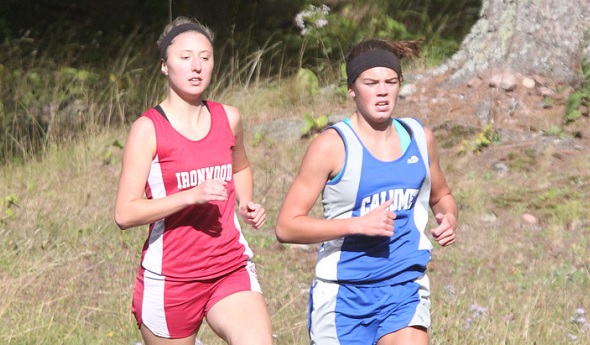
PHOTO: Calumet's Chelsea Jacques (right) won this season's Calumet Invitational with a time of 21:08.06, just ahead of Ironwood's Jessica Gering at 21:46.16. (Photo courtesy of Calumet athletic department.)
Block Party: 2025 Girls Volleyball Week 8 Report
By
Geoff Kimmerly
MHSAA.com senior editor
October 15, 2025
We easily could devote the majority of this week’s “Block Party” to the one that took place at Schoolcraft College on Saturday as several of the state’s top teams across Divisions 1, 2 and 3 met to play more than 50 matches, including several which may have nudged this week’s state rankings.
The Region 15 Showcase also had some notables – including wins by Clarkston and Lake Orion over Division 1 contender Bloomfield Hills before both fell to South Lyon. And those were only two of several events of note.
But the biggest matches of the season are still on the way, and we continue to advance into our final three weeks before the start of the MHSAA Tournament.
Records, results and schedules below are those posted for teams on MHSAA.com, and rankings reflect the latest polls posted by the Michigan Interscholastic Volleyball Coaches Association.
Week in Review
The countdown of last week’s five most intriguing results:
1. Rockford d. Bloomfield Hills Marian (25-16, 25-22) What a week for the Division 1 top-ranked Rams (31-1-0) – over the last six days they defeated No. 8 Grand Haven and No. 9 Hudsonville in league play and went 6-0 at the Beast of the East Tournament topped by this win over No. 3 Marian (34-4-0).
2. Grand Rapids Christian d. Grand Rapids Catholic Central (25-19, 25-15, 19-25, 27-25) Fresh off moving up a spot to No. 1 in Division 2, the Eagles (19-7-0) held on for a key win over the No. 5 Cougars (26-9-1).
3. Farmington Hills Mercy d. Bloomfield Hills Marian (20-25, 18-25, 25-18, 25-15, 15-10) The Division 1 No. 2-ranked Marlins came back from two sets down to claim the Catholic High School League Bishop Tournament championship after previously losing the first set but defeating Marian in four during league play.
4. Orchard Lake St. Mary’s d. Detroit Country Day (25-18, 25-19, 25-20) The Eaglets are unranked but might get some attention soon with a 26-6-3 record, CHSL Cardinal championship won last week and now this win over the formerly Division 2 top-ranked Yellowjackets (12-7-0), who also lost to Romeo over the weekend.
5. Hudsonville d. South Lyon East (20-25, 26-24, 15-8) The Eagles’ last two matches have been losses to Rockford, but Hudsonville (25-8-1) otherwise has continued to rise – moving up a spot to No. 9 in Division 1 this week after going 4-1 at Beast of the East topped by this win over the formerly No. 6 Cougars (26-7-1) and another over Grand Rapids Christian.
Watch List
With an eye toward November, here are two teams in each division making sparks:
DIVISION 1
Grand Rapids Forest Hills Northern (26-8-1) The Huskies are coming off a solid run at Beast of the East, falling to Marian but defeating Mattawan and then-No. 5 Utica Eisenhower. That saw them move up from No. 8 to No. 6 in this week’s poll, and they also have wins over No. 9 Hudsonville, No. 8 Grand Haven, honorable mentions Jenison, East Grand Rapids and Byron Center and three current top-10 teams in Division 2 – No. 5 Grand Rapids Catholic Central, No. 6 Holland Christian and No. 10 Edwardsburg.
Lowell (24-7-2) The Red Arrows have been especially sharp the last three weeks, with a run of 9-1-1 that has seen them move up to No. 5 in the Division 1 poll. Over those 11 matches they’ve defeated No. 8 Grand Haven, No. 6 Forest Hills Northern and Division 2 top-ranked Grand Rapids Christian among others. Lowell finished undefeated in River Cities Alliance matches with the league tournament this weekend, and the Red Arrows can take another step when they host several of the state’s best Oct. 25 for the East vs. West Challenge.
DIVISION 2
Essexville Garber (32-9-2) The Dukes are on the move again after last season’s run to the Division 2 Semifinals, with 16 wins over their last seven matches including a 6-0 march through the New Lothrop Tournament this past weekend during which they gave up just one set. Garber tested itself right away this fall, with a pair of early losses to Marian and one apiece to Kingsley and Flat Rock especially sticking out over the first few weeks. They’ll get the chance Oct. 30 to avenge a midseason loss to Division 3 No. 9 Saginaw Valley Lutheran.
Marshall (25-8-1) A win over Division 3 honorable mention Bronson last week was the latest highest for the Redhawks, who sit at No. 9 in Division 2 with 10 wins over their last 11 matches. They are undefeated in Interstate 8 Athletic Conference play with Battle Creek Harper Creek and Hastings left before the league tournament Oct. 25. Much like a win over Division 3 No. 7 Kalamazoo Christian earlier this month, upcoming matches against No. 10 Edwardsburg and Division 3 No. 6 Pewamo-Westphalia also will be solid tune-ups for the postseason.
DIVISION 3
Beal City (23-5-0) All five of the Aggies’ losses this season have come against either Division 2 teams or ranked Division 3 opponents – the latter a pair against No. 4 Kingsley and their most recent, to No. 10 Manton a week ago. That loss to the Rangers was Beal City’s only one over its last eight matches, and big opportunities remain including a regular-season finale Oct. 28 against top-ranked Roscommon. On Thursday, the Aggies will travel to face honorable mention McBain – which won both of their matchups last season including in the Regional Semifinals.
Traverse City St. Francis (18-13-0) The Gladiators’ No. 8 ranking in Division 3 tells the story more than the team’s record. All but St. Francis’ first loss this season (to Manton) came against Division 1 or 2 opponents, including four that are ranked on their respective top-10 lists this week. All of that experience could pay off with another long tournament run after the Gladiators finished Division 3 runners-up a year ago. They are one of only two teams this fall with a win over top-ranked Roscommon and began this season with Cadillac Invitational victories over honorable mention Cass City and Division 4 No. 2 Ubly.
DIVISION 4
Atlanta (26-0-1) The Huskies are closing in on a third-straight 30-win season and after reaching the Quarterfinals a year ago. A tie with Traverse City Christian at the Sept. 27 Onaway Invitational – which Atlanta then bettered with a three-set championship win over the Sabres – was the only trip-up during an otherwise flawless run so far. The Huskies have lost only five sets to a combined three opponents and have multiple wins over Oscoda and Onaway – two of the five teams that defeated Atlanta a year ago.
Buckley (22-5-1) The Bears have won 11 straight matches, but more importantly have clinched a share of the Northwest Conference championship – their first league title in this sport. That came with wins this month over Frankfort and honorable mention Onekama, and Buckley also went 4-0 at the Brethren Tournament this past weekend. The Bears will get an opportunity Monday to avenge one of their losses when they host Manton, and on Oct. 30 they face Traverse City Christian – which ended Buckley’s 2024 season in a Regional Final.
Can’t-Miss Contests
Be on the lookout for results of these matches and tournaments coming up:
Thursday – Jenison (27-3-1) at Byron Center (22-4-0) – A pair of Division 1 honorable mentions face off in nonleague play.
Saturday – Motor City Power Series at UWM Sports Complex in Pontiac – This will be the final Power Series weekend this season, and arguably the most intriguing pool includes Division 1 No. 10 South Lyon East (26-7-1), Division 2 No. 4 North Branch (25-7), New Baltimore Anchor Bay (12-15-1), Lake Fenton (13-10-0) and Detroit Cass Tech (8-11-1).
Saturday – McBain Invitational – Included in this field are Division 3 No. 8 Traverse City St. Francis (18-13), No. 4 Kingsley (39-4-1), honorable mentions Beal City (23-5-0) and host McBain (14-9-0), Division 4 No. 6 Mount Pleasant Sacred Heart (18-6-3), Traverse City Christian (21-7-2) and Midland (23-7-2).
Saturday – Clash of the Divisions at Kingsford – A handful of the Upper Peninsula’s best will compete including Calumet (15-9-1), Division 4 No. 7 Crystal Falls Forest Park (30-1), Marquette (9-9-1) and the host and Division 2 honorable mention Flivvers (16-0-0).
Tuesday – Lake Linden-Hubbell (20-4-2) at Hancock (21-3-2) – Division 4 No. 8 Hancock begins this closing stretch with Ishpeming on Thursday before facing the Lakes, a very possible District Final opponent.
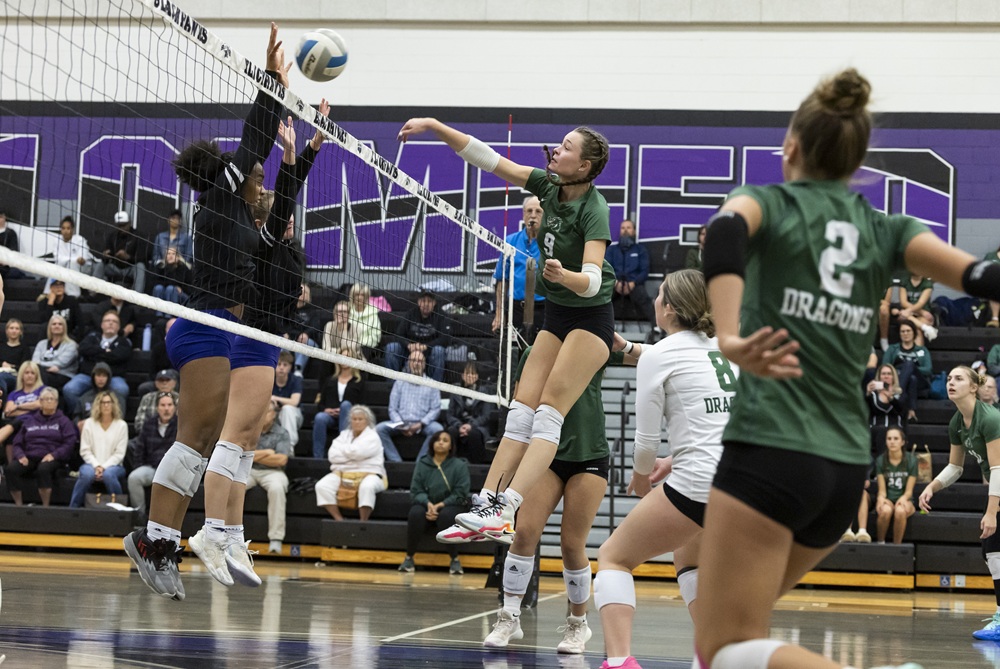
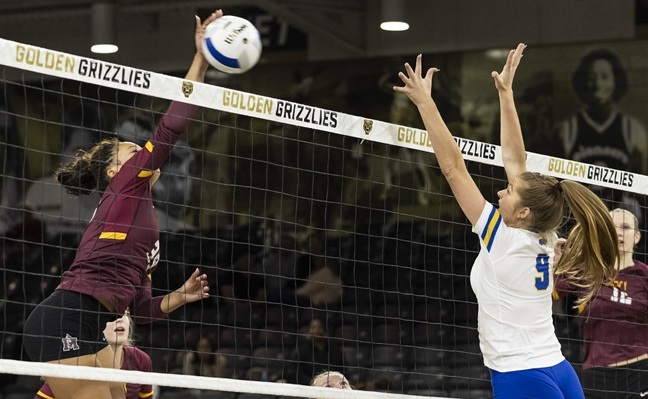
PHOTOS (Top) Lake Orion’s Lilah Eliassen (9) powers a kill attempt toward a block by Bloomfield Hills on Saturday. (Middle) Farmington Hills Mercy’s Cydnee Speights (39) elevates above the net as Bloomfield Hills Marian’s Cecilia Murray goes for the block during the CHSL Cardinal championship match. (Photos by Kristina Sikora/KMS Photography.)