

Century of School Sports: MHSAA Tickets Continue to Provide Fan-Friendly Value
By
Geoff Kimmerly
MHSAA.com senior editor
February 19, 2025
A buck went a lot farther a century ago, and a family of four wishing to watch the MHSAA Class A Boys Basketball Final in 1928 could have done so, at the minimum, for a grand total of $2 – or $6 if they were looking to splurge on the best seats.
Of course, relating the value of money 100 years ago to now is not apples to apples. But for Michigan school sports, a deal like that is meant to last forever.
The MHSAA has made it part of long-standing philosophy to keep ticket prices for its tournament events as low as possible, continuing to provide opportunities for entire families to attend together, and hoping to provide the best bargain as tickets to sporting events at other levels have climbed much more rapidly over the decades.
For the sake of comparison, consider tickets over the years for the Boys Basketball Tournament – the first event hosted by the newly-created MHSAA in 1925.
In 1928 (the first year for which cost of admission could be found), ticket prices for the MHSAA Boys Basketball Finals at the Olympia in Detroit were listed at 75 cents, $1 and $1.50, and a newspaper report after noted that in fact the cheapest seats were sold for 50 cents apiece instead. One ticket was good for all four games.
Less than 30 years later, $1.50 still got a fan two championship games – reserved seats for 1955 Boys Basketball Finals at Jenison Field House cost $1.50 per session, with Class C and B Finals in the afternoon and Class A and D in the evening. A decade after that, in 1965, tickets still cost $1.50 per session – although sessions were now split into the Class B game in the morning, Class D and C games in the afternoon, and a Class A session that night.
Sixty years later, prices have continued to rise incrementally – but again, while prioritizing keeping them as low as possible.
These days for boys basketball, District tickets cost $7, Regional tickets cost $9, Quarterfinals cost $10, and Semifinals and Finals tickets cost $12 per two-game session.
On its face, that’s quite a jump from the 1960s, much less the 1920s. But consider: Multiple inflation calculators say that $1.50 ticket for two games in 1955 would be worth more than $17 for two games now, meaning MHSAA Finals ticket prices have grown at a much slower rate.
Consider as well MHSAA ticket prices against Consumer Price Index data over the last 20 years. The U.S. Bureau of Labor Statistics reported in 2023 that admission costs to sporting events nationally had doubled over the previous two decades – literally going up 100 percent – yet price increases for the MHSAA Boys Basketball Tournament since 2005-06 have increased just 40 percent at the District level, where 60 percent of our boys basketball tickets are sold. Ticket prices for Regionals and Finals also have grown slower than that national rate.
And it remains tough to argue with what spectators get for their money at the MHSAA Tournament level.
For the 2024-25 school year, tickets for all District and Regional competitions – and some Quarterfinals and Semifinals – remain in the $7-$9 range. Finals tickets cost $10-$12, except for Individual Wrestling Finals ($18) and 11-Player Football Finals ($20) both at Ford Field – and one ticket for those is good to watch championships in five divisions in wrestling and four football championship games over one day, respectively.
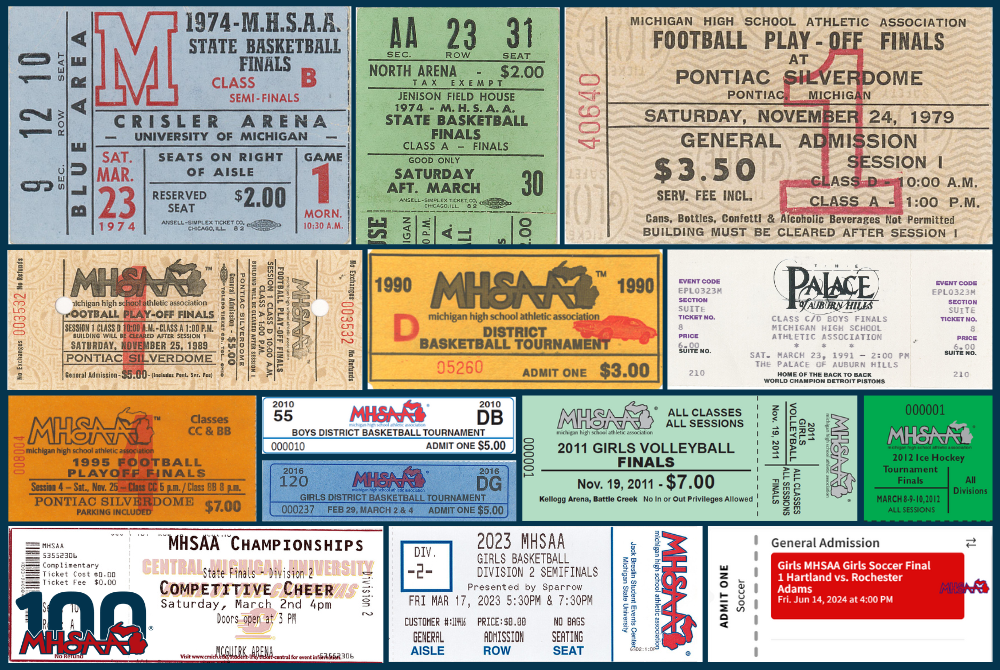
In fact, the most recent change to ticketing has had nothing to do with the price – but instead, the move away from the paper tickets you see above. All tournament tickets are now digital, which keeps the MHSAA current with what’s done in college and pro sports and other forms of entertainment and assists in efficiency by taking cash out of the equation.
Previous "Century of School Sports" Spotlights
Feb. 11: We Recognize Those Who Make Our Games Go - Read
Feb. 4: WISL Conference Continues to Inspire Aspiring Leaders - Read
Jan. 28: Michigan's National Impact Begins at NFHS' Start - Read
Jan. 21: Awards Celebrate Well-Rounded Educational Experience - Read
Jan. 14: Predecessors Laid Foundation for MHSAA's Formation - Read
Jan. 9: MHSAA Blazes Trail Into Cyberspace - Read
Dec. 31: State's Storytellers Share Winter Memories - Read
Dec. 17: MHSAA Over Time - Read
Dec. 10: On This Day, December 13, We Will Celebrate - Read
Dec. 3: MHSAA Work Guided by Representative Council - Read
Nov. 26: Finals Provide Future Pros Early Ford Field Glory - Read
Nov. 19: Connection at Heart of Coaches Advancement Program - Read
Nov. 12: Good Sports are Winners Then, Now & Always - Read
Nov. 5: MHSAA's Home Sweet Home - Read
Oct. 29: MHSAA Summits Draw Thousands to Promote Sportsmanship - Read
Oct. 23: Cross Country Finals Among MHSAA's Longest Running - Read
Oct. 15: State's Storytellers Share Fall Memories - Read
Oct. 8: Guided by 4 S's of Educational Athletics - Read
Oct. 1: Michigan Sends 10 to National Hall of Fame - Read
Sept. 25: MHSAA Record Books Filled with 1000s of Achievements - Read
Sept. 18: Why Does the MHSAA Have These Rules? - Read
Sept. 10: Special Medals, Patches to Commemorate Special Year - Read
Sept. 4: Fall to Finish with 50th Football Championships - Read
Aug. 28: Let the Celebration Begin - Read
5 Tips to Prevent Sports-Related Injuries
December 3, 2019

Henry Ford Health System
Participating in sports provides so many benefits to kids and teens. There are the obvious benefits of physical fitness and promoting regular exercise. Then, there are also the character-building lessons learned from being part of a team, working hard toward a goal, celebrating tough competition and gracefully accepting defeat. But sports don’t come without some risk.
Sports-related injuries are the leading cause of emergency room visits for kids ages 12-17, according to the Centers for Disease Control and Prevention (CDC).
These injuries impact twice as many males as females. Not surprisingly, contact sports also have higher injury rates. Football, basketball, baseball and soccer account for roughly 80 percent of all sports-related emergency room visits for children.
Sports injuries depend on the age of the athlete and the type of sport played, according to Bridget McArdle, D.O., a Henry Ford pediatrician. Generally, she says, sports injuries are divided into two groups: injuries from overuse like strains and tendonitis, and acute injuries such as concussions, fractures and tears.
The teen years pose special hazards, too. The adolescent growth spurt places teens at higher risk for injuries.
“The growth plates could still be open, which increases the risk for damage,” Dr. McArdle says. “This can lead to long-term problems.”
5 Important Injury Prevention Tips
Fortunately, many sports-related injuries can be prevented — the CDC estimates that as many as half of them could be avoided.
Here are Dr. McArdle’s tips for injury prevention for parents and coaches:
1. Ease into training. It’s important to start gradually in order to decrease the chance of sports injuries. “When you train too quickly at full peak, you are more likely to get hurt. Ease into it – and don’t overdo it,” says Dr. McArdle.
2. Cross train. Changing up the way your child trains is one way to help prevent sports injuries. “Taking a break from one sport to play another is important,” she recommends. Training a different way and using different muscles decreases the strain placed on the same body parts. Practicing gentle stretching exercises such as yoga or Pilates can also help, she adds.
3. Use the right equipment. Everything from the proper shoes and appropriate, properly fitted safety gear for the particular sport are essential for minimizing the risk of injury, as well.
4. Avoid excessive heat. The American Academy of Pediatrics (AAP) recommends young athletes avoid heat illness by wearing light clothing and drinking plenty of fluids before, during and after exercise or play. Coaches should decrease or stop practices during high heat or high humidity periods.
5. Take time to recover. If a sports injury does occur, taking time to recover is very important. Returning to play too soon increases the risk of making the injury worse, and increases the chance of long-term consequences. “Make sure the injury is completely healed before returning. Don’t allow your child to play through pain,” advises Dr. McArdle.
If you have questions or concerns about your child’s readiness to play, be sure to get a sports physical and talk with your pediatrician or primary care provider.
Dr. Bridget McArdle is a board-certified pediatrician, seeing patients at Henry Ford Medical Center – Sterling Heights.
Want to learn more? Henry Ford Health System sports medicine experts are treating the whole athlete, in a whole new way. From nutrition to neurology, and from injury prevention to treatment of sports-related conditions, they can give your athlete a unique game plan.
Visit henryford.com/sports or call (313) 972-4216 for an appointment within 24 business hours.