

Expert Teammates Fill Health Roster
January 2, 2020
By Rob Kaminski
MHSAA benchmarks editor
Teamwork is a necessity in athletics. The MHSAA has put together the beginnings of a solid roster to combat mental health ailments throughout schools in the state.
Among the experts listed on the MHSAA Mental Health Speakers Bureau are Christy Buck, executive director, and Cat Lanting, program coordinator at the Mental Health Foundation of West Michigan; and Brooke Buys, mental and behavioral health specialist and founder of BLND Health. They already are serving MHSAA schools in various capacities.
Through personal appearances, promotional videos and staff availability, both organizations emphasize the same strategy when tackling mental health issues: recognition and treatment from within the school buildings and districts.
“We wanted to create self-starting kits that anyone in the district can implement,” said Lanting. “We have in-person trainings and opportunities for students to get together – students talking to students – for high schools and for middle schools.”
Lanting coordinates the be nice.® Action Plan, founded by Buck. The plan calls for people to “notice, invite, challenge and empower” when recognizing changes in those close to them.
“It’s an attractive statement, but the key to the action plan is that it’s transferable. It can work from the pre-K level to senior citizens,” she said. “We want people to notice change, invite people into the conversation, challenge stigmas, and empower themselves with knowledge surrounding mental health.”
Buys, meanwhile, is one of a team of behavioral health specialists delivering messages to student-athletes around the state. Many of her associates in BLND (pronounced “blend”) not only talk the talk, but have walked the walk as collegiate athletes.
“The best course of action for administrators, teachers, coaches is to strive to build and maintain trust with the student-athlete; have genuine, non-judgmental conversations to include open-ended questions and authentic concern,” said Buys, who played soccer at Kalamazoo College.
Both be nice.® and BLND staff members made appearances at schools this year to assist in promoting recognition. A 90-second video produced by be nice.® was included in all MHSAA online rules meetings this year, featuring endorsements from University of Michigan coaches Jim Harbaugh and Carol Hutchins and Michigan State University coaches Mark Dantonio and Tom Izzo.
“When our team met with Mark (Uyl) and some athletic directors in Spring 2019, the room was filled with people who have just started to recognize mental health as an issue. The challenge was to deliver a 90-second video promoting the be nice.® Action Plan with a quick turnaround so it was ready for the fall rules meetings,” said Lanting.
She encourages people to visit be nice.org and “take the be nice.® pledge.”
“be nice.® started in 2010, and when people first see it they think, ‘bullying prevention,’ but really it is an action plan that is evidence-based,” Lanting said. “The be nice.® Action Plan can be used anywhere – in the workplace, community organizations – but schools is where we started and where we are currently having the most impact.”
 Connecting with the most people possible is the goal across the board. Buys encourages schools to utilize the “one-stop shopping method” in the BLND programming.
“An external referral service that is qualified, efficient, dynamic, and integrated in nature – like BLND – helps provide a one-stop shop for student-athletes and parents to receive the support they need,” said Buys.
Lanting agrees, stating, “The more students and parents become familiar with some of the signs and symptoms, the better. Coaches and teammates might be the first to notice a change in someone’s behavior whether through daily interaction or social media activity.”
Buys and company have noticed a few recent trends leading to school-aged anxiety and stress, and have people in place to visit groups and lead discussions.
“The signs and symptoms can be very individualized, but some general factors may include isolation, irritability, drastic changes to an individual’s common mood or behavior,” noted Buys. “Students can also be affected by major life changes such as parent divorce, break-up with significant other, changing schools, things of that nature.”
When Lanting receives inquiries from individual coaches regarding the be nice.® program, she encourages them to get entire teams or districts involved, because, “it’s a K-12 initiative, and sports is really a great place to start.”
Sport participation offers a different set of variables. Student-athletes enjoy additional support and guidance, but there is a flip side.
“Student-athletes do have access to more adult guidance through coaches, and certainly enjoy inclusion as part of a team, but they also tend to be more at risk for anxiety,” Lanting said.
Buys points out several reasons for this, including added expectations – whether from within or from peers, parents and coaches. They are also busier than many others.
“Time management is an issue for all of us, but student-athletes can have difficulties finding that rhythm,” Buys said. “This can cause a lot of anxiety if an area of the athlete’s life that they value is perceived as not getting the attention it needs.”
Another source of stress more likely to affect athletes is injuries.
“One of the biggest challenges in the athlete population dealing with stress and anxiety is the strong relationship between stress and injury,” said Buys. “Susceptibility to injury as well as the length of time for recovery are affected by stress.”
Identifying physical conditions is much simpler than recognizing behavioral ailments. That’s why it’s important for groups like BLND and be nice.® to teach the school population to self-diagnose.
Lanting coordinated a be nice.® football game between Holland/Zeeland-area high schools last fall, and is planning a similar event during a Fennville-Saugatuck boys basketball game this winter.
“We see all the ‘pink-out’ games and events for other causes, and that’s great,” Lanting said. “But a person in high school is so much more likely to be affected by mental health than suffer a physical ailment. That’s why the student-led part of this is so important; they tell us when things happen that might trigger certain behaviors.”
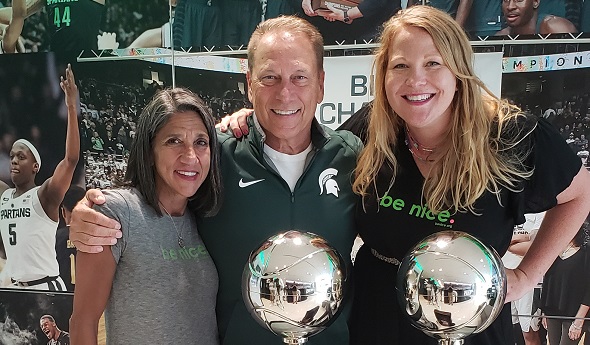
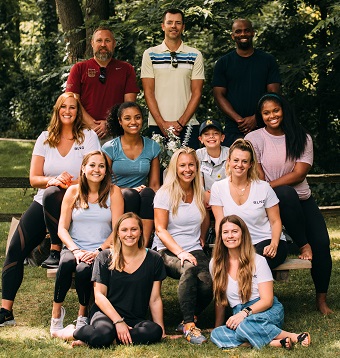
PHOTOS: (Top) be nice. founder Christy Buck (left) and program coordinator Cat Lanting pose with MSU men’s basketball coach Tom Izzo during production of a promotional video this summer. (Middle) The BLND Health Detroit Metro Team, including founder Brooke Buys (seated middle, second row from bottom.)
Century of School Sports: From Nearly A to Z, Schools Repped by 221 Nicknames
By
Geoff Kimmerly
MHSAA.com senior editor
May 20, 2025
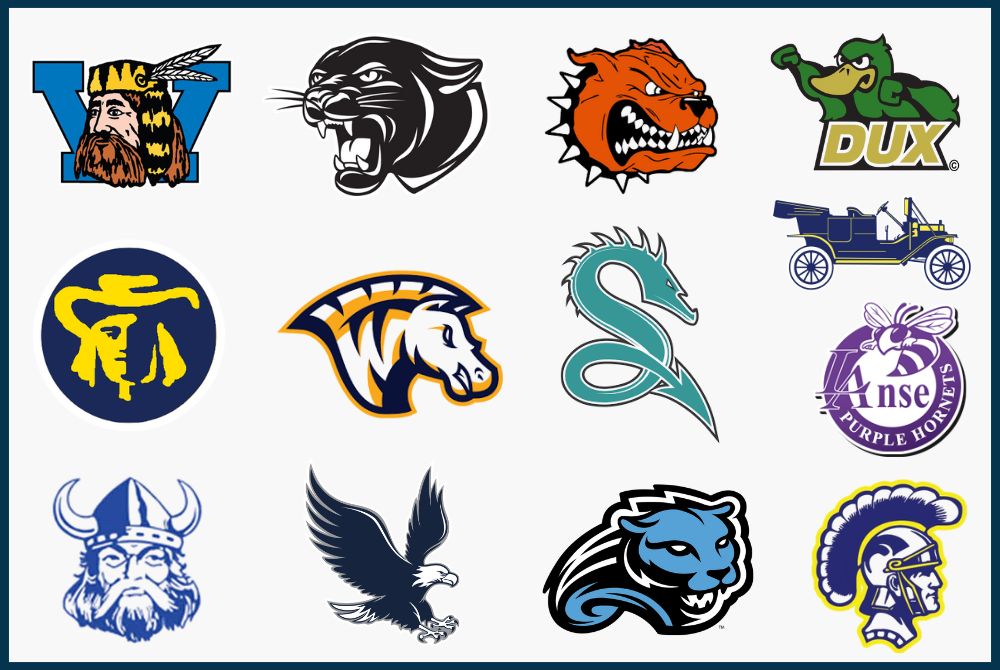
Combine all the Bronchos, Cubs, Loggers, Purple Hornets and Tractors running around Michigan’s sports fields on any given day, and they still would have some work to catch up with the wide scattering of Eagles representing their Michigan high schools across the state.
There are a combined 221 mascots representing the MHSAA’s 754 member high schools this 2024-25 school year.
A total of 127 schools have a mascot reserved all to themselves, including those five listed above – Holly (Bronchos), Detroit U-D Jesuit (Cubs), Boyne Falls (Loggers), L’Anse (Purple Hornets) and Dearborn Fordson (Tractors).
And then there are the Eagles. A total of 48 schools are represented by the fearsome birds of prey, and that’s not counting the Golden Eagles (Brooklyn Columbia Central), Aztec Eagles (Detroit Cesar Chavez Academy) and Soaring Eagles (Hannahville Nah Tah Wahsh).
The next-most popular nickname – Panthers – is adorned by 28 schools, followed by 26 Bulldogs, 23 Vikings and 22 Wildcats. Rounding out the top 10 are Falcons and Cougars (both 20 schools), Trojans (19), and Tigers and Warriors (both 18). The Mustangs (15 schools), Pilots (11) and Comets, Lakers and Spartans (10) also reach double digits.
There have been several mascot changes of late as a number of schools have moved away from Native American names and imagery. Those have resulted in a few new sets of Red Devils, Red Wolves/Wolves, and RedHawks/Red Hawks as the most popular selections among those making a switch.
Another fun fact: Every letter but “U” and “X” start at least one MHSAA member high school nickname.
Big assist to the Quakers (Lansing Eastern) and Zebras (Wayne Memorial) for cutting down that list – and keep an eye out for Underdogs and Xylophones coming to a school near you.
Previous "Century of School Sports" Spotlights
May 13: These Record-Setters were Nearly Impossible to Defeat - Read
May 6: 200+ Representatives Fill All-Time Council Roster - Read
April 29: MHSAA Programs Prioritize Health & Safety - Read
April 23: Patches Signify Registered Officials' Role in MHSAA Story - Read
April 16: Student Advisory Council Gives Voice to Athletes - Read
April 9: State's Storytellers Share Spring Memories - Read
April 2: Sharp Leadership Synonymous with MHSAA Success - Read
March 25: Athletic Directors Indispensable to Mission of School Sports - Read
March 18: 2025 Finals Begin Next Half-Century of Girls Hoops Championships - Read
March 11: Boys Basketball's Best 1st to Earn MHSAA Finals Titles - Read
March 5: Everything We Do Begins with Participation - Read
Feb. 25: Slogans & Logos Remain Unforgettable Parts of MHSAA History - Read
Feb. 19: MHSAA Tickets Continue to Provide Fan-Friendly Value - Read
Feb. 11: We Recognize Those Who Make Our Games Go - Read
Feb. 4: WISL Conference Continues to Inspire Aspiring Leaders - Read
Jan. 28: Michigan's National Impact Begins at NFHS' Start - Read
Jan. 21: Awards Celebrate Well-Rounded Educational Experience - Read
Jan. 14: Predecessors Laid Foundation for MHSAA's Formation - Read
Jan. 9: MHSAA Blazes Trail Into Cyberspace - Read
Dec. 31: State's Storytellers Share Winter Memories - Read
Dec. 17: MHSAA Over Time - Read
Dec. 10: On This Day, December 13, We Will Celebrate - Read
Dec. 3: MHSAA Work Guided by Representative Council - Read
Nov. 26: Finals Provide Future Pros Early Ford Field Glory - Read
Nov. 19: Connection at Heart of Coaches Advancement Program - Read
Nov. 12: Good Sports are Winners Then, Now & Always - Read
Nov. 5: MHSAA's Home Sweet Home - Read
Oct. 29: MHSAA Summits Draw Thousands to Promote Sportsmanship - Read
Oct. 23: Cross Country Finals Among MHSAA's Longest Running - Read
Oct. 15: State's Storytellers Share Fall Memories - Read
Oct. 8: Guided by 4 S's of Educational Athletics - Read
Oct. 1: Michigan Sends 10 to National Hall of Fame - Read
Sept. 25: MHSAA Record Books Filled with 1000s of Achievements - Read
Sept. 18: Why Does the MHSAA Have These Rules? - Read
Sept. 10: Special Medals, Patches to Commemorate Special Year - Read
Sept. 4: Fall to Finish with 50th Football Championships - Read
Aug. 28: Let the Celebration Begin - Read