


Ultimate Teammate, Ultimate Captain
October 1, 2012
 By Jed Blanton
MSU Institute for the Study of Youth Sports
What does it mean to be a team captain?
When I was in high school, our team captain was the best runner. There was no vote, no question. The best runner after the team time trial took over for the year. They led stretches, told the freshmen what to do, and did their best to stay in front of the pack.
And that’s what I did when I emerged first in our time trial. It was my team and my season now. The position was a status, a marker of my dominance, and a free pass to be a jerk. And I did it well.
When I went to college on a cross country scholarship, I was at the bottom of the totem pole again, and was nervous about how my captains would treat me and what a year it would be adjusting to college training and racing … while carrying the water and catering to our top runners. I wanted to be the fastest, so that it would be my team.
But in college, the team voted for our captains, and along with our coaches’ consensus, a leader was chosen. It wasn’t the best runner. Our team time trial had nothing to do with it. In fact, our women’s team captain didn’t even score for our team.
I asked one of the seniors, and one of the fastest runners, why these people had been chosen when there were several people faster. They answered simply, “They earned it, I respect them, and don’t mind being told what to do by them.”
I learned throughout the course of the year that the captain of this team had a lot to do, far more than I had ever done in high school ... when I thought I knew how to be a great captain.
When I earned the captain’s position on my college team my senior year, after a less-motivated try at captaincy my junior year, I had a completely different outlook on what needed to happen. For one, I wasn’t the fastest on the team anymore. An injury had prevented me from a successful offseason training regimen. But it was a new role and new challenge that I decided to have some fun and make my senior year memorable. But how could I make my team successful, even if it wasn’t by running fast?
That year I spent more time with the freshmen than I ever had, even more than when I was a freshman myself. I went to the dining halls, and invited them to my house for dinner. I went running with them on the weekends, and didn’t mind not being with the fastest guys on the team. I took an interest in our women’s team and how its training and experience was going. I went to study hall, which was an enforced weekly gathering for freshmen and anyone with lower than a 3.0 grade-point average, although I was about to graduate with honors and had twice been named “major of the year” in my department. I learned that being a captain was not a prize reserved for one person to selfishly hold. Being a captain meant being the ultimate teammate.
Since my college cross country days, I’ve spent the last six years in graduate school, researching and studying team captains. I’ve learned more about the position than I ever thought possible, but nothing I’ve read or discovered has been as powerful as seeing what it’s like to be respected as a captain. I keep in touch with far more teammates from my senior season than I do with anyone who graduated before me. Being a captain is far more than a title; it’s a calling. I whole-heartedly believe that anyone can become a great captain. They are made, not born. The difference is those who want it and those who don’t. Earning the captaincy position is not a status symbol, it’s not a recognition; it’s a job with a long task list.
The best captains I’ve met are the most organized, and also the most caring teammates. Placing the team before themselves is not the cliché; it is expected. And while I never was busier as an athlete than my senior year of college, I’ve never appreciated any other athletic achievement more than the friendships I made and the experiences I had leading my team through our season.
Blanton is a doctoral candidate at Michigan State University in the department of Kinesiology, specializing in the PsychoSocial Aspects of Sport and Physical Activity, and a research assistant for MSU's Institute for the Study of Youth Sports. He has served as a facilitator at MHSAA Captains Clinics the last three years and currently is assisting the association with its student leadership programs.
Century of School Sports: 'The Mitten' Becomes Sought-After Symbol of MHSAA Greatness
By
Geoff Kimmerly
MHSAA.com senior editor
June 10, 2025
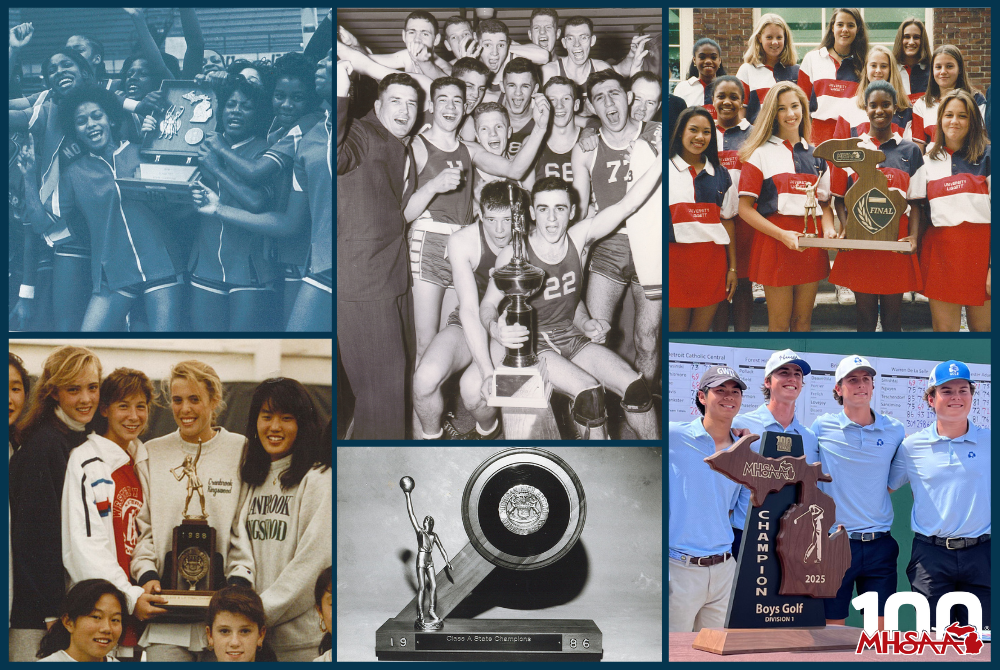
The MHSAA championship trophy – often referred to as “The Mitten” – has become perhaps one of the most iconic and enduring symbols of this organization over the last 25 years, most frequently greeting visitors strolling past a school’s trophy case or serving as the centerpiece of celebration photos over the final month of every sport season.
More than 2000 MHSAA trophies are presented to teams every school year, the great majority to District, Regional and Finals champions at the high school level.
There actually have been several versions of MHSAA trophies awarded over the last century – probably more than we can tell about, since our knowledge of the first 30-40 years especially is reliant on photos of winning teams holding their awards, and trophies that have been returned to us after a school has closed or those artifacts have made their ways into yard sales or second-hand stores.
 Our early trophies take on a few specific designs – there are traditional cups, later columns affixed to bases with inscriptions celebrating champions, or metal statuettes representing their respective sports. Later versions incorporated a combination of those features, for example a square or rectangular wooden plaque affixed to a base with a statuette (or two, or even three) decorating the trophy. The 1974-75 version was especially notable; celebrating the 50th year of the MHSAA, those trophies included a large county map of Michigan and the state seal.
During the mid-1980s, the MHSAA made another move to a unique design among its trophies – a circular award affixed to a base by a wooden arm at a 45-degree angle. Then came a return to a more traditional squared-off pedestal and statue before the 1989-90 move to a triangular plaque – which in theory could be hung up in a trophy case as something of a space-saver. But that idea didn’t seem to gain traction – which in part led to the creation of the inaugural version of “The Mitten” awarded today.
That first rendition made its debut during the 1992-93 school year. What started out as an artistic wooden representation of the state’s peninsulas evolved at the start of 2009-10 into the current more map-accurate version of the state’s land masses affixed to a black background. The only noticeable change since has been the addition this 100-anniversary year of a medal at the top celebrating that milestone.
How beloved has “The Mitten” become?
During the 2008-09 school year, our students let us know. With the MHSAA Trophy & Medal Committee deliberating on a possible two design – and two proposals that did not include the wooden state version in the mix – then-Executive Director Jack Roberts presented the possibilities to the MHSAA’s Student Advisory Council.
In resounding fashion, the Advisory Council said keep “The Mitten” – and it remains the symbol of achievement for thousands of MHSAA Tournament champs every school year.
Previous "Century of School Sports" Spotlights
June 3: MHSAA's Move to TV, Now Internet, 60 Years Old & Growing - Read
May 27: Upper Peninsula Helps Make Michigan's School Sports Story Unique - Read
May 20: From Nearly A to Z, Schools Repped by 221 Nicknames - Read
May 13: These Record-Setters were Nearly Impossible to Defeat - Read
May 6: 200+ Representatives Fill All-Time Council Roster - Read
April 29: MHSAA Programs Prioritize Health & Safety - Read
April 23: Patches Signify Registered Officials' Role in MHSAA Story - Read
April 16: Student Advisory Council Gives Voice to Athletes - Read
April 9: State's Storytellers Share Spring Memories - Read
April 2: Sharp Leadership Synonymous with MHSAA Success - Read
March 25: Athletic Directors Indispensable to Mission of School Sports - Read
March 18: 2025 Finals Begin Next Half-Century of Girls Hoops Championships - Read
March 11: Boys Basketball's Best 1st to Earn MHSAA Finals Titles - Read
March 5: Everything We Do Begins with Participation - Read
Feb. 25: Slogans & Logos Remain Unforgettable Parts of MHSAA History - Read
Feb. 19: MHSAA Tickets Continue to Provide Fan-Friendly Value - Read
Feb. 11: We Recognize Those Who Make Our Games Go - Read
Feb. 4: WISL Conference Continues to Inspire Aspiring Leaders - Read
Jan. 28: Michigan's National Impact Begins at NFHS' Start - Read
Jan. 21: Awards Celebrate Well-Rounded Educational Experience - Read
Jan. 14: Predecessors Laid Foundation for MHSAA's Formation - Read
Jan. 9: MHSAA Blazes Trail Into Cyberspace - Read
Dec. 31: State's Storytellers Share Winter Memories - Read
Dec. 17: MHSAA Over Time - Read
Dec. 10: On This Day, December 13, We Will Celebrate - Read
Dec. 3: MHSAA Work Guided by Representative Council - Read
Nov. 26: Finals Provide Future Pros Early Ford Field Glory - Read
Nov. 19: Connection at Heart of Coaches Advancement Program - Read
Nov. 12: Good Sports are Winners Then, Now & Always - Read
Nov. 5: MHSAA's Home Sweet Home - Read
Oct. 29: MHSAA Summits Draw Thousands to Promote Sportsmanship - Read
Oct. 23: Cross Country Finals Among MHSAA's Longest Running - Read
Oct. 15: State's Storytellers Share Fall Memories - Read
Oct. 8: Guided by 4 S's of Educational Athletics - Read
Oct. 1: Michigan Sends 10 to National Hall of Fame - Read
Sept. 25: MHSAA Record Books Filled with 1000s of Achievements - Read
Sept. 18: Why Does the MHSAA Have These Rules? - Read
Sept. 10: Special Medals, Patches to Commemorate Special Year - Read
Sept. 4: Fall to Finish with 50th Football Championships - Read
Aug. 28: Let the Celebration Begin - Read